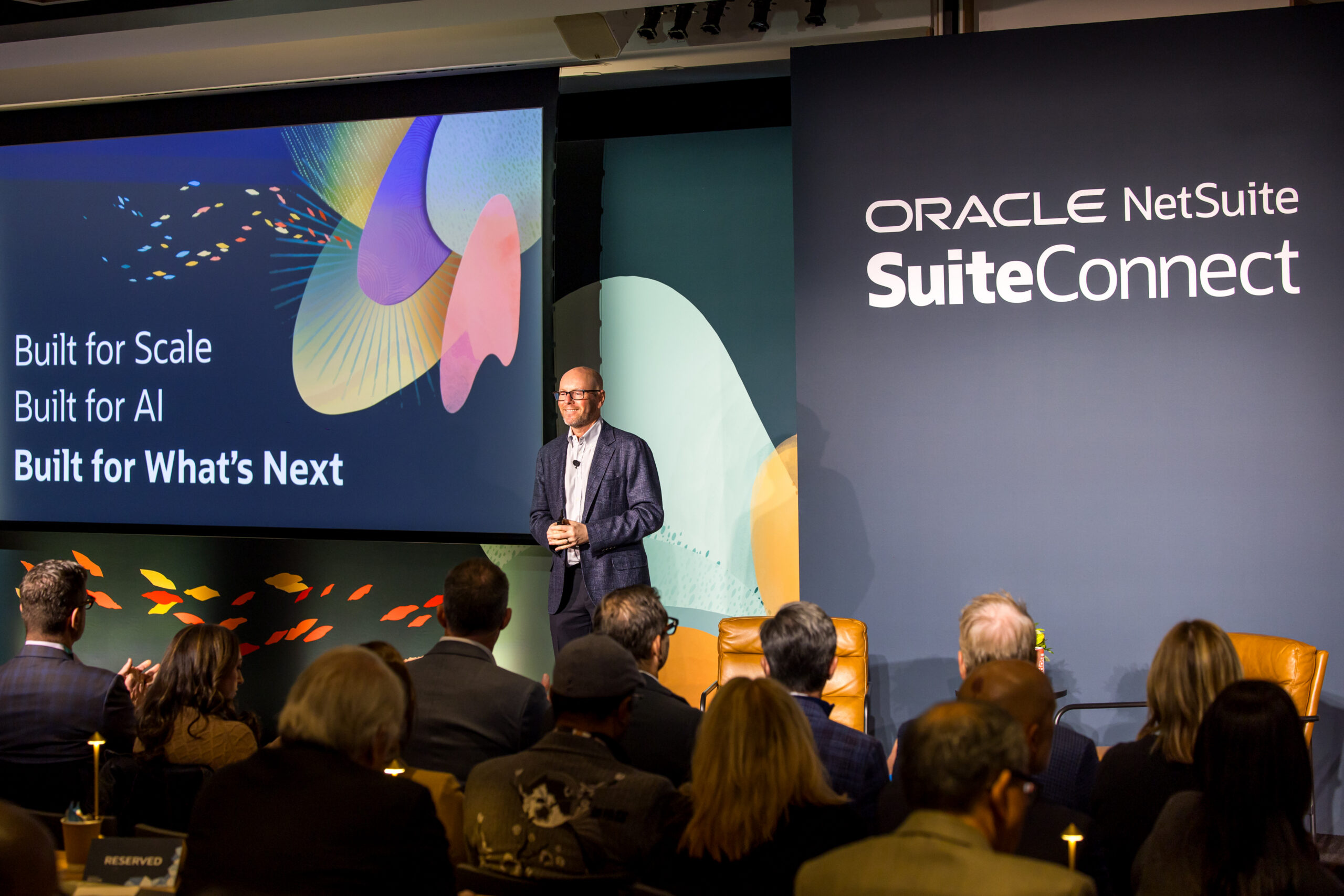
During SuiteConnect New York on February 11, Oracle NetSuite tried to answer one of the biggest questions shaping the next phase of ERP competition: When every platform has AI, what actually makes it usable for real business work?
Founder and EVP Evan Goldberg’s answer was to reframe the problem because the challenge is not model power. It is operational context. “For AI to be truly effective in business, it needs to understand your data, your workflows, and your environment,” he said during his keynote.
Throughout the day-long summit, that premise was repeatedly surfaced as attendees were urged to visualize “what’s next” in the industry. The future of ERP AI will be determined by depth of operational integration, not model sophistication alone.
From Copilot to Autopilot
Goldberg framed the current moment as comparable to NetSuite’s original bet on cloud ERP, calling it “a once in a generation shift” that companies cannot pause operations to accommodate.
His metaphor was aviation. Most enterprise AI today resembles a cockpit full of instruments that users must interpret. NetSuite’s goal, he explained, is the opposite. “We want to build a fully automated system that coordinates intelligence in the background, so you can focus on where you’re going instead of just trying to stay airborne,” he said.
The distinction matters strategically. Copilot-style AI assumes humans remain primary operators. Autopilot-style AI assumes software handles monitoring, exception detection, and orchestration while humans intervene only when judgment is required.
NetSuite is positioning its platform for the latter model. To support that approach, Goldberg also previewed NetSuite Next, an interface layer designed to operationalize AI inside everyday workflows. Built “from the ground up for collaborating with AI,” it surfaces insights, recommendations, and anomalies directly inside dashboards, searches, and records.
Same Questions, Different Answers
The most concrete product example was Ask Oracle, NetSuite’s conversational interface across the suite. Unlike some generative AI assistants, it adapts responses based on who is asking and where the question originates inside the system.
“The assistant knows who you are, knows your business, and knows your moment,” Goldberg said.
That design choice reframes analytics itself. Instead of one standardized report per question, ERP systems become capable of generating role-specific narratives on demand. A CFO, warehouse manager, and SaaS operator can ask identical questions yet receive different analyses aligned to their responsibilities.
For ERP leaders, that shift is structural: reporting moves from static artifacts to context-generated decision support.
NetSuite also is pushing a more opinionated definition of enterprise AI agents. Rather than generic bots, the company showed agents configured as role-bound digital workers with defined instructions, permissions, and policy awareness.
In one scenario, a credit agent evaluated transactions against company policy and external credit data, then automatically adjusted behavior when policy documents changed. Such agents “reason, analyze, and generate insights while [the user] stays firmly in control.”
Trust as Architecture, not Interface
Another major theme was verifiability. Executives repeatedly stressed that AI output must be traceable to underlying data and logic. Ask Oracle responses link directly back to transactions, reports, and/or records so users can audit how an answer was produced.
Because NetSuite’s assistants run inside the system of record, they inherit role permissions and approval workflows automatically. Even when external models are used, the platform exposes data through governed business objects rather than raw tables, for instance.
NetSuite extended the same logic to commerce and integration. Its AI Connector framework allows external assistants to interact with ERP data such as pricing, inventory, and orders through controlled interfaces, turning conversational agents into front-end transactional entry points.
The goal is cumulative intelligence, said Goldberg. Integrations learn from previous patterns rather than starting from scratch each time. NetSuite is treating “context aware AI” not as a single feature but as a platform architecture spanning analytics, automation, and execution.
What This Means for ERP Insiders
ERP AI differentiation is shifting to architecture, not algorithms. NetSuite argues that long-term advantage will come from embedding intelligence into live workflows rather than layering assistants on exported data. Vendors and system integrators will need deeper integration discipline if they want AI initiatives to deliver operational value.
Persona-driven AI changes how ERP value is defined. When systems generate answers differently for each role, success metrics shift from report speed to decision effectiveness. That forces organizations to design and govern AI personas with the same rigor they apply to roles, permissions, and process models.
AI-first operating models are replacing AI add-ons. By embedding automation into close, reconciliation, pricing, and planning workflows, NetSuite is signaling that future ERP competition will hinge on how completely intelligence is woven into daily operations. Platforms that treat AI as infrastructure rather than a feature are likely to set the pace.