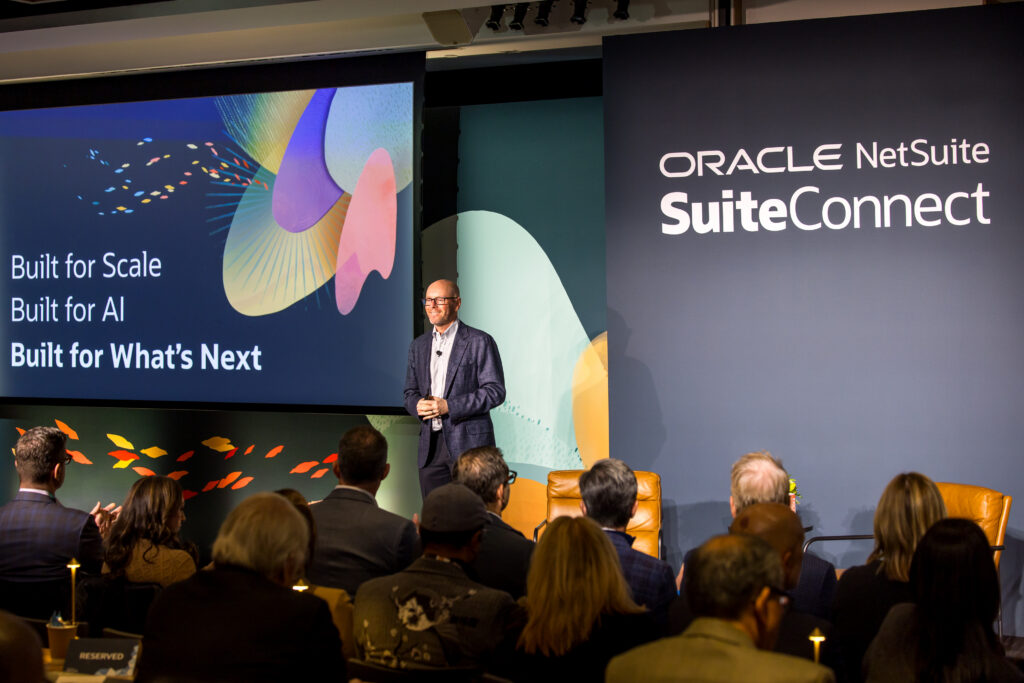
Oracle NetSuite has been recognized as a Leader in Gartner’s 2025 Magic Quadrant reports for Cloud ERP for Service-Centric Enterprises and Financial Planning Software. This highlights the platform’s continued momentum as organizations seek AI-enabled, cloud-based financial and operational systems.
The acknowledgment reflects NetSuite’s expanding customer base, its investment in embedded AI, and its positioning as a unified suite that can adapt to rapid shifts in financial operations and service delivery.
AI-Infused Financial, Planning Capabilities
According to the announcement, Gartner’s evaluations emphasize NetSuite’s progress in modernizing financial management and planning workflows with native AI capabilities. These include tools that streamline period close, support intelligent planning cycles, and surface anomalies for faster decision-making.
The article also notes NetSuite’s expansion of real-time visibility across financial, operational, and project-based processes, a critical need for service-centric organizations facing increasing pressure to deliver more accurate forecasts and improved margin management.
NetSuite cites its integrated architecture as a differentiator, particularly for organizations looking to consolidate multiple financial and operational applications. AI-driven features introduced throughout 2025—ranging from conversational interactions to predictive insights—are reducing manual work and helping teams react more quickly to changing business conditions.
Expanding Innovation
The recognition aligns with a broader year of product and platform development for NetSuite. The introduction of NetSuite Next, expanded SuiteCloud AI capabilities, and enhancements to planning and reporting workflows form a landscape in which intelligence is embedded deeper into core processes. These developments support the trend toward autonomous finance, where systems increasingly assist with analysis, exception handling, and workflow orchestration.
For organizations relying on NetSuite to manage billing, resource planning, or financial consolidation, the award highlights the platform’s continued investment in tools designed to improve operational clarity and reduce dependency on manual reconciliation. As service delivery models become more complex, the ability to unify data and automate routine processes is becoming central to ERP strategy.
In addition to leadership placement, the announcement highlights customer adoption across a wide market segment. NetSuite stresses that organizations continue to prioritize cloud ERP systems capable of supporting distributed teams, automating compliance-heavy workflows, and delivering real-time operational visibility. The recognition serves as validation of both NetSuite’s technology direction and the broader shift toward AI-supported enterprise platforms.
What This Means for ERP Insiders
AI maturity is becoming a key evaluation criterion. Gartner’s recognition reflects a market in which ERP leadership increasingly depends on native AI capabilities that directly enhance financial and planning processes. ERP providers and product teams may see this as accelerating the timeline for embedding intelligence across workflows.
Unified architecture gives providers an edge. The emphasis on NetSuite’s integrated suite highlights the growing importance of consolidation for organizations seeking consistent data flows and lower maintenance overhead. Enterprise architects and system integrators should interpret this as a signal to reduce system sprawl.
Service-centric transformation reshapes ERP expectations. As service delivery models evolve, planning accuracy and financial speed become strategic priorities. This creates demand for platforms capable of linking project execution, forecasting, and financial outcomes through shared data and automated insights.