Mawared MENA shows how shared procurement infrastructure can improve supplier visibility, local sourcing, and resilience.
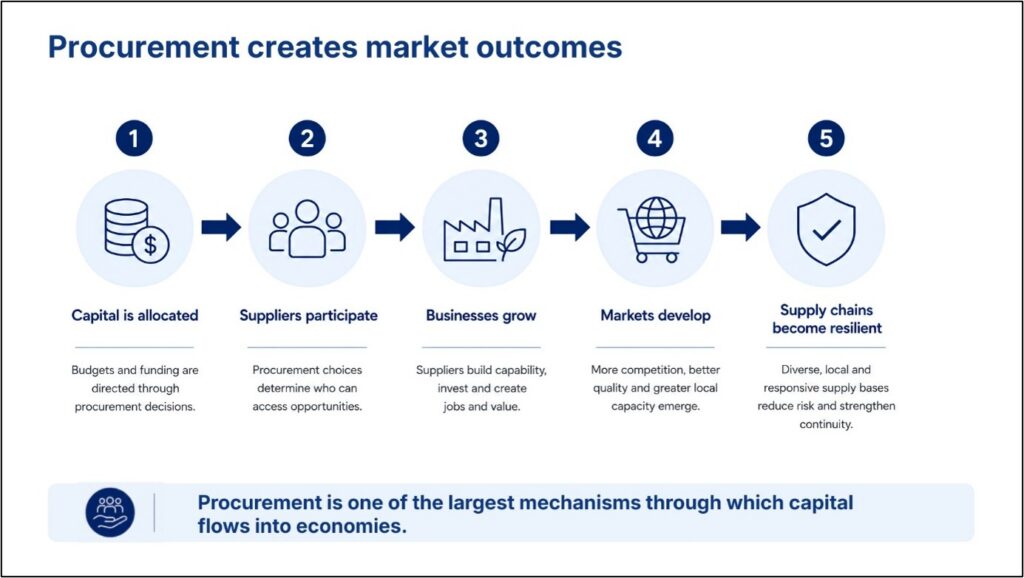
Procurement is one of the largest mechanisms through which capital moves through economies.
Every year, governments, corporations, healthcare systems, humanitarian organizations, and development programs direct billions of dollars through procurement. Those purchasing decisions determine which businesses grow, how resilient supply chains become, how quickly innovation reaches markets, and how local economies develop.
Enterprise technology has largely treated procurement as an internal workflow. ERP systems and sourcing tools have made organizations far better at managing what happens after a buyer knows who it wants to buy from. Less attention has been given to everything that happens before that decision: understanding markets, finding suppliers, creating competition, supporting local participation, and building resilience.
That earlier stage is where market infrastructure becomes important.
In practical terms, market infrastructure means the shared digital foundation that helps buyers and suppliers see each other, participate consistently, and transact with greater trust. It includes supplier profiles, visible demand, standardized participation, auditable sourcing activity, multilingual access, and reusable market intelligence across buyers.
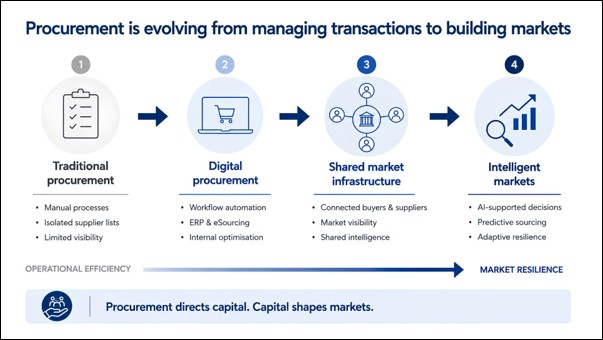
For procurement leaders, that distinction is becoming strategic. Across humanitarian and development organizations, procurement and supply chains typically represent between 65% and 80% of organizational expenditure, according to research published in the Journal of Humanitarian Logistics and Supply Chain Management. Similar pressures are visible across healthcare, government, infrastructure, manufacturing, and energy, where geopolitical instability, supplier concentration, sustainability commitments, localization policies, and resilience have become board-level priorities.
Organizations that manage these activities well will not simply procure more efficiently. They will build stronger markets.
ERP Solved Transactions; Today’s Challenge Is Markets
For more than 30 years, ERP has transformed internal operations. Finance, manufacturing, human resources, and projects all became digital. Procurement followed the same path. Purchase orders, approvals, supplier records, and sourcing workflows are now managed more efficiently than ever before.
But ERP largely assumed that the market already existed. Known suppliers, known products, known relationships.
Today’s operating environment challenges those assumptions. Procurement leaders are asking different questions. How do we identify new suppliers when supply chains fail? How do we organize fragmented regional markets? How do we increase small and midsized enterprise participation? How do we support localization without weakening compliance? How do we improve supplier diversity? How do we gain visibility into markets that remain largely invisible?
These are not only transaction problems. They are market problems.
Resilience cannot be achieved through procurement processes alone. It depends on the quality, diversity, and visibility of the markets from which organizations procure. Procurement is moving from an operational function to a strategic capability because the world around procurement has changed.
Humanitarian procurement encountered these realities early.
Few sectors operate under greater complexity. Humanitarian organizations must work across multiple donors, regulatory frameworks, currencies, and rapidly changing operating environments, often with urgent demand and limited infrastructure. Procurement teams must move quickly while maintaining transparency and accountability.
Suppliers face their own barriers. Procurement remains fragmented across hundreds of organizations, each maintaining separate supplier databases, qualification processes, and sourcing activities. Buyers cannot easily see the market. Suppliers cannot easily see demand. Capital fails to flow efficiently to where it can create the greatest value.
These are not uniquely humanitarian problems. They are becoming enterprise procurement challenges across many sectors.
Mawared MENA, Market Before the Purchase Order
When Solvoz partnered with HELP Logistics to enable Mawared MENA, the objective was not simply to digitize procurement. The question was different. What if organizations started by structuring the market itself?
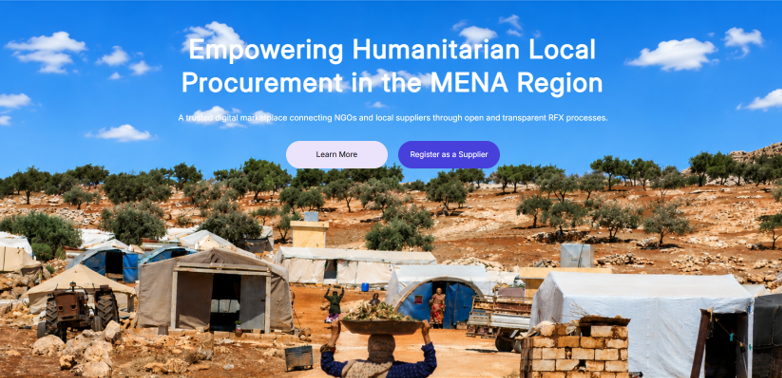
Launched across the Middle East and North Africa, Mawared MENA demonstrates what can happen when procurement begins by organizing supplier ecosystems rather than only digitizing purchasing workflows.
The platform provides humanitarian organizations with a shared digital environment where suppliers become visible across organizations rather than remaining hidden within isolated databases. Organizations can discover suppliers, publish sourcing opportunities, manage procurement workflows, compare quotations, maintain audit trails, and generate market intelligence through one shared environment.
Suppliers register once, participate in Arabic or English, and gain visibility across multiple buyers through a transparent and standardized process.
According to Solvoz, Mawared MENA launched in July 2025 and registered more than 100 suppliers within its first months, with supplier registrations growing 10% month over month. Humanitarian organizations began publishing live tenders, and procurement activities started moving from fragmented spreadsheets and email exchanges into a shared digital environment.
The outcome is not simply faster procurement. It is a market that functions better.
When procurement becomes more transparent, competition can increase. Supplier participation can expand. Local businesses gain greater access to demand. Organizations gain more confidence in where they spend resources, and donors gain a clearer audit trail for how procurement decisions were made.
That is operational innovation.
Get Our Free Weekly Newsletter
Repeatable Model for Fragmented Markets
Although Mawared MENA operates in humanitarian procurement, the underlying model is not limited to humanitarian work. It applies to any fragmented market where buyers struggle to identify suppliers, suppliers struggle to discover opportunities, and procurement depends on better market visibility.
The same logic can support healthcare supply chains, public procurement, strategic manufacturing, critical minerals, circular economy initiatives, sustainable food systems, energy transition programs, supplier diversity efforts, and regional innovation ecosystems.
The question changes from “How do we digitize procurement?” to “How do we organize the market that procurement depends on?”
That shift creates a different role for enterprise technology. Procurement systems are no longer judged only by whether they move purchase orders, approvals, and sourcing events more efficiently. They are also judged by whether they make supplier ecosystems more visible, more accessible, and more resilient.
Sponsor Industry‑Grade Research
AI Needs a Market It Can See
Artificial intelligence is already changing procurement. It can draft specifications, analyze bids, identify risks, recommend suppliers, and automate workflows. But AI can only work with the market it can see.
If supplier ecosystems remain fragmented, invisible, or disconnected, AI will automate an incomplete view of the market. Market visibility therefore becomes part of the foundation for intelligent procurement.
The future is not AI instead of procurement. The future is AI operating on well-structured, transparent, and connected markets.
That is why market infrastructure matters. It gives buyers and suppliers a shared environment. It gives AI systems better context. It gives procurement leaders a clearer view of competition, capacity, participation, and risk.
Next Chapter for Enterprise Procurement
ERP transformed organizations by bringing structure to internal operations. The next opportunity is bringing that same structure to markets themselves.
Markets where buyers discover suppliers, suppliers discover demand, information becomes transparent, competition becomes healthier, compliance becomes easier, and resilience becomes measurable.
Mawared MENA was recognized as runner-up in ERP Today’s 2025 Operational Innovation category because it demonstrated how structured procurement can create meaningful operational impact in one of the world’s most demanding environments. The broader lesson extends beyond humanitarian procurement.
Any organization seeking to build stronger supplier ecosystems, improve market visibility, or create more resilient sourcing networks faces the same challenge. The next generation of procurement technology will not be defined only by faster purchase orders or more efficient sourcing workflows. It will be defined by its ability to make markets visible.
Procurement directs capital. Capital shapes markets. Organizations that understand that connection will not simply build better procurement functions. They will build stronger markets.
Editor’s Note: What This Means for ERP Insiders
Procurement technology is moving upstream from transactions to market visibility. ERP and sourcing leaders should evaluate whether their procurement environments help buyers find suppliers, expand participation, and understand market capacity before a purchase order is created.
Supplier ecosystems need shared infrastructure. Mawared MENA shows how a common environment for supplier registration, tenders, quotations, audit trails, and market intelligence can reduce fragmentation across buyers and suppliers. That model has relevance beyond humanitarian procurement wherever supplier access, resilience, and local participation are strategic priorities.
AI procurement will only be as strong as the market data beneath it. If suppliers remain invisible and demand is fragmented across isolated systems, AI will automate an incomplete view of the market. Procurement leaders should treat market visibility as a foundation for future AI-supported sourcing, risk analysis, and supplier recommendations.