Part 2 of a two-part ERP Today series on SAP’s AI reinvention.
After a series of announcements, ERP leaders are asking, what is SAP’s Autonomous Enterprise strategy exactly?
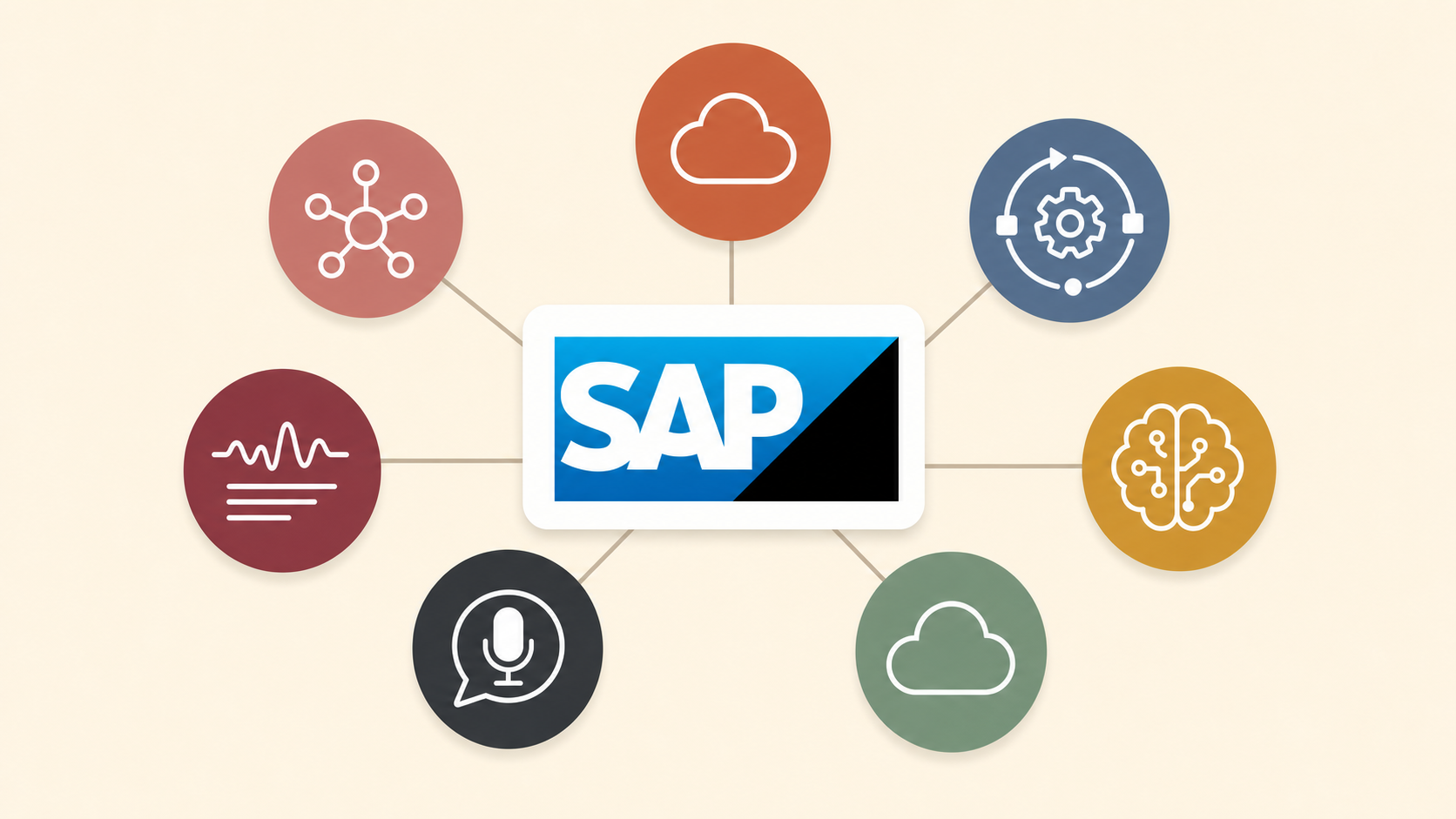
It is not as much a product vision as it is an ecosystem architecture. Since SAP Sapphire in May, the company has accelerated partnerships across commerce, workflow orchestration, model choice, service automation, sovereign AI, and zero-copy data access, giving customers a clearer view of how SAP plans to turn business context into AI execution.
Part 1 of this series looked at Christian Klein’s claim that SAP could have no human software developers within three to four years. That comment showed how SAP sees AI changing the way enterprise software is built. The partnership sprint shows how SAP wants that software to run—through a modular stack where SAP data and process context remain the control layer, while external models, automation tools, and cloud platforms extend what the system can do.
SAP formalized that direction with SAP Business AI Platform. The platform brings together SAP Business Technology Platform, SAP Business Data Cloud, and SAP Business AI, with Joule Studio positioned as the environment for building agents, applications, and agentic workflows.
The strategy gives SAP more reach without forcing it to build every AI capability itself. It also gives customers more choices to govern. The next phase of SAP’s AI strategy will depend on whether those partnerships simplify execution or add another layer of architecture decisions to already complex SAP estates.
Google Cloud: SAP in Agentic Commerce
SAP and Google Cloud expanded their partnership in June with an agentic commerce architecture built around SAP Commerce Cloud, Google Gemini, and the Universal Commerce Protocol.
The commerce angle is easy to underestimate. Retail and customer experience are early test beds for enterprise agents because the use cases are visible, high-volume, and tightly connected to revenue. A shopping assistant can recommend products, support customers, personalize offers, and guide transactions. The operational challenge sits behind the interaction: inventory must be accurate, pricing must be current, consent must be respected, and fulfillment promises must match reality.
SAP is trying to keep that back-end truth connected to the AI experience. SAP Commerce Cloud’s alignment with Google’s Universal Commerce Protocol is designed to let merchants participate in AI-native buying experiences across Gemini, Google Search, and AI Mode without rebuilding their commerce stack. Google Gemini capabilities are also being brought into SAP Commerce Cloud through a Shopping Assistant that can engage through chat, voice, and text.
The data layer carries the real ERP implication. SAP and Google are connecting SAP Business Data Cloud with Google BigQuery through bidirectional, zero-copy access, allowing customers to work with SAP data and Google ecosystem signals without duplicating data into another environment. For brands and retailers, that could make agentic commerce less of a standalone customer experience project and more of a live operating model tied to inventory, orders, marketing, service, and finance.
The risk is execution complexity. Retailers that already struggle with product data quality, pricing consistency, and fragmented customer records will not solve those problems by adding an AI shopping layer. Agentic commerce will raise the cost of bad data because errors move closer to the customer.
n8n: Execution Surface for Joule Studio
SAP’s n8n investment addresses a different weakness in enterprise AI: Agents need somewhere to act.
n8n announced on May 12 that SAP had made a strategic investment as part of a deal valuing the workflow automation company at $5.2 billion. The companies also signed a multi-year commercial agreement to embed n8n’s workflow automation platform natively within Joule Studio.
The appeal for SAP customers is orchestration. n8n brings a visual automation environment with more than 1,000 integrations across business tools, databases, and AI models. Embedded inside Joule Studio, that capability gives SAP a way to connect agents across SAP and non-SAP systems without forcing every workflow through custom middleware.
That is an important piece of the Autonomous Enterprise architecture. Agents cannot create enterprise value by producing recommendations that stop at the edge of the application. They need to trigger tasks, route approvals, update systems, escalate exceptions, and preserve an audit trail. Orchestration is where AI moves from insight into controlled execution.
Customers should watch how deeply n8n becomes part of SAP’s governance model. Visual workflow tools can accelerate delivery, but they can also create automation sprawl if ownership, permissions, monitoring, and lifecycle management are weak. The value of n8n inside Joule Studio will depend on whether SAP can make workflow creation faster without making workflow control looser.
Analysis
What this means: SAP is building an AI control layer through partnerships. The company is using external models, orchestration tools, data platforms, and service agents while keeping SAP business context at the center of execution. SAP customers should compare current AI and integration projects against the platform roadmap before funding custom builds that native capabilities may soon replace.
Model Choice: A Governance Decision
SAP’s model partnerships show how the company is handling one of the harder AI platform questions: no single model will fit every enterprise requirement.
At Sapphire, SAP said Claude from Anthropic would be available as a foundation model powering Joule agents across HR, procurement, and supply chain. SAP also named Cohere and Mistral as sovereign model options running on SAP cloud infrastructure, with regulated industries and public-sector customers as the obvious audience.
That gives SAP a broader AI model story than a single LLM partnership. It also shifts evaluation from model performance alone to model governance. Customers will need to understand where a model runs, which data it can access, how outputs are controlled, and whether the deployment satisfies residency, privacy, industry, and public-sector requirements.
SAP’s role is to make those choices usable inside the platform. Customers do not want to manage separate model contracts, disconnected APIs, and one-off governance reviews for every use case. They want model optionality without losing control over data, workflow, and auditability.
That is the strongest version of SAP’s platform argument. The company can let customers choose from external models while anchoring those models in SAP business context. The harder work will be making those choices understandable to buyers who already struggle to map SAP’s commercial and technical layers.
Get Our Free Weekly Newsletter
Zero-Copy Data: The Architecture Thread
The Google BigQuery and Amazon Athena integrations point to a common theme across SAP’s AI roadmap: Data movement is becoming a liability.
SAP announced zero-copy data integration between SAP Business Data Cloud and Amazon Athena at Sapphire, alongside the Google BigQuery work. These integrations are designed to let customers query SAP data in analytics and AI environments without repeatedly copying it into new stores.
For ERP customers, zero-copy is more than a technical convenience. Every additional copy of operational data creates cost, latency, reconciliation work, access-control risk, and governance overhead. AI increases that pressure because every new model, agent, dashboard, and analytics environment wants fresh business data.
SAP is trying to position Business Data Cloud as the governed source of business context while still allowing customers to use hyperscaler analytics environments. That is a pragmatic architecture move. Most SAP customers already run multi-cloud and hybrid data estates. The question is whether SAP can make that interoperability reliable enough for production AI, not just analytics pilots.
Parloa: Service Automation, Same Principle
Parloa’s integration into SAP Service Cloud applies the same pattern to customer service.
SAP named Parloa as a partner for AI voice and digital self-service agents that can access business data and service processes directly inside SAP Service Cloud. The promise is customer interaction automation grounded in live business context rather than static knowledge bases.
Service is a useful proving ground because the cost of weak context is immediate. An agent that cannot see order status, entitlement, warranty coverage, invoice history, or open service cases will frustrate customers quickly. An agent that can act across those processes needs strong controls before it changes commitments, escalates cases, or resolves requests.
This is the practical test for SAP’s Autonomous Enterprise. Agents need business context, but they also need boundaries. The more action they can take, the more customers will need governance over permissions, audit trails, escalation logic, and human review.
Analysis
What this means: Data architecture will decide how quickly SAP AI can scale. Zero-copy integrations with BigQuery and Athena show SAP trying to reduce the cost, latency, and governance risk created by repeated data replication. Enterprise architects should identify where SAP data is copied today and decide which workloads could move toward governed access patterns over the next two release cycles.
Sponsor Industry‑Grade Research
Delivery Window Is Murky
SAP’s partnership sprint shows a coherent architecture. Google Cloud expands agentic commerce. n8n gives Joule Studio workflow orchestration. Anthropic, Cohere, and Mistral broaden model choice. Google BigQuery and Amazon Athena support zero-copy data access. Parloa extends agentic automation into service.
The architecture is modular and partner-led, with SAP positioning itself as the business context and governance layer. That is a defensible strategy for a company whose strongest asset is the enterprise data and process logic embedded in its installed base.
Customers should still separate direction from delivery. Some capabilities are available now, others are targeted for Q3 or H2 2026, and many will mature through partner integration, licensing decisions, and customer implementation experience. SAP’s AI roadmap gives customers more options, but it also creates new evaluation work around availability, cost, data control, lifecycle management, and accountability.
The Autonomous Enterprise will not be judged by the number of partners SAP can name. It will be judged by whether customers can turn those partnerships into governed, production-grade workflows that reduce complexity rather than redistribute it.
Analysis
What this means: Partner breadth will increase customer choice and evaluation burden. SAP’s ecosystem now spans commerce, orchestration, model choice, sovereign AI, service automation, and hyperscaler data access, giving customers more paths to AI adoption but more dependency to manage. ERP program leaders should press SAP and implementation partners for clear availability dates, subscription terms, data-control boundaries, and accountability models before scaling agentic workflows.