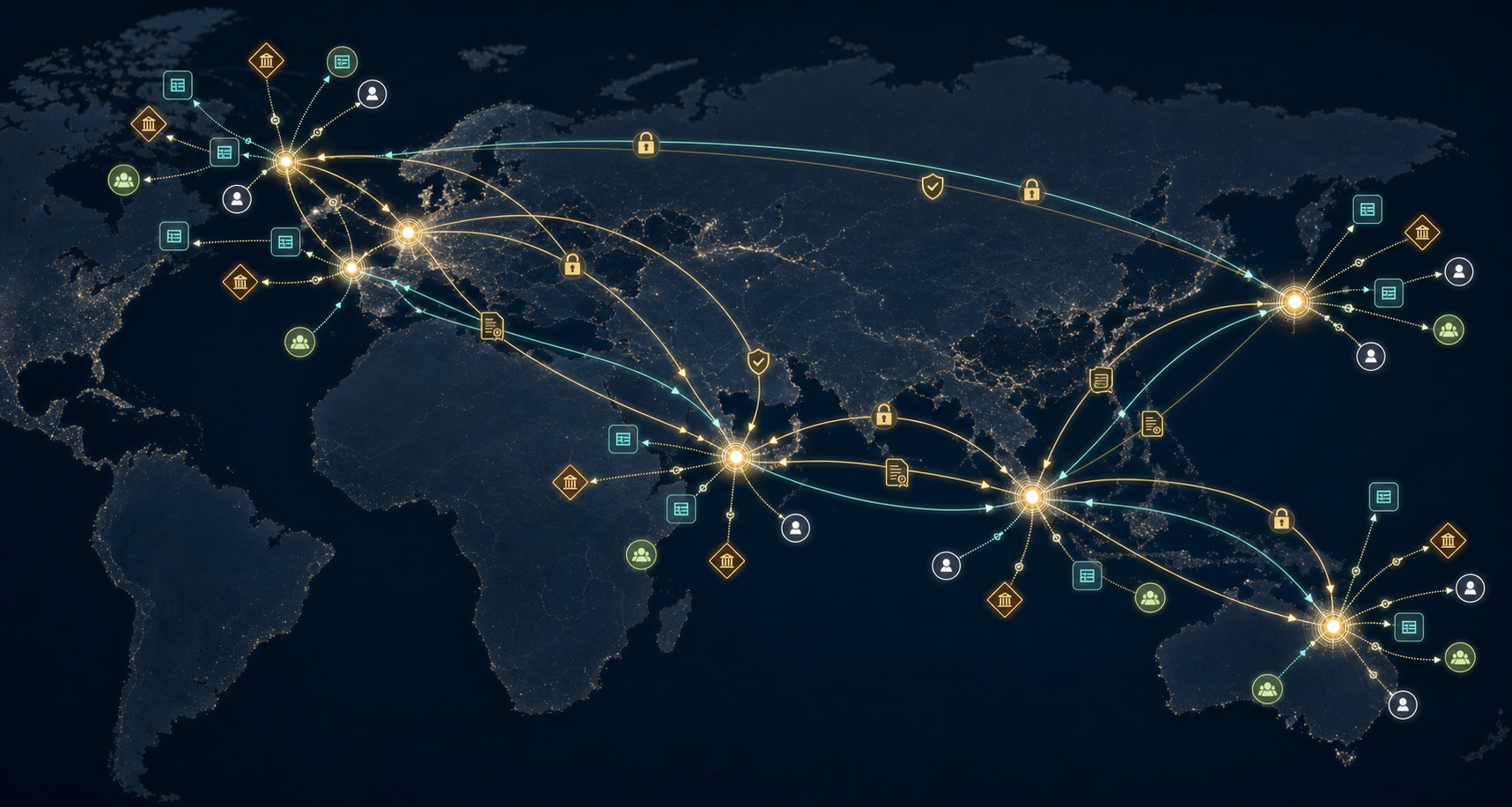
Sovos announced on June 2 the general availability of its Compliance Network. The launch comes as governments across Europe, the Middle East, and APAC accelerate e-invoicing mandates, pushing tax compliance out of local finance teams and into the center of ERP architecture planning.
The company positions it as a global e-invoicing and continuous transaction controls platform within the Sovos Tax Compliance Cloud. Sovos said at least eight major mandates will take effect across three continents within 18 months, with different models spanning certified private platforms, centralized government portals, post-audit regimes, and Peppol-based networks.
That variety is the pressure point for ERP teams. A multinational business may face France’s Plateforme Agréée model, Poland’s centralized KSeF platform, Germany’s post-audit approach, and the UAE’s Peppol five-corner framework inside the same planning window. Treating each mandate as a separate implementation creates brittle integrations, duplicated monitoring, and local workarounds that become harder to maintain with every new country rollout.
Compliance Inside the Transaction
E-invoicing mandates are no longer asking companies to submit reports after the fact. They are moving compliance into the invoice flow itself.
Sovos’ platform strategy responds to that shift by creating a single compliance layer across invoice models, formats, country requirements, and government connections. The pitch: connect ERP, accounts payable, and accounts receivable processes once, then manage country variation through the compliance network rather than through local point solutions.
That architecture will appeal to companies that have built tax compliance through successive country projects. It also raises the evaluation bar. A global e-invoicing platform has to do more than translate invoice formats. It must preserve invoice flow, support auditability, handle regulatory change, and integrate tightly enough with ERP to avoid creating a parallel tax operating model.
Analysis
What this means: E-invoicing can belong in ERP architecture planning. Finance and tax leaders can no longer isolate mandate readiness from order-to-cash, procure-to-pay, master data, and integration strategy. ERP teams should assess where invoice compliance sits in the transaction flow before new mandates force rushed country-level builds.
France, Poland, the UAE Show the Challenge
France’s mandate illustrates the orchestration problem. Starting on September 1, 2026, all companies established in France and subject to VAT must be able to receive e-invoices, while large and mid-sized companies must also issue them through a state-approved platform. That pushes ERP teams to align customer and supplier master data, invoice status handling, e-reporting, archiving, and platform selection before the deadline.
Poland’s KSeF model creates a different constraint. The European Commission’s e-invoicing profile for Poland said businesses with annual revenue above PLN 200 million (approximately USD 54 million) had to begin e-invoicing by February 1, 2026, with the requirement extending to all B2B transactions by April 1, 2026. That centralized platform model changes how invoices are issued, received, timestamped, corrected, and reconciled.
The UAE adds another version of the same architectural problem. Its rollout uses a Peppol-based model, with a pilot beginning July 2026 and large businesses required to comply from January 1, 2027. Businesses above AED 50 million (approximately USD 13.61 million) in annual revenue must appoint an Accredited Service Provider by October 30, 2026.
These mandates differ in mechanics, but they create the same enterprise risk: invoice processes now depend on regulated connectivity between ERP, tax, suppliers, customers, and government-controlled infrastructure.
Analysis
What this means: Point solutions will struggle as mandate variety increases. France, Poland, Germany, the UAE, and other markets are moving on different timelines and technical models, making local fixes harder to govern across multinational operations. Enterprise architects should prioritize reusable compliance patterns that can absorb new countries without multiplying fragile integrations.
Sponsor Industry‑Grade Research
Continuous Change Management
The strongest case for a network model is not deadline coverage. It is change management.
E-invoicing regimes rarely stay still. Schemas change, timelines move, enforcement policies shift, and governments refine platform requirements as programs mature. Finance and IT teams that build for one deadline often find themselves rebuilding for the next revision.
That makes e-invoicing a governance issue as much as a tax issue. CFOs need confidence that invoices keep flowing. Tax leaders need accurate, auditable compliance. Enterprise architects need a clean integration pattern that does not overload ERP with country-specific custom code.
The next 18 months will test whether companies can move from mandate-by-mandate compliance to a reusable operating model. The winners will be the teams that treat e-invoicing as a permanent control layer inside order-to-cash and procure-to-pay.
Analysis
What this means: Continuous regulatory change will define tax technology value. The real test is not whether a platform supports one deadline, but whether it can manage schema updates, timeline shifts, audit requirements, and government platform changes without disrupting invoice flow. CFOs and program leaders should build e-invoicing roadmaps around ongoing readiness rather than one-time compliance projects.
Get Our Free Weekly Newsletter
Editor’s note: For more information on tax readiness and compliance, review our latest FAQ checklist.