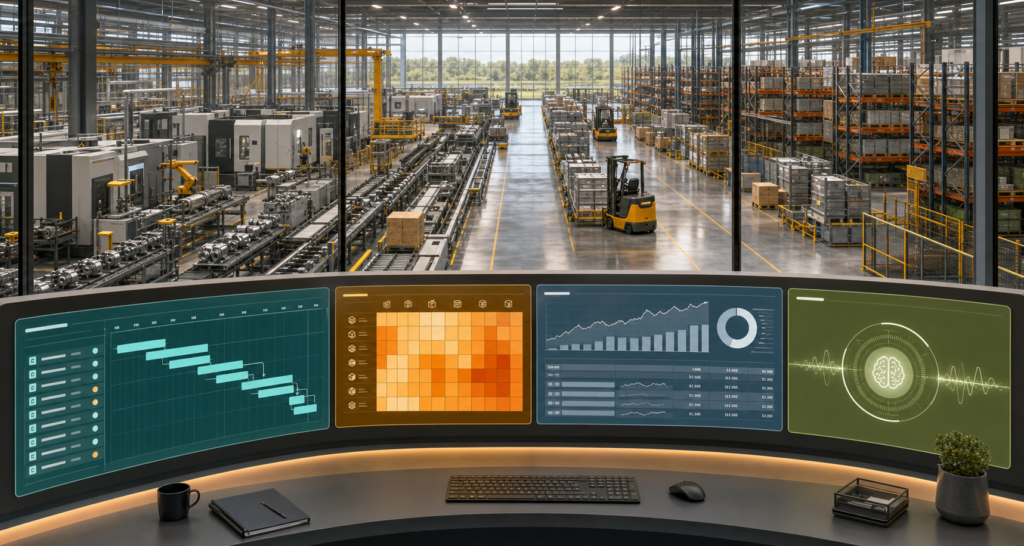

Syspro has launched Torque, an industrial AI platform that detects operational problems, recommends the next step, and takes approved action inside the systems that manufacturers already run. Announced today, the platform works with any ERP, connects to MES, SCADA, and warehouse systems through MCP connectors, and logs every action it takes with its full reasoning, including the rule applied, the data used, and why.

Torque entered a controlled availability program in August with manufacturers and distributors spanning food and beverage, industrial equipment, and fabricated metals, and Syspro will showcase the platform publicly for the first time at IMTS 2026 in Chicago, September 14 to 19. The company is calling Torque the most significant product in nearly five decades.
However, it has entered a market where manufacturers have been vocal about the gap between AI ambition and AI accountability. Ahead of the launch, ERP Today sat down with Chris Lloyd, Chief Solutions & Technology Officer at Syspro, to unpack why autonomous operations became possible now, how the platform earns trust from an industry that has been largely skeptical about AI, and what early adopters are willing to hand over to AI.
From Experimentation to Operationalization
For Lloyd, the timing is a story of convergence: AI models, cloud infrastructure, industry data, and manufacturers’ readiness to move past pilots have aligned. Yet, he believes that the deeper answer is about the nature of manufacturing itself.
“Manufacturing is so highly governed, regulated, time-sensitive, and repeatable that prior AI tools were too probabilistic for its nature,” Lloyd said. “Now that we are in this place of a strong mix of probabilistic models running deterministic tools at scale, with knowledge and augmentation, it is a much safer space to move away from experimentation and into operationalization.”
Syspro has shipped AI capabilities before, from machine learning and cognitive services to the embedded automation that helped earn its Leader position in the 2026 Nucleus Research SMB ERP Technology Value Matrix. What makes Torque different, Lloyd argued, is packaging. Definable and pre-packaged agents, autonomous workflows, skills, integrations, a rules engine, knowledge graph memory, and cloud or on-premises deployment now sit inside one governed workspace.
“We have created a top-to-bottom package that solves autonomous operations, rather than pieces of it with different labels that come across as confusing,” he said.
Dissolving the Trust Barrier
When ERP Today last spoke with Lloyd, he described a “trust barrier of letting AI take action,” especially among mid-market manufacturers, and noted that keeping the human in the loop would be critical. Torque is his answer to that barrier, built on what Syspro calls the Glass House principle: everything visible, nothing hidden.
Lloyd described Glass House as “the exact opposite of a black box”. Explainability runs through the platform’s full lifecycle, from design and implementation through operations and audit. Users can drill into any action to see why it was taken, which data was considered, the guardrails within which it could act, and the rules it applied.
“To breach Maslow’s hierarchy of AI, the biggest contender was trust,” he said. “Driving trust, and explainability more importantly, is the key differentiator.”
Critically, manufacturers can start at any point of AI maturity, from human-in-the-loop assistance to fully autonomous execution, moving the dial as governance and confidence allow. That graduated model echoes the governance-first architecture that Syspro’s CEO Leanne Taylor described when she outlined AI as an “activation layer” for ERP earlier this year.
Industrial AI First, ERP Second?
Asked whether an ERP-agnostic AI layer signals that Syspro now sees itself as an industrial AI company first, Lloyd did not hesitate. “Absolutely yes,” he said.
“To make the leap from ERP to industrial AI, you need to breach the unification of IT, OT, and ET,” he noted. “You have to reach into the OT systems, into the WMS, into the MES, to provide this unified contextual layer.”
Torque can operate without Syspro ERP, but it runs deepest with it. “With Torque on top of ERP, you are taking an intelligence layer built on top of the rock of your ERP data,” Lloyd said. The two have value in isolation, he added, and Torque can even serve as an integration and workflow mechanism ahead of an ERP transformation program. The platform does not replicate data anywhere, keeping governance risk contained. That positioning aligns with Syspro’s public argument that manufacturing AI succeeds or fails at the ERP layer, where operational controls already exist.
No Code Doesn’t Mean No Control
Torque lets anyone on an operations team describe an agent in plain language and deploy it without developers, a shift in who owns AI inside a manufacturing business. Lloyd frames it as a redistribution of labor rather than a removal of control. Under this approach, domain experts drive business value while IT controls permissions, data boundaries, audit requirements, and deployment standards.
“We see the future of transformation as a series of small, incremental workflow changes owned by the domain experts who understand the outcomes,” he observed. “No-code doesn’t mean no control. In our world it means closer alignment with outcomes, on top of closely guarded guardrails within the IT space.”
ROI a CFO Can Track
Perhaps Torque’s sharpest differentiator from other industrial AI platforms and solutions is cost governance. Most manufacturers experimenting with AI end up with spend that they cannot track, managing costs retroactively as they accumulate. Torque inverts that. During setup, users define the KPIs that matter, whether fewer stockouts, reduced waste, or faster disruption handling, and agents are built to “obsess over those KPIs,” Lloyd said.
A built-in value calculator predicts the cost of running each workflow, and manufacturers set the cadence and the budget so each workflow must achieve its ROI before it ever runs. “Before you even step into month one, you decide what budget each workflow has to go after certain ROIs,” Lloyd explained. “You can see where it’s running, how it’s running, and the budget it’s taken against the monthly budget you have given it.”
For CFOs, the metrics to watch are cost avoidance, hours saved, scrap reduction, and faster resolutions.
What Early Adopters Are Handing Over
Inside the controlled availability program, most use cases sit in frequent, rules-based territory: sales order adherence, job status monitoring, supplier follow-ups, and eliminating “swivel chair” integration work. But outliers are emerging at the enterprise end, including a supply chain control tower implementation that Lloyd described as “a massive implementation across the supply chain.”
Where the autonomy dial moves next depends on trust earned in production. “Visibility, transparency, and explainability earn the trust in moving the autonomy dial,” Lloyd noted. “Customers want to see the first use cases working with a human in the loop before they hand off to autonomous.”
Finally, he pointed to two deliberate design choices that differentiate Torque in the market: deterministic workflows that can deploy on-premises for customers that want data sovereignty, and a platform lightweight enough that it does not require “a full team of deployed engineers” to get running.
What This Means for ERP Insiders
Autonomous AI is now an ERP selection criterion, and explainability is the gate. Torque’s full reasoning chain, from rules applied to data considered, sets a bar buyers should now hold every vendor to. ERP users evaluating AI roadmaps should ask not whether a platform can act, but whether it can prove who approved an action, why, and under which business rule.
AI cost governance has moved from afterthought to architecture. Torque’s per-workflow budgets and upfront cost estimates directly address the AI sprawl problem that has stalled manufacturing pilots. CFOs should expect, and demand, workflow-level cost and ROI visibility from any agentic AI investment rather than reconciling spend retroactively.
The ERP vendor category is redrawing itself. Syspro’s ERP-agnostic positioning, along with its Nucleus Leader ranking and embedded AI investments, signals that midmarket industrial vendors are competing as intelligence layers across IT and OT, not just systems of record. ERP users should reassess whether their incumbent’s AI strategy reaches the shop floor systems where decisions land.