Financial Management

Enterprise Resource Planning (ERP) is integral to robust Financial Management within organizations. ERP systems seamlessly integrate financial modules, encompassing accounting, budgeting, and reporting. This consolidation ensures real-time visibility into financial data, streamlining processes and facilitating informed decision-making. By unifying financial information, ERP enhances accuracy, reduces errors, and improves compliance. Automation within ERP accelerates financial workflows, from invoicing to reconciliation, optimizing efficiency. Furthermore, ERP fosters collaboration between departments, aligning financial data with broader business operations. With its comprehensive financial capabilities, ERP empowers organizations to manage resources effectively, mitigate risks, and maintain financial transparency. The synergy between ERP and Financial Management contributes to strategic financial planning, cost control, and sustained fiscal health.


Sage HCM Targets Cost Gaps Bleeding Product Manufacturers Dry
Manufacturers, facing tight margins, are turning to Sage HCM to unify HR, payroll, and financial data in real time, enabling better visibility and management of labor costs to prevent margin losses.
Finance professional working on a laptop reviewing data, representing AI in quote-to-cash workflows and finance processes.
AI in Finance Faces Its Real Test Inside Quote-to-Cash Workflows
Most finance teams are using AI, but measurable impact remains limited. A Zuora webinar shows how quote-to-cash workflows expose the real constraints: integration, auditability, and control.
invoice automation
Addovation and Snowfox Bring AI-Driven Invoice Automation into IFS Finance Workflows
Addovation's partnership with Snowfox enables IFS customers to automate over 90% of invoice processing within existing finance workflows using embedded AI, addressing rising invoice volumes and enhancing operational efficiency without requiring system redesigns.
ERP cost
ERP Overspending Is Being Driven by Governance Gaps, Not Just Software Pricing
ERP cost overruns stem more from post-purchase management and governance issues, like underutilized licenses and ongoing subscription growth, rather than the initial license pricing itself.
Sage Targets Agentic Future With Expanded Developer Platform
Sage is enhancing its developer platform with new AI tools and flexible commercial models to streamline partner-led innovation, aiming to accelerate solution delivery for its customers and strengthen ecosystem collaboration.
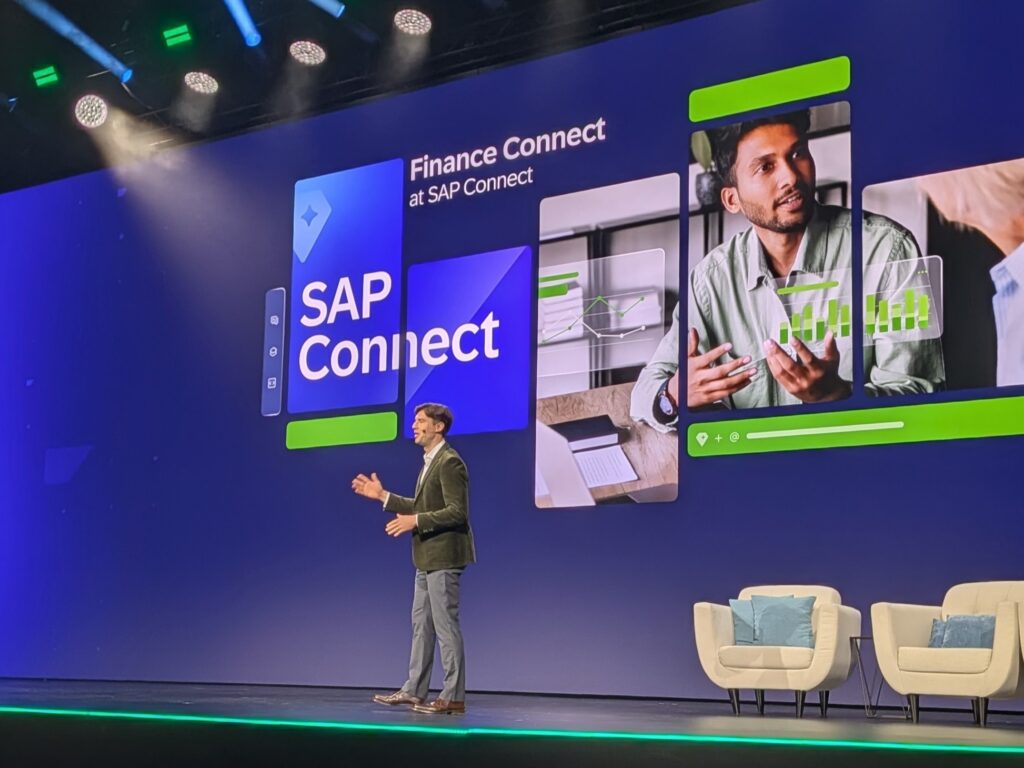
Sage CEO Steve Hare talking about the future of AI and ERP systems.
Sage Future Keynote Highlights Discipline, Transparency for AI Finance
Sage Future 2026 in San Francisco highlighted the integration of AI in finance that enhances decision-making while maintaining human accountability as experts demonstrated the shift towards empowered, data-driven finance operations leveraging modern ERP systems.
Sage AI Agents Target Everyday Finance And HR Friction
Sage is advancing from AI copilots to integrated task-focused agents within finance, HR, and operations workflows, launching AI agents that automate processes in Sage Intacct, Sage HCM and Sage X3 with a focus on accuracy, auditability, and human oversight to enhance decision-making while reducing manual tasks.
Sage and AI Agents
Sage Acquires Doyen AI to Improve SMB AI Migration
Sage's acquisition of Doyen AI aims to enhance ERP and financial system implementations by embedding AI in migration workflows, promising faster, more efficient deployments for SMBs while ensuring transparency and governance in data handling.
Dynamic Finance Emerges as a Competitive Differentiator in the AI Era
Research from the IBM Institute for Business Value reveals finance functions are evolving from retrospective roles to proactive decision-makers in enterprise performance, highlighting a stark performance gap where only 12% of organizations exhibit advanced maturity in strategic influence and digital agility.
Sage Intacct Tightens Grip On Connected Finance Workflows
Sage enhances its Sage Intacct platform by integrating planning, spend management, cash flow, and industry-specific workflows to provide finance leaders with a comprehensive mid-market solution, ensuring quicker insights while maintaining control over core processes.
Empty enterprise office environment with desks and workstations, representing business operations, workflows, and organizational structure tied to unrealized AI value.
Companies Are Acting on AI Value They Haven’t Realized Yet
Most organizations say AI delivers value, but few can measure it consistently. New research shows that measurement maturity and operating models determine whether AI produces repeatable enterprise ROI.
Sage HCM Aims To Close HR Finance Data Gaps
Sage has launched Sage HCM, a new cloud solution for mid-market organizations that integrates HR, payroll and financial data, featuring AI-powered workflows and construction-specific capabilities to enhance labor cost visibility and payroll accuracy.
Shipping containers stacked at a logistics facility, representing supply chain operations in a SAP S/4HANA transformation context.
Clorox Shows What SAP S/4HANA Transformations Require Before 2027
Clorox’s $580M SAP S/4HANA transformation highlights how design, benchmarking, and execution decisions shape outcomes beyond go-live.
Sage And PwC Turn Agentic AI On Intacct Rollouts
Sage and PwC are integrating agentic AI into the Sage Intacct implementation process to enable faster, standardized onboarding for finance teams, enhancing efficiency by automating key stages while maintaining consultant oversight.
Sage Intacct Advisory Puts AI To Work For CAS
Sage is enhancing its Intacct Advisory services with AI-driven workflows and templates to standardize client accounting services, enabling firms to deliver consistent advisory support and improve efficiency without increasing staff, as showcased at the upcoming Sage Future Conference.
U.S. Department of the Treasury building in Washington, D.C., before regulators met to discuss AI cyber risk in financial systems.
Claude Mythos Preview Shows How AI Collapses the Distance Between Discovery and Exploitation in Financial Systems
Claude Mythos Preview is prompting regulators and banks to reassess cyber risk as AI accelerates vulnerability discovery and exploitation across interconnected financial systems.
Wipro’s Alpha Net Deal Targets AI Application Services
Wipro's acquisition of select customer contracts and teams from Alpha Net Consulting for up to $70.8 million emphasizes a shift towards providers integrating enterprise software development, data engineering and AI capabilities.
Designing Finance for Scale: Why Charts of Accounts and Dimensions Matter More Than ERP Features
ERP projects often face significant challenges not during implementation but years later due to underlying financial architecture decisions—including chart of accounts and entity structures—being overlooked in favor of immediate functionality, which can hinder scalability and complicate management reporting as business complexities evolve.
Frankfurt business district skyline representing enterprise finance systems, data infrastructure, and AI-driven collections workflows in Europe.
Zuora Collections Launches in Europe with Germany Data Center for In-Region Data and AI-Driven Workflows
Zuora has launched Collections in Europe with a new Germany data center, bringing AI-driven workflows and in-region data handling to finance teams managing cash collection and forecasting.
Internal Revenue Service building exterior illustrating IRS impersonation scams and tax season fraud risks in 2026.
Tax Season Scams 2026: How IRS Phishing, Fake Tax Messages, and AI Fraud Threaten Businesses
Tax season scams in 2026 are expanding beyond individual taxpayers into broader business risk. IRS impersonation, fake tax messages, QR codes, and AI-enabled fraud are targeting tax professionals, payroll teams, and organizations handling sensitive financial and employee data.
Dynamics 365 Gains Momentum: Franklin Sports, Zwilling Highlight ERP Standardization and Finance Automation
Microsoft Dynamics 365 is experiencing significant growth as organizations move towards ERP standardization and process optimization, exemplified by Franklin Sports' shift to unify global operations and Zwilling Beauty Group's transition from system consolidation to process automation.
Oracle Fusion Agentic Apps Target Everyday Enterprise Friction
Oracle's new Fusion Agentic Applications aim to enhance ERP efficiency by utilizing AI-driven agents to automate processes across finance, HR, supply chain and customer experience, promoting real-time decision-making and reducing manual tasks.
SAP Shifts to AI Consumption Pricing as Agents Threaten Saas Revenue Model
SAP is shifting from per-user and subscription-based pricing to a consumption-based model in response to the automation of workflows by AI agents, reflecting a significant transformation aimed at aligning costs with AI usage rather than user access.
Dynamics 365 Wave 1 Puts Agentic AI at the Heart of ERP
Microsoft's Dynamics 365 2026 release wave 1 transforms Copilot from a productivity tool into an autonomous, integrated operating layer across various enterprise functions, emphasizing proactive AI-driven workflows and low-code agent design to enhance operational efficiency and reshape ERP implementation.
Tennant ERP Rollout Disruption Triggers $30M Sales Hit and Investor Scrutiny
Tennant Company is experiencing significant operational and financial challenges due to a troubled ERP rollout that disrupted order processing, resulting in approximately $30 million in lost sales and a 23% drop in stock value, highlighting the critical nature of ERP systems in revenue operations.
Abu Dhabi skyline with modern high-rise buildings along the waterfront
UAE Approves SAP for e-Invoicing, Expanding ERP’s Role in Compliance Architecture
The UAE has pre-approved SAP as an e-invoicing service provider, becoming the first ERP vendor in the framework. The decision places ERP systems within compliance architecture ahead of the 2027 mandate.
Abstract geometric data structure representing a unified ERP data architecture across connected systems
SAP Business Data Cloud Explained: A New Model for ERP Data and Analytics
SAP Business Data Cloud reflects a shift in ERP data architecture, introducing a unified, governed data layer that changes how data is structured, managed, and used across systems.