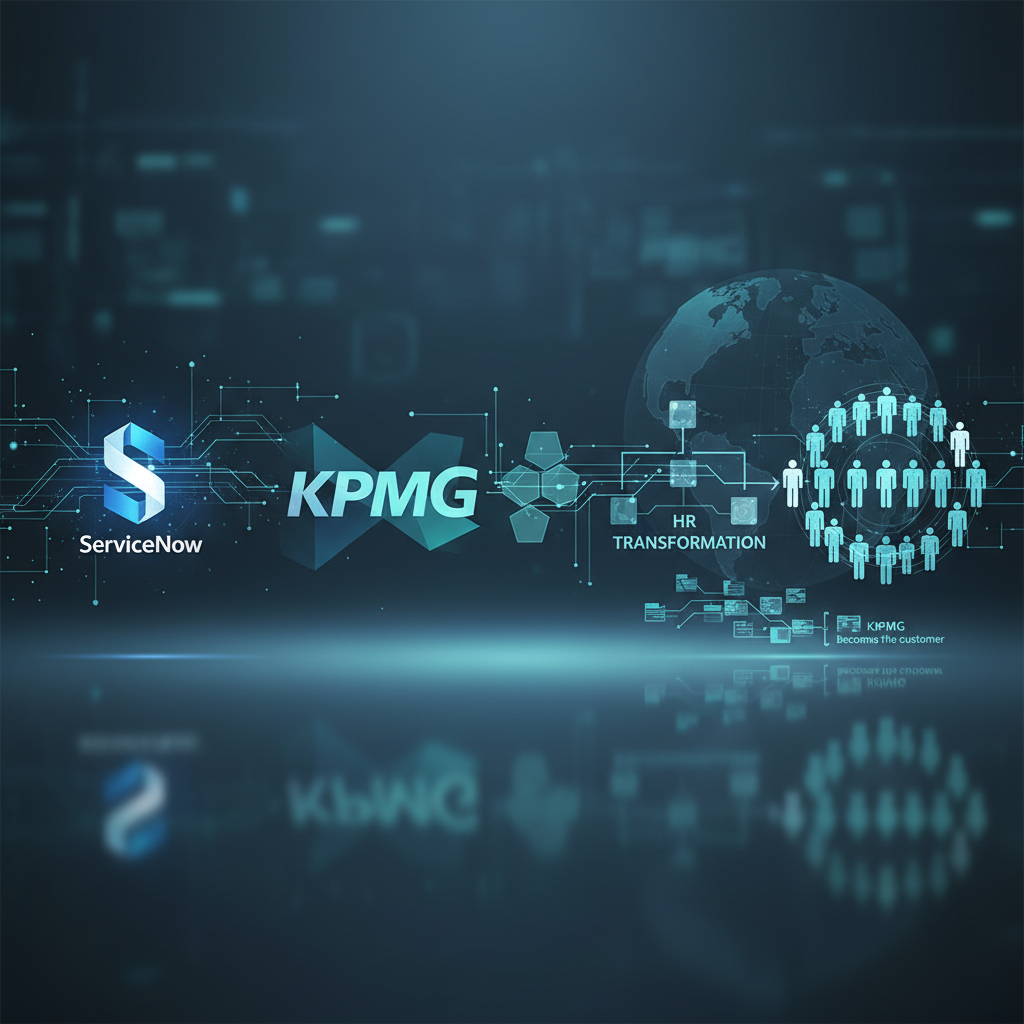
The most telling line in KPMG’s September 9 announcement is not about AI. It is the arrangement itself. KPMG will serve as an implementation and services partner for ServiceNow’s own global rollout of EmployeeWorks and HR Service Delivery, while expanding its internal deployment of the ServiceNow AI Platform, including AI Control Tower. The vendor is buying its partner’s services to deploy its own product, and the partner is buying the product to run its own firm. Each side is the other’s reference customer.
That circularity is the point. Michael Park, ServiceNow’s SVP of global partnerships, put it plainly: “When partners prove the outcomes in production first, customers move faster.” ERP professionals have heard versions of this before, but the current wave of agentic AI makes the claim more consequential. Enterprises are not short of pilots. They lack evidence that agents can run high-volume employee processes inside a governance model that survives an audit.
Why HR is The Proving Ground
HR is a deliberate choice. Employee service requests are frequent, rule-bound, and low in individual risk, which makes them an ideal environment to test autonomous execution before it touches finance or procurement. KPMG’s stated outcomes are unified service delivery across HR, IT, workplace, and payroll; real-time signals on employee needs and bottlenecks; and agentic AI that automates routine transactions while flagging exceptions for escalation.
The architecture behind that ambition is what ERP leaders should study. At Knowledge 2026, ServiceNow introduced Otto, a single conversational entry point that unifies Now Assist and Moveworks, and positioned it as a user interface for completing work across systems rather than another chatbot. ERP Today’s analysis of Otto noted that many enterprise AI deployments still break down at the user experience layer: the assistant produces an answer, but the employee must leave the workflow, open another system, and finish the action themselves. EmployeeWorks isServiceNow’ss attempt to close that gap, and its own launch materials cite multi-step execution across Workday, SAP, and other systems of record.
That is where this stops being an HR story. An employee front door that updates benefits, books leave, and pushes changes into an ERP is an integration and control question. The ERP remains the system of record, but the transaction increasingly originates somewhere else.
Governance is The Thread, Not an Afterthought
Both firms frame the expansion around AI Control Tower, which KPMG is deploying to discover, observe, govern, secure, and measure AI regardless of where it runs. This tracks the repositioning ERP Today described at Knowledge 2026, where ServiceNow stopped presenting itself as a workflow platform with AI features and began pitching itself as the governance and action layer for enterprise agents, identities and workflows.
The commercial validation followed quickly.ServiceNow’s second-quarter results showed its AI business crossing $1 billion in annual contract value, with subscription revenue up 24.5% year over year. ERP Today’s read on those numbers was that enterprises are willing to pay for control, orchestration and trusted execution, not only for generative features, and that data foundations such as the CMDB will decide how far autonomous work can scale.
KPMG’s deployment is a live test of that thesis. If a 276,000-person professional services firm can run governed agents across its internal support organization, the argument for the control-layer model gets stronger. If the deployment stalls on data quality or change management, the limits become visible in public.
The ERP Boundary Is Moving
The pattern extends beyond this alliance. In June, ServiceNow and Accenture launched a joint offering to migrate enterprises off legacy cyber risk and GRC platforms. In August, Australia’s Infrastructure Department chose Workday and ServiceNow to replace SAP ECC6, splitting finance, HR and payroll from service management and workflow. ERP Today observed that running two platforms instead of one ERP requires expanded governance structures, not just new licenses.
HR service delivery is becoming the first layer where enterprises decide how much work sits above the ERP rather than inside it.
What This Means for ERP Insiders
Treat employee-facing AI as an ERP integration decision. When agents originate transactions that land in Workday, SAP, or Oracle, ERP teams own the downstream data integrity. Integration governance, not the chatbot, is where the risk concentrates.
Ask partners for their own production evidence. The KPMG and ServiceNow model sets a new bar: implementation partners running the product internally at scale. ERP leaders evaluating agentic HR should request the partner’s own deployment metrics before accepting a methodology.
Fund the control layer before expanding agent scope. AI Control Tower is the common thread in every ServiceNow announcement this year. Enterprises that scale agents without discovery, observation, and audit capabilities will face the reckoning later, when the volume is higher and the fix is harder.