
The word that unifies some of the most significant enterprise software announcements this month is not “intelligence” or “insight,” it is execution. Four acquisitions targeting the AI execution layer—Asana buying StackAI, Coupa buying Rossum, Salesforce buying Contentful, and Vertice buying Vendr—show vendors purchasing the specific capabilities agents need to act, not just advise.
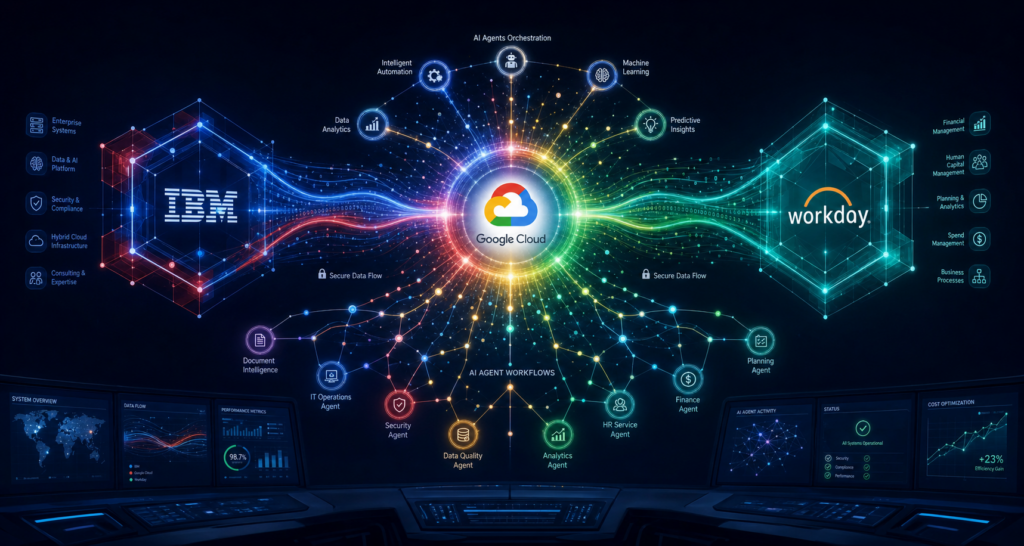
Google Cloud’s deeper integration of Gemini Enterprise into Workday and IBM and its expansion to NTT DATA show a hyperscaler building the delivery infrastructure to move those models into production at scale. Microsoft’s connection of Dynamics 365 Field Service to Project Operations and Financials closes the loop between service execution and financial reality in ways the two systems previously could not.
And on the vendor side, both Nominal and Priority Software are telling customers the same thing: the point of AI in ERP is not to explain what happened; it is to do the work. The market is converging on a single architectural direction, and the race is now about who gets to own the execution layer inside live enterprise operations.
The Acquisition Signal
Four acquisitions covered by ERP Today in early June do not sit in the same software category, but the pattern they trace is coherent.
- Asana is buying StackAI, a no-code AI workflow platform that connects agents across ERP, CRM, ITSM, document systems, Salesforce, AWS, DocuSign, and Oracle. The deal positions Asana around “human-agent teams,” with StackAI executing cross-system workflows and Asana providing the project context, ownership structure, and history of work.
- Coupa is buying Rossum, of which transactional LLM has been trained on tens of millions of documents and can learn from each customer’s document set—bringing intelligent document processing into Coupa’s full source-to-pay portfolio, well beyond accounts payable.
- Salesforce has signed a definitive agreement to acquire Contentful, used by more than 4,800 brands for composable digital content delivery. The intent is to give Agentforce a native, structured content layer it can query, assemble, and deliver dynamically—Salesforce’s acknowledgement that agents need approved, reusable content at scale, not just customer records and prompts.
- Vertice has acquired Vendr to build what it describes as the world’s largest procurement intelligence dataset: more than $75 billion in global indirect spend, more than 2 million pricing data points, and more than 250,000 negotiated contracts, all feeding Vertice’s 60-plus AI agents, including its autonomous negotiation agent, Ana.
Vendors are buying domain-specific data, document intelligence, workflow context, and structured content because generic AI capabilities cannot substitute for them. Agents that need to negotiate vendor contracts, process invoices, personalize customer experiences, or execute project tasks require high-quality, domain-specific inputs to do that work reliably.
The acquisitions are an acknowledgement that those inputs cannot be built from scratch or approximated with general-purpose models. The AI execution stack is fragmenting before it is governed, and every platform acquiring these capabilities is building its own control layer.
The Hyperscaler Delivery Race
Google Cloud is running the most visible delivery expansion of any hyperscaler this month.
The Workday partnership puts Workday’s Sana Self-Service Agent into early access for eligible customers inside Gemini Enterprise, with Gemini becoming the default AI model for Sana. Employees can ask questions and trigger workflows in natural language with Workday’s security, business rules, and approval chains in place; managers can approve timesheets in bulk, initiate performance reviews, and submit payroll inputs; finance users can query expense policies and receive guided help on requests—all within a governed agent interaction model that supports agent-to-agent handoffs, agent-to-UI flows, and the Model Context Protocol.
The IBM partnership provides the delivery infrastructure that model partnerships alone cannot: thousands of Google-Cloud-certified consultants and forward-deployed engineers organized into a new Google Cloud Practice targeting banking, government, retail, telecommunications, energy, insurance, and life sciences. IBM described the partnership as a multi-billion-dollar opportunity.
The NTT DATA expansion extends the pattern further: a dedicated global Gemini Enterprise practice targeting 5,000 certified experts and the co-development of up to 500 AI agents across banking, insurance, manufacturing, retail, and finance operations. NTT DATA’s own research finds that 99% of enterprises say AI is driving greater demand for cloud investment and 88% say current cloud investment levels are putting AI and modernization initiatives at risk.
Microsoft, meanwhile, is building execution connectivity inside its own Dynamics 365 ecosystem. The Field Service and Project Operations integration, now generally available, ends the separation between work order execution and project financials that has historically left service organizations reconciling costs, billing, and revenue recognition after the fact rather than in real time.
Under the new model, a technician marking materials as used on a work order in the field—offline if necessary—creates project actuals that flow directly into estimates, forecasts, invoicing, and revenue recognition. The integration supports two deployment paths: a core model that keeps invoicing inside Project Operations, and a finance model that posts through Dynamics 365 Finance via the Project Operations Integration Journal. Field execution and financial accountability become the same process rather than sequential ones.
What Vendors Are Telling Customers
The clearest articulation of where the market is heading came from an interview at Sage Future in San Francisco. Nominal CMO Stephanie Montelius drew a line that is easy to state and hard to act on: chatbots explain, agents execute. Nominal’s model—agentic performance management that sits alongside the ERP, follows customer standard operating procedures, and handles accounting workflows, reconciliation, and intercompany transactions with human oversight—is a direct response to the question finance teams keep raising: How do you trust AI with real operational work?
The answer Nominal offers is determinism, auditability, and human review built into the workflow design, not bolted on after the fact. The target customers are organizations with high transaction volumes, multi-entity complexity, and manufacturing processes where the manual accounting overhead is large enough to make the value case clear.
Priority Software is making the same argument in the midmarket. Version 26.0 of Priority ERP introduces an aiERP Companion plus task-specific agents embedded directly into finance, sales, and supply chain workflows. The agents create journal entries, post receipts, process invoices, generate purchase orders, run inventory checks, and execute forecasts, not as external automations but as actions taken inside the ERP with user approval and auditable controls.
Sagive Greenspan, Priority’s CEO, described the intent as, “The aiERP Companion and specialized agents analyze signals, trigger workflows, and execute routine operations inside the ERP, reducing manual effort while elevating decision quality and on-time performance across the business.”
The pattern running through acquisitions, hyperscaler partnerships, platform integrations, and vendor product releases in June 2026 is the same: Enterprise software is being restructured around the question of who controls the layer where AI decisions become actions. The data, the workflows, the delivery capacity, and the domain-specific intelligence are all being acquired, built, or partnered into position. The organizations that will determine the shape of that layer and the enterprises that will benefit from it are making their moves now.
What This Means for ERP Insiders
- The acquisition pattern reveals what vendors believe agents cannot do without. The four enterprise AI acquisition deals above share a single logic: Generic AI cannot substitute for domain-specific data, document context, and workflow history. Enterprise architects evaluating agent platforms should ask directly what proprietary data layer each vendor controls, because that is where execution capability will diverge.
- Model partnerships without delivery capacity are not a business. The Workday Gemini integration and the NTT DATA practice expansion show Google is treating consulting capacity as the product, not the model. For enterprise IT teams evaluating hyperscaler AI partnerships, the question is no longer which model but which delivery network will actually put it into production.
- Field execution and financial accountability should be the same process, not sequential ones. The gap between work completed in the field and costs, billing, and revenue recognition appearing in financials is not a technology problem; it is a controls problem that technology can now close. The Dynamics 365 Field Service to Project Operations integration is one example of vendors closing it at the platform level. Organizations running both modules that have not activated the integration are carrying an avoidable financial reporting lag.
- “Agents execute” is a governance statement. Both Nominal and Priority Software frame their execution models around human oversight, auditability, and customer SOPs—not autonomous operation. For finance and operations teams approving AI agent pilots, the design question is not whether the agent can perform the task but whether the approval chain, audit trail, and exception handling are defined before the agent touches live data.
- The midmarket is no longer waiting for large-enterprise proof points. Priority’s V26.0 release (i.e., agents creating journal entries, posting receipts, processing invoices, and running inventory checks inside the ERP across 75,000 customers in 70 countries) confirms that embedded AI execution in ERP is a mainstream product decision, not an enterprise-only capability. Midmarket organizations still treating agentic ERP as a future-roadmap item are already behind their peer group.