
Why the most expensive risk in ERP transformation rarely appears on a status report
ERP implementations have never moved faster. As AI-enabled delivery methods compress timelines and organizations face mounting pressure to modernize finance, standardize global processes, and demonstrate measurable business value, the pace of transformation has become both an asset and a risk.
Executive sponsors monitor implementation costs, milestone completion, testing progress, defect counts, and deployment readiness through detailed governance dashboards. Every week, steering committees receive reports designed to answer one fundamental question.
Is the program on track?
Yet one of the largest financial exposures in an ERP transformation rarely appears on any dashboard. It has no budget line. It is rarely assigned an owner. It is almost never quantified. By the time leadership recognizes its impact, the cost has already been absorbed into the operating model.
That hidden liability is decision debt.
McKinsey research on technical debt found that CIOs estimate such off-balance-sheet liabilities can amount to 20% to 40% of the value of an organization’s entire technology estate. Decision debt works in a similar way, except it accumulates not from deferred technology work but from deferred business decisions. Unlike technical debt, it almost never appears on a risk register, and it grows quietly while every project milestone turns green.
The Decision That Never Happened
Early in a global ERP implementation, the project team reached a design workshop focused on intercompany processing. The discussion quickly exposed competing perspectives across the business. Finance leaders wanted one operating model. Regional business units preferred another. Tax had additional requirements. The implementation team could not continue designing the future-state process without direction.
The issue was elevated to the steering committee. Everyone agreed the decision was important. No one made it.
Rather than delay the project, the implementation team did what experienced project teams often do under schedule pressure. They designed a temporary workaround that allowed the program to keep moving. Configuration continued. Testing proceeded. Training materials were developed. The implementation stayed on schedule. On paper, the program appeared healthy.
Eighteen months later, when the solution went live, the workaround remained. It had become embedded in business processes, security roles, reporting logic, reconciliation activities, training documentation, and operational procedures. The organization no longer viewed it as temporary. It had become the new way of working.
The original business decision had never actually been made.
No one intentionally designed a less efficient operating model. It simply evolved because delaying the decision seemed easier than resolving it.
This pattern is common in complex ERP transformations. It rarely appears on risk registers. It is almost never discussed during post-implementation reviews. Yet it shapes how organizations operate long after project teams have moved on.
The Blind Spot in ERP Governance
Transformation programs are disciplined about measuring execution. Program Management Offices monitor budget variance. Testing teams report defect closure rates. Leadership tracks schedule performance. These metrics are essential because they provide visibility into delivery execution.
What they rarely measure is the financial exposure created by unresolved business decisions.
PwC’s 2026 Digital Trends in Operations research found that 89% of operations and supply chain leaders said their technology investments have not fully delivered expected results. The most common reasons included integration complexity, data issues, and user adoption challenges. PwC also recommends defining decision rights, accountability, and oversight upfront so experimentation can drive value without creating fragmentation.
That point translates directly into ERP governance. When ownership of the chart of accounts remains unresolved, implementation does not stop. When approval authority has not been finalized, the project continues. When enterprise structure discussions remain open, teams continue designing around assumptions. Each temporary assumption influences configuration, integrations, reporting, testing, training, and ultimately the future operating model.
The cost is not immediately visible because it is distributed across multiple workstreams. Individually, each consequence appears manageable. Collectively, they represent a liability that was never included in the original business case.
This is not simply a reporting gap. It is a governance gap. Most governance frameworks are designed to measure what the implementation team is doing. Very few are designed to measure what the business has failed to decide. Those are fundamentally different questions, and only one creates a liability that compounds over time.
Get Our Free Weekly Newsletter
Why Good Organizations Still Accumulate Decision Debt
Decision debt is not created by inexperienced teams. It is not a symptom of poor consultants. It is a leadership and governance challenge that most program structures were never designed to catch.
Most organizations have capable business leaders who understand their operations. Finance executives understand reporting requirements. Technology leaders understand system capabilities. Yet projects accumulate decision debt because accountability is frequently fragmented. The individual with the deepest business knowledge may not have authority to decide. The executive with decision-making authority may not have enough operational context. The steering committee has visibility into the issue but lacks a disciplined mechanism for forcing timely resolution.
Deloitte’s 2026 Finance Trends survey of more than 1,300 global finance leaders found that 41% of early-stage teams cite legacy technology as a barrier to AI adoption. The same report found that 28% of respondents plan to build more agile governance models to support faster decision-making. As AI shortens delivery cycles and implementation methods become faster, the cost of delayed business decisions increases. Projects have less time to absorb uncertainty, and the pressure to maintain momentum leads to more temporary assumptions that quietly increase decision debt.
Discussions continue. Meetings are held. Action items remain open. Eventually, implementation teams design around uncertainty because standing still is no longer an option. The project delivers. The business inherits the consequences.
What makes decision debt particularly dangerous is that it rarely feels like a crisis while it is accumulating. Each workaround appears reasonable. Each deferred discussion seems understandable given the schedule pressure. The danger is cumulative, and it only becomes visible when the organization looks back and asks why a standard ERP implementation now requires so many exceptions, manual activities, and operational workarounds.
Measuring What Has Always Been Invisible
Organizations routinely measure budget variance, schedule variance, defect trends, and resource utilization. There is no reason they cannot also measure decision exposure.
That is the purpose of the Decision Debt Index, a framework developed from field observation across large-scale ERP programs to make the invisible cost of unresolved decisions visible before it compounds.
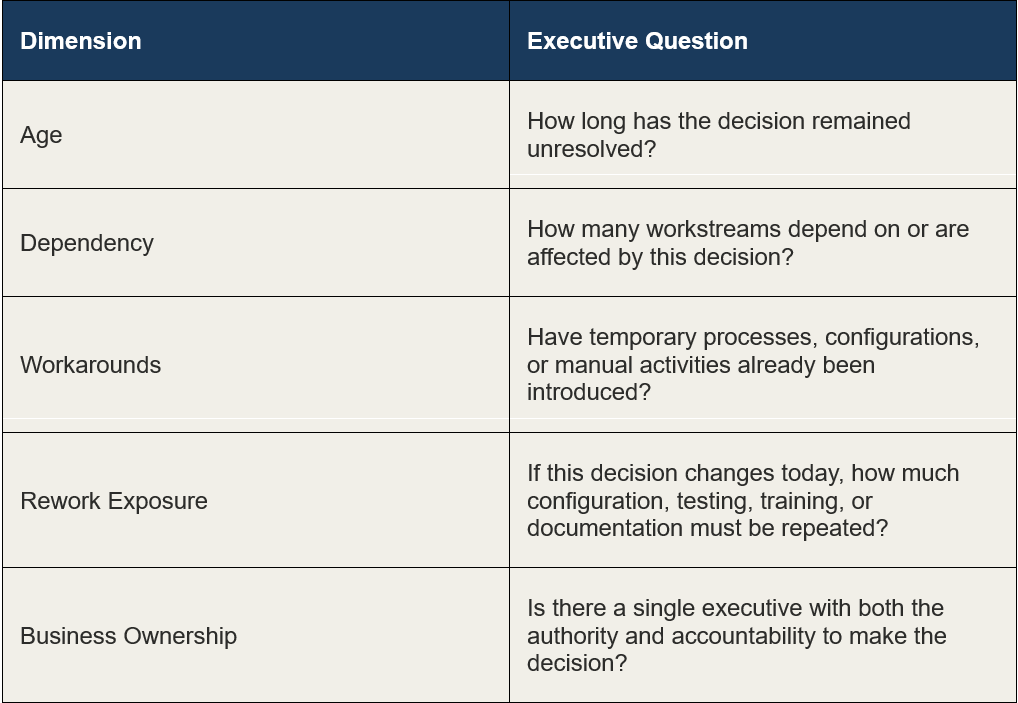
Instead of asking whether a decision is still open, the Decision Debt Index asks a more important question: What is it costing the organization to leave it unresolved?
Rather than simply tracking whether a decision is open or closed, the Decision Debt Index evaluates the business exposure created by delay. Five dimensions determine the level of decision debt. These dimensions are not intended to produce a mathematically precise score. They are intended to improve executive judgment.
Consider two open decisions. One affects a single reporting requirement and has been open for five days. The other has been unresolved for two months, affects finance, procurement, tax, security, reporting, integrations, and data migration, has already required three temporary workarounds, and would force extensive rework if changed after User Acceptance Testing.
Most project status reports present these issues the same way. Both appear as open decisions. They are not equivalent. One represents routine project activity. The other represents an accumulating business liability that should command immediate executive attention.
Changing the Conversation in the Steering Committee
Most steering committee meetings follow a familiar agenda. Milestones are reviewed. Progress is presented. Risks are evaluated. Open decisions are listed. The meeting moves on.
Every unresolved decision receives approximately the same amount of attention regardless of the financial exposure it is creating. What is almost always missing is any discussion about the cost of delay.
The Decision Debt Index changes that conversation.
Consider an enterprise structure decision that has been open for eight weeks. It now affects finance, procurement, tax, security, reporting, integrations, and data migration. Three temporary workarounds have already been built to keep the program moving. Changing the decision after User Acceptance Testing would require hundreds of hours of redesign, configuration changes, regression testing, updated training materials, revised operating procedures, and additional deployment effort.
On a traditional dashboard, this appears as one unresolved issue among many. Through the lens of the Decision Debt Index, it becomes one of the most expensive unresolved liabilities in the transformation.
The decision is no longer an administrative item waiting for the next available meeting slot. It becomes a measurable business exposure demanding executive accountability.
When decision debt becomes visible, behavior changes. Urgency becomes tangible. Leadership discussions become more decisive because delay now carries a measurable business consequence instead of simply representing another open action item.
That is the real value of the Decision Debt Index. It does not improve governance by creating another report. It improves governance by changing executive behavior.
Sponsor Industry‑Grade Research
The Hidden Liability Every ERP Program Should Measure
A project risk represents something that might happen. Decision debt represents something that is already happening.
Every week an important business decision remains unresolved, the liability grows. Configuration continues. Testing expands. Training materials evolve. Temporary assumptions become embedded in the future operating model. By the time leadership finally reaches a decision, the implementation has already absorbed much of the cost.
Go-live does not eliminate decision debt. It transfers it. Every workaround accepted during the project becomes someone else’s operational reality. Finance teams reconcile around it. Internal audit evaluates it. Support organizations maintain it. Future enhancement projects inherit it. Over time, organizations stop recognizing complexity that never should have existed in the first place. That normalization may be the greatest long-term cost of decision debt.
Technology will continue to evolve. McKinsey research on AI and ERP delivery suggests that AI agents have the potential to reduce the effort needed to implement ERP systems by at least 50% and cut program duration in half. That acceleration narrows the window for making critical business decisions at the same time the cost of deferring them rises.
An implementation completed in half the time leaves only half the time for business leaders to make the decisions that shape the future operating model.
The organizations best positioned to realize value from AI-enabled ERP capabilities will not simply implement better technology. They will build stronger governance, create clearer accountability, and begin measuring the one liability that has remained invisible throughout enterprise transformation.
The organizations that learn to identify, measure, and reduce decision debt before it becomes embedded in their operating model will not simply deliver more successful ERP implementations. They will build organizations that make faster, better decisions long after the implementation team has gone home.
How much decision debt did this program accumulate this month? That question should be on every steering committee agenda.
Editor’s Note: What This Means for ERP Insiders
Green dashboards can hide expensive business indecision. ERP leaders should not treat on-time milestones, closed defects, and completed testing as proof that the operating model is healthy. Steering committees need visibility into unresolved business decisions that are already shaping configuration, integrations, reporting, training, and user roles.
Decision ownership needs the same discipline as budget ownership. When finance, tax, procurement, operations, and IT all influence a decision, but no single executive owns it, teams often build around assumptions just to keep the program moving. ERP programs should assign decision owners, escalation paths, and deadlines before unresolved issues become embedded in the solution.
Open decisions should be ranked by business exposure. A decision affecting one report does not carry the same risk as a decision touching finance, procurement, security, data migration, and testing. ERP teams should track decision age, dependencies, workaround creation, rework exposure, and executive ownership so steering committees can focus on the decisions creating the greatest long-term cost.
AI-enabled ERP delivery raises the cost of slow decisions. If AI compresses implementation timelines, business leaders have less time to resolve the decisions that define the future operating model. Organizations that want faster ERP delivery need faster governance, clearer accountability, and better visibility into the cost of delay.