
When ERP programs go off track, it is not because leadership failed to run change workshops or sent enough communications. They go off track because leadership made weak structural decisions earlier in the program, then expected change management to absorb the consequences later.
That distinction matters more now because ERP delivery has become structurally harder. AI is compressing implementation economics. Vendors are moving closer to customers. System integrators are under pressure to prove value faster. Boards still expect stronger ownership, quicker returns, and cleaner execution. Yet many programs still treat change management as the answer for every non-technical issue that surfaces in delivery.
The deeper problem usually sits upstream of adoption. Capital, capability, and capacity shape what gets delivered, how quickly decisions get made, who owns critical knowledge, and whether the organization is actually stronger after go-live.
That is the gap this article addresses through defining “Transformation Capability Management,” or TCM. The point is not to diminish change management, but to explain why a program can communicate well, train the right users, and still drift into expensive, partner-dependent execution because the harder structural constraints were never governed early enough.
Change Management vs TCM
Change management usually refers to the work that helps people adopt what is being delivered. That includes sponsor alignment, stakeholder mapping, communications, role-based training, readiness planning, manager enablement, and support for new behaviors. It helps users understand what is changing, why it matters, and how they are expected to work in the new environment.
TCM addresses a different problem. It governs the conditions that determine whether the program is building durable capability inside the organization or simply moving work through the delivery cycle. In practical terms, that means:
- making capital, capability, and capacity constraints visible early enough for leadership to act on them
- deciding what the organization must own, what can be rented temporarily, what operating bandwidth actually exists, and which trade-offs need to be made before they surface.
Get Our Free Weekly Newsletter
Change management helps people adopt the future state. TCM helps leadership decide whether the future state is being designed, funded, sequenced, and staffed in a way the organization can actually absorb. Programs run into trouble when those two disciplines get collapsed into one and adoption activity is expected to compensate for unresolved structural problems in scope, decision rights, ownership, or execution capacity.
Where Traditional Change Management Stops
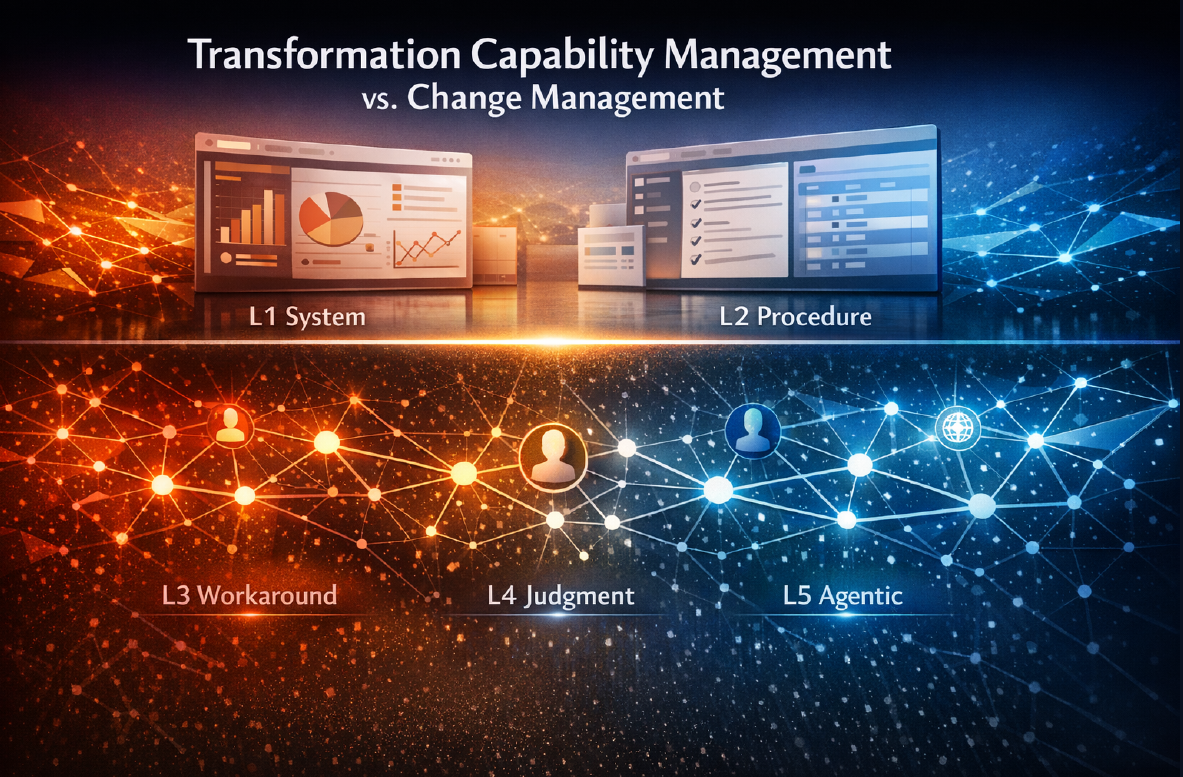
Traditional ERP change practice is usually strongest at the system and procedure levels. The harder delivery constraints often sit lower down, in workarounds, judgment, and orchestration.
The breakdown is as follows:
- L1 System: configuration, roles, transactions, tools
- L2 Procedure: process steps, controls, SOP-level design
- L3 Workaround: the informal work people do to keep delivery moving
- L4 Judgment: decision logic, escalation patterns, exception handling
- L5 Agentic: orchestration potential, AI-assisted coordination, adaptive execution.
Change management impact is mapped mainly across L1 and L2, and communications and training are designed around that scope. That work matters, but it is also incomplete.
The bigger constraint on adoption often sits in L3 to L5. People fall back to old habits when the unofficial fixes they rely on are still easier than the new process. Decisions stall because judgment is concentrated in a handful of overloaded leaders. New automation or AI capability fails to land because orchestration logic is missing.
That is why a program can look well designed on paper while still remaining fragile in execution. TCM is different because it explicitly governs all five layers, not only the top two.
Change Management Remains Necessary
In well-run ERP programs, change management does critical work. It drives sponsor alignment, stakeholder mapping, communication and engagement design, role-based training, and readiness support.
ERP delivery frameworks have long acknowledged organizational change management (OCM) as a real workstream. Change management research from advisory firm Prosci shows a strong correlation between effective OCM and better project outcomes. That is not in dispute. What is in dispute is whether strong OCM, by itself, can carry programs where capability constraints below L2 remain unmanaged.
This is not a “change management is dead” argument.
ERP transformations now run inside a higher-volatility environment marked by tighter timelines, AI pressure, skills constraints, and cost scrutiny. In that environment, adoption excellence cannot compensate for poor transformation architecture. A program can have strong communications, disciplined training, and visible executive sponsorship and still make bad structural decisions.
Where ERP Transformation Actually Gets Stuck
Most ERP leaders will recognize this sequence:
- Fit-to-standard workshops establish a baseline.
- Business process conversations begin cleanly.
- Exceptions and local realities start to surface.
- Scope and design decisions become political, not technical.
- Delivery keeps moving, but confidence starts dropping.
Sponsor Industry‑Grade Research
To put this in context, research suggests SAP ECC-to-S/4HANA migration costs typically land in the tens of millions of dollars for large enterprises, with the largest multi-landscape global programs running substantially higher depending on scope, customization, and deployment model. Plus, many SAP S/4HANA programs take roughly 40 to 60 weeks in cloud deployment scenarios, while large global migrations can stretch to 18 months or more; recent SAPinsider benchmark coverage also shows that although 55% of organizations have started the move, only 34% say they have fully completed it.
Those numbers are not evidence of weak change management, but they point to a program architected around the top two layers. On paper, the program still has momentum. But with value and risk sitting in L3 to L5, three constraints are pulling in different directions:
- Capital drift. Investment starts following urgency rather than value evidence. Work gets funded because it is loud, not because it drives measurable business outcomes.
- Capability drift. Critical knowledge and decision logic accumulate outside the client organization in partner teams, temporary structures, and consultant playbooks that were never designed to transfer. The system may go live, but ownership is still rented.
- Capacity drift. The same leaders are expected to keep business as usual while absorbing process redesign, data cleanup, governance redesign, and new role accountability at full speed. Dashboards often describe this as resistance. On the ground, it is often a bandwidth problem.
None of the above gets solved by another wave of communication. It requires a different operating layer.
Why This Matters More Now
In March 2026, SAP CEO Christian Klein said it “would be foolish to still charge subscription base, because AI is so powerful that it will automate a lot of tasks.” Reports on the Bloomberg interview also said SAP will create forward-deployed engineering teams from July, bringing consultants and developers closer to customers to build tailored AI applications.
That changes the delivery equation. When the vendor moves closer to the client, the key question goes from being just who governs the project to whether the transformation is building lasting capability inside the organization or increasing dependence on outside parties.
At the same time, the implementation market is under pressure. IBM’s Q4 2025 results showed consulting revenue up 3% and up 1% at constant currency for the quarter. Accenture faced similar pressure in March 2026, when two broker downgrades followed its Q2 FY26 earnings even as the company pointed to $22.1 billion in total new bookings in Q2 FY26 and $5.9 billion in generative AI bookings for full-year FY25.
The broader structural point is this: Delivery economics are shifting. Vendors and partners are using AI to compress their own cost base. Customers need clearer discipline for deciding which capabilities they are building internally and which they are only renting temporarily.
Change management does not answer that question. TCM does, as it introduces a governance discipline for the above three constraints. It asks leadership teams to make trade-offs explicit, measurable, and time-bound before they become late-stage delivery surprises.
In practice, that means funding work based on business value rather than milestone completion, deciding which capabilities the organization must own versus rely on partners for, and testing whether leaders and teams have the bandwidth to execute the plan.
In ERP language, TCM helps protect Clean Core ambitions from dirty delivery dynamics, for example. Clean Core cannot stay commercially clean if L3 and L4 work remains unarticulated and unmanaged. The point is not to create more governance paperwork, but to stop hidden constraints from becoming visible when rework is at its most expensive.
A Quick Field Test
As a practical test, ERP leaders can run these checks at the next steering meeting:
TCM Check
- Is this quarter’s spend clearly tied to business value, not only milestone completion?
- Are the five capabilities that must be internalized within 12 months of go-live clearly defined?
- Do the people responsible for those decisions have realistic capacity to execute?
If the answer is no to any of the above, you have a transformation capability gap, not just a change gap.
Change Management Check
- Are impacted groups clear on what is changing?
- Are managers equipped to reinforce behavior?
- Is adoption support and training fit for role?
These two sets of questions operate at different levels. The TCM set tests whether the program is structurally viable. The change management set tests whether the organization is ready to adopt the outcome.
This distinction predicts outcomes. A program can optimize adoption and still drift into expensive, partner-dependent, low-confidence execution. A program that governs transformation capability and adoption together improves its odds of faster decision cycles, lower late-stage rework, stronger post-go-live ownership, and more credible value realization.
TCM is necessary, and so is change management. They solve different layers of the same problem. Change management helps people move, while TCM helps the organization become better at moving.
For active programs, the practical question is not which discipline to use. It is where adoption activity is compensating for unresolved structural constraints, and which of those constraints involve capability the organization has not yet chosen to own. Answer that honestly, and the next quarter will likely look very different.
Editor’s Note: What This Means for ERP Insiders
Program failure often starts upstream of adoption. Many ERP programs still treat change management as the default answer for problems that begin in funding logic, capability ownership, or execution capacity. That leaves leadership reacting to visible adoption symptoms later in delivery while the structural causes remain unmanaged.
Capability ownership is a harder commercial question in ERP delivery. As vendors move closer to customers and implementation economics tighten, the issue is no longer just whether a program successfully goes live. The more consequential question is whether the organization will exit the program with stronger internal capability or deeper dependence on partners, temporary structures, and rented expertise.
ERP governance has to account for execution reality, not just delivery status. The TCM lens pushes leadership to test spend against business value, define which capabilities must be internalized, and assess whether decision-makers have the bandwidth to execute. For ERP leaders, that raises the standard for steering committees and project management teams by shifting attention from milestone progress alone to the operating conditions that determine whether transformation will hold after go-live.