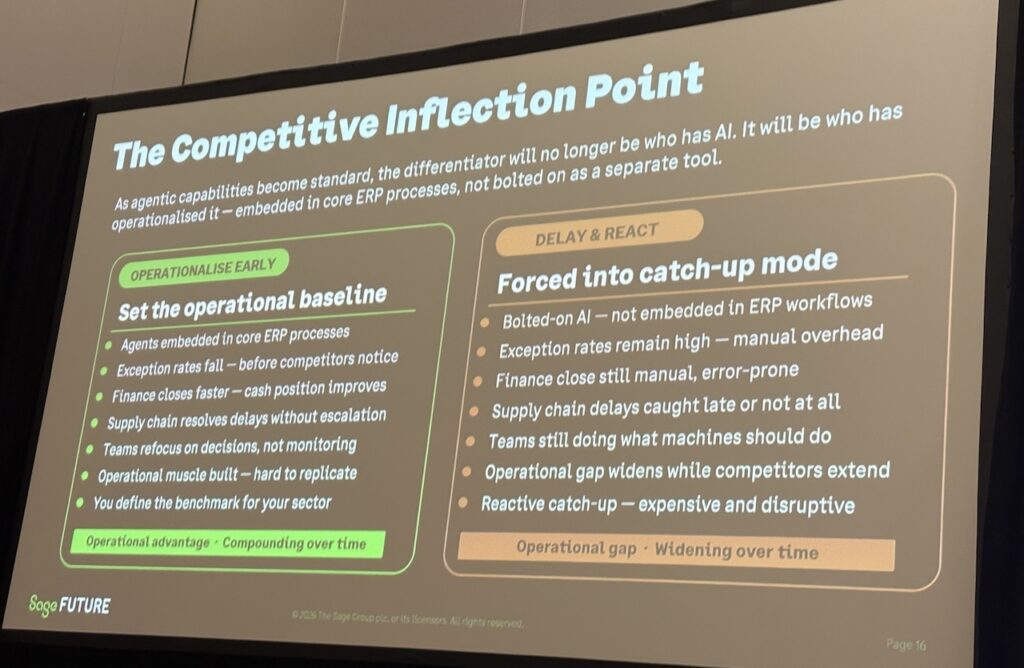

Sage Intacct’s connected finance push now has a harder follow-up question: How much access should AI get to the finance system?
ERP Today covered Sage’s move to connect planning, expense management, receivables, cash flow, and industry workflows inside Sage Intacct. The next layer is less about adding more finance functions and more about governing the data and controls that AI will need to operate across them.
That is where Sage Intacct 2026 R2 becomes more interesting than a standard release update. The release brings AI Gateway into the Intacct architecture, adds intelligent 3-way matching in AP Automation, and continues Sage’s push into construction and distribution workflows. Together, those moves show how mid-market finance AI is moving from embedded assistance toward controlled access to live ERP data.
For CFOs, that shift cuts both ways. AI can reduce manual reconciliation, surface exceptions faster, and support more responsive finance operations. It can also create new exposure if data access, permissions, audit trails, and workflow boundaries are not designed before automation expands.
AI Gateway Moves the Control Point
Sage Intacct AI Gateway is the clearest signal in the release because it changes where finance AI is allowed to connect.
Sage describes AI Gateway as a secure, standardized bridge between Sage Intacct financial data and AI applications, giving customers and partners access through REST APIs and the Sage Intacct Model Context Protocol (MCP) server. The MCP server is designed for AI interactions and read-only access, while REST APIs provide broader access under the roles and permissions defined in Intacct.
That distinction matters for finance teams. AI assistants and external applications need context to be useful, but finance data is not a general knowledge base. It includes bank activity, vendor records, customer balances, invoices, approvals, dimensions, project costs, payroll, and close data. Access to that information has to respect the same permissions and control logic that govern users inside the ERP system.
AI Gateway gives Sage a way to support external AI workflows without treating Intacct data as an unmanaged export. The architecture lets customers build AI processes around their own finance data while keeping access tied to defined roles, permissions, and governance. For a mid-market customer base that may not have large internal AI engineering or security teams, that control layer becomes central to adoption.
The risk sits in implementation discipline. A gateway can standardize access, but it does not decide which AI workflows should exist, which users should approve them, or which actions should remain read-only. CFOs and CIOs will need governance models that define where AI can query, where it can recommend, and where it can trigger action.
Sponsor Industry‑Grade Research
3-Way Matching Shows Practical AI Use Case
Sage says intelligent 3-way matching in AP Automation uses AI-driven automation to link invoices, purchase orders, and receipts, compare prices, quantities, and totals, and flag line-level discrepancies before payment. That is the right kind of finance AI use case: narrow, control-heavy, measurable, and tied to a process where errors have a direct cost.
Three-way matching has always been a core finance control. It helps prevent overpayment, duplicate payment, procurement leakage, and fraud by checking that what was ordered, received, and invoiced actually aligns. In practice, matching often breaks down because exceptions are messy. AP teams spend time chasing missing receipts, correcting invoice lines, interpreting tolerances, or manually resolving discrepancies that systems cannot handle cleanly.
AI can help by reducing the manual work around those exceptions, but the control cannot disappear. The value comes from better triage, faster discrepancy detection, and clearer routing for review before payment. Finance teams still need threshold rules, approval paths, segregation of duties, and audit evidence.
That makes 3-way matching a useful test case for finance AI more broadly. The goal is not autonomous payment approval. The goal is more reliable exception handling that preserves oversight while reducing the time AP teams spend matching documents line by line.
Get Our Free Weekly Newsletter
Construction Raises Stakes for Finance Controls
Construction finance is difficult because labor, payroll, job costing, procurement, retainage, project billing, compliance, and field activity are deeply connected. Sage HCM for Construction, which Sage says is generally available in the US and Canada, is designed to connect HR, payroll, and workforce data with financial management while supporting requirements such as union rules, certified payroll, and prevailing wage compliance.
That connection is important because labor data drives project economics. If time, payroll, job costing, and financial reporting sit in different systems, project leaders may not see margin pressure until it is too late. Finance teams also face higher risk when payroll compliance, subcontractor costs, procurement activity, and billing schedules are managed through disconnected workflows.
AI does not make those controls simpler. It makes the data model more important. A payroll agent, an AP matching workflow, or a finance assistant can only be trusted if the underlying roles, project structures, cost codes, approval paths, and compliance rules are reliable.
Distribution has a similar control problem around purchasing, fulfillment, tax, inventory, and supplier activity. The more Sage Intacct moves into operational finance, the more customers will need to align AI governance with the workflows that sit closest to margin, cash, and compliance.
Buyer Question Is Readiness
Sage’s R2 release gives CFOs more than a checklist of new features. It gives them a preview of the AI governance questions that will shape finance modernization.
Customers evaluating Sage Intacct should ask how AI Gateway access will be approved, monitored, and audited. They should know which workflows use MCP read-only access and which require REST API access with broader permissions. They should understand how intelligent matching handles tolerances, exceptions, overrides, and audit evidence.
Construction and distribution customers should go further. They need to validate how AP Automation, HCM, project costing, purchasing, inventory, and reporting fit together in real deployments, not just in product positioning. Partner expertise will matter because the control model has to reflect industry-specific processes before AI is layered on top.
Finance AI will not scale on feature adoption alone. It will scale when CFOs trust that automation can work inside the same control environment that protects the close, cash, procurement, payroll, and project margin.
What This Means for ERP Insiders
Finance AI needs governed access before it can deliver trusted automation. Sage Intacct AI Gateway shows how ERP vendors are moving from embedded AI features toward controlled connectivity between financial data and external AI workflows. CFOs and CIOs should define access rights, approval ownership, monitoring, and audit requirements before allowing AI applications to query or act on ERP data.
AP automation will become a proving ground for practical finance AI. Intelligent 3-way matching gives Sage Intacct a focused use case where AI can reduce manual work while preserving review before payment. Finance leaders should prioritize AI projects that improve exception handling, reconciliation speed, and fraud controls before expanding into higher-risk autonomous actions.
Industry workflows will raise the bar for AI governance. Construction and distribution expose how quickly finance AI touches labor, job costing, procurement, inventory, tax, compliance, and project margin. ERP buyers should test whether vendor and partner controls match their industry workflows before scaling AI across operational finance.