The ERP system’s fundamental role is changing. For decades, enterprise resource planning platforms have functioned as sophisticated record-keepers, capturing transactions, surfacing exceptions after the fact and waiting to be asked. Sage is arguing the next phase of ERP intelligence replaces the passive model with one that monitors operations, detects problems before they escalate and acts within defined boundaries without waiting for human instruction.
Gareth Guest, Director Staff Architect at Sage, laid out that vision at Sage Future 2026 in San Francisco, framing the shift as the culmination of five years of platform investment across Sage’s six ERP products and a single intelligence layer shared across all of them.
“The question isn’t whether AI is ready,” Guest said. “It’s whether your ERP is.”
From Recording To Reasoning: The Four-Stage AI Capability Arc
Guest outlined a four-stage progression that defines where ERP intelligence has been and where it is heading for technology executives evaluating their platform’s current position.
The first two stages describe the ERP systems most enterprises still rely on. Stage one records and captures transactions and events such as ledger entries, stock movements, order confirmations, receipts and production events.
Stage two reports and summarizes what happened in the past through period-end reports, dashboard snapshots, variance analysis and manual queries. Both stages are passive by design: the system responds only when asked, and exceptions surface after the damage is done.
Stage three marks the inflection point. At this level, AI reasons and evaluates context, options and risk in real time, providing explained recommendations that include cross-domain analysis, risk pattern detection and multi-variable reasoning.
Stage four completes the arc. The agent acts as a bounded, auditable unit, handling autonomous routine tasks with full context, escalating only what requires human judgment and maintaining a complete audit trail throughout.
For technology executives, the practical distinction is significant. A stage-two ERP delivers a month-end report showing a production order ran 10% over labor budget. A stage-four agentic ERP detects the signal mid-shift, cross-checks production schedule impact and surfaces a revised plan before the shift starts.
Analysis
What This Means for ERP Insiders
Passive ERP architecture is now a competitive liability. As agentic platforms demonstrate measurable gap between reactive and proactive operations, vendors and SIs still building on stage-two reporting architectures face accelerating displacement pressure from product-centric buyers.
Three Forces Making Agentic ERP Viable Now
Guest identified three specific structural changes that have made agentic ERP operationally viable in 2026, none of which existed at meaningful scale two years ago.
- Inference cost. The cost of running AI reasoning fell 100x over 24 months, crossing the threshold where production-grade, continuous monitoring across ERP workloads became economically feasible.
- Context window scale. Large language model context windows expanded to the point where an entire ERP schema now fits within a single context, allowing agents to reason across the full data model without summarization loss or fragmented understanding.
- The emergence of model context protocol (MCP) as a universal standard. MCP replaces the fragmented approach of building bespoke integrations for each agent and each product with a single interface through which any AI agent can operate any ERP system.
Sage adopted MCP across its full product portfolio, meaning partners building agents on one Sage product gain access to capabilities and governance controls across the entire platform without rebuilding integrations from scratch.
“The bottleneck isn’t your team. It’s the system,” Guest said. “Traditional ERP has changed and evolved into something more autonomous and agentic.”
Guest noted Sage’s AP invoice agent represents the near-term benchmark for what agentic processing delivers. Eighty percent of invoices processed end-to-end automatically with no human intervention, leaving the remaining 20% for accounts payable teams to handle as exceptions.
Analysis
What This Means for ERP Insiders
MCP adoption is becoming the decisive ERP platform integration standard. Vendors that commit to MCP across full product portfolios eliminate the integration tax that has historically slowed agent deployment, creating a structural speed advantage for partners building AI-enabled solutions.
What Agentic Operations Actually Prevents in the Real World
For manufacturing, distribution and finance leaders, Guest translated the architectural framework into specific operational outcomes that technology executives can use to evaluate readiness and build the business case.
In manufacturing, agentic ERP prevents production delays by monitoring supplier lead times overnight, detecting component shortfalls before shift start and recommending revised production schedules before the team arrives. The shift from reactive problem-solving to proactive planning is the measurable outcome.
In distribution, inventory drops below safety levels are identified in real time. Affected open orders are flagged immediately, alternative options are surfaced and customer impact is assessed with resolution paths included, all before a customer service team receives a complaint.
In finance, period close is accelerated by agents that monitor posting completeness mid-month, flag missing accruals before they are overdue and detect inter-company gaps while draft entries are still actionable.
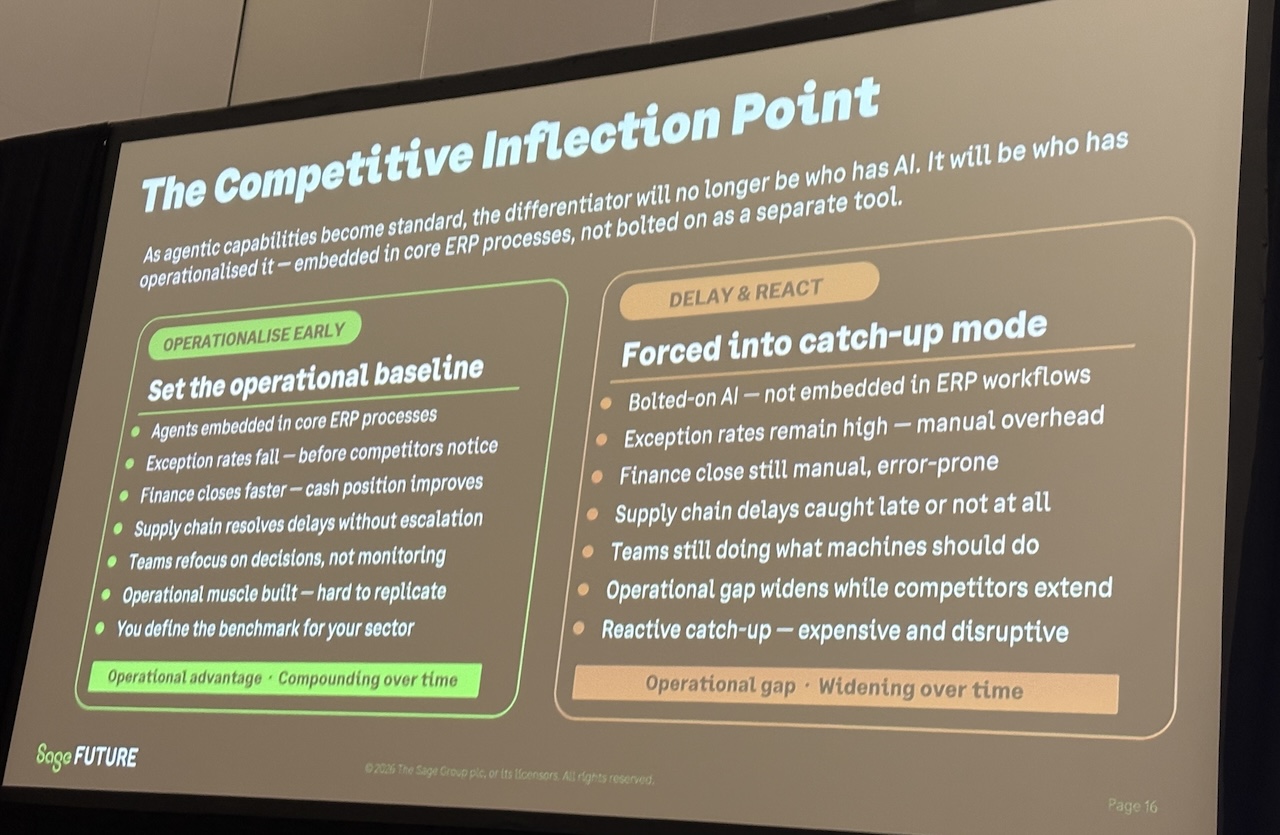
Guest framed the competitive imperative: As agentic capabilities become standard, the differentiator will no longer be which vendor has AI. It will be which organizations have operationalized it by embedding it inside core ERP processes rather than treating it as a bolt-on tool.
“We’re not in a catch-up mode,” Guest said. “We’re building this at the same speed as the rest of the industry. We’ve spent the last five years building the structure and now it’s come to pay dividends.”
Analysis
What This Means for ERP Insiders
Agentic ERP evaluation must prioritize audit architecture alongside automation. Technology executives should require vendors to demonstrate bounded execution controls, complete action logging and human-in-the-loop escalation paths before committing to agentic deployment at scale.