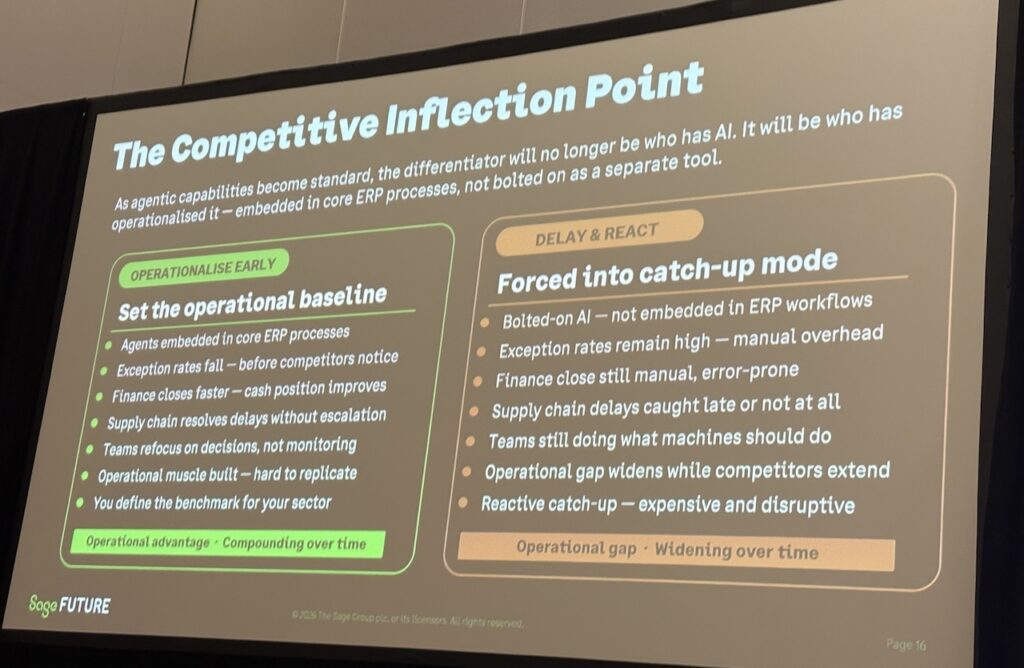
Manufacturers operating on razor-thin margins have accepted the painful reality that by the time labor cost variances surface, the order has shipped, the customer has been billed and the margin is gone.
Sage is positioning their Sage HCM as the platform to change that, which was described in the presentation “The Workforce Engine Behind Profitable Production: Sage HCM for Product-centric Businesses” at Sage Future 2026 in San Francisco.
By bringing HR, payroll, time tracking and financial data onto a single system, it gives operations, HR and finance teams a shared, real-time view of labor costs.
“It’s not HR versus finance,” says Brett Schklar, Fractional CMO at Sage. “It’s two systems keeping them apart. The margin lives in the gap.”
Analysis
What This Means for ERP Insiders
Labor cost visibility is becoming a core ERP competitive differentiator. Sage HCM’s real-time integration with Intacct financials signals that mid-market ERP platforms must treat workforce data as live financial intelligence, not a period-end reconciliation artifact.
Disconnected Systems are Destroying Manufacturing Margins
The core problem Sage HCM addresses is not a technology gap so much as a data flow failure rooted in organizational silos.
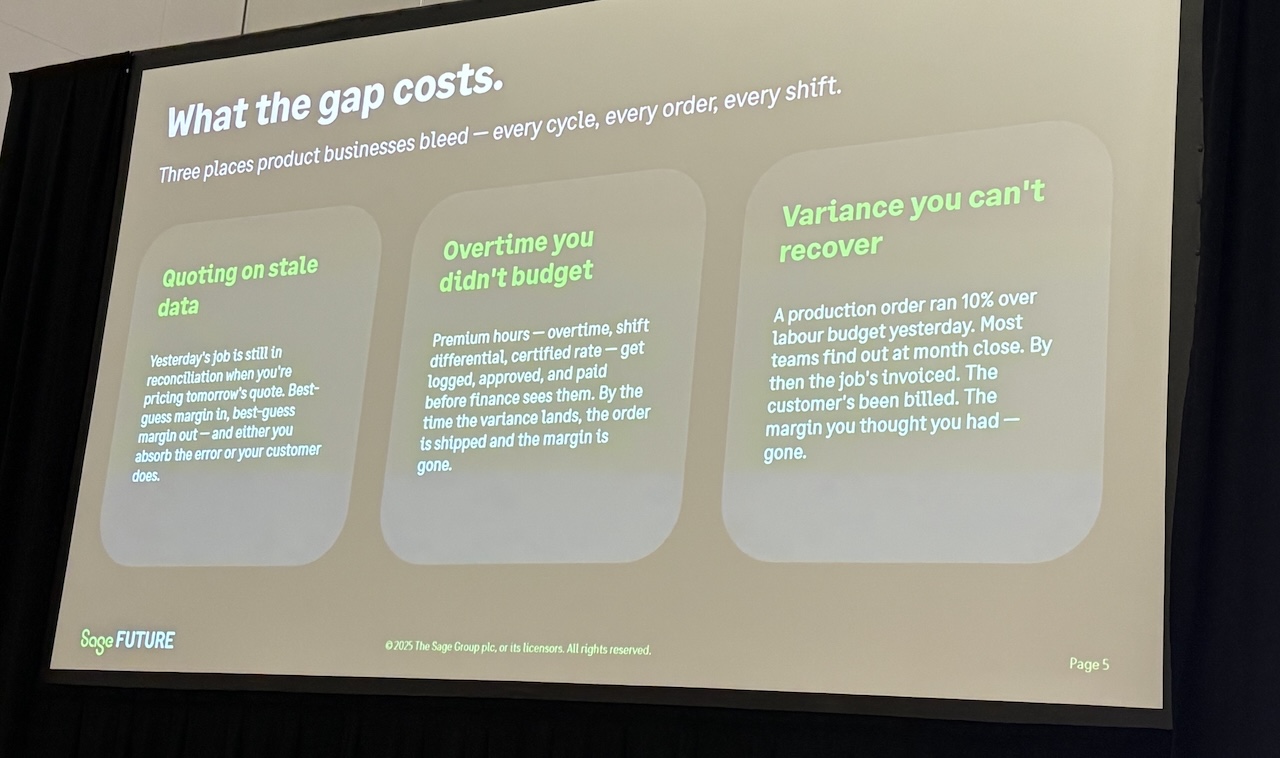
Dan Dalton, Director of Product Management at Sage, identified three specific points where product businesses lose margin on every production cycle.
- Quoting on stale data. Yesterday’s job is still in reconciliation when teams are pricing tomorrow’s order, forcing best-guess margins in both directions.
- Unbudgeted overtime. Premium hours, shift differentials and certified rates are logged and paid before finance ever sees them, so the variance arrives after the order ships.
- Unrecoverable labor variance. When a production order runs 10% over its labor budget, most teams find out at month’s close after the job has been invoiced and the margin has already been lost.
“The margin lives in the gap,” Schklar says. “The different divisions are talking out loud to one another. Margins no longer exist.”

Research cited by Sage reinforces the scale of the problem: 74% of organizations identify improving workforce data for decision making as a critical priority, yet most still lack unified systems to support that goal.
Analysis
What This Means for ERP Insiders
Disconnected HR and payroll systems are a margin risk. Manufacturers bleeding margin at every shift and order cycle will accelerate HCM consolidation, creating urgent opportunity for ERP vendors and SIs offering unified labor-to-ledger workflows.
Real-Time Labor Visibility Changes How Decisions Get Made
For technology and operations executives, Sage HCM’s practical value is the shift from after-the-fact reporting to in-the-moment decision support across the production floor.
Stephen Tompkins, Product Manager at Sage, demonstrated the platform’s mobile and self-service capabilities during the session. Managers can see in real time who is working, how long they have been on task and when overtime thresholds are approaching, with automated alerts before premium labor costs are incurred.
Certification tracking is built in with expiration notices sent to the employee, manager and compliance officer simultaneously. Time and attendance data flows directly into Sage Intacct, so labor costs by project, pay type and department are visible in financials without a separate export or reconciliation step.
That integration is the structural shift Sage HCM offers manufacturers. Labor cost is no longer a lagging indicator reconciled at period close. Instead, it becomes a live variable that project managers, operations leaders and finance teams can act on within the same shift.
Evaluating HCM Platforms For Manufacturing Environments
For technology executives assessing HCM platforms in manufacturing or construction contexts, the selection criteria must go beyond standard payroll functionality.
Integration depth with existing ERP or project financial systems is the first requirement. Platforms that require manual data exchange between HR and finance reproduce the disconnection problem Sage HCM is designed to eliminate.
Multi-entity and multi-jurisdiction payroll support matters for manufacturers managing multiple plants or operating across state or national lines. Mobile-first time tracking and self-service capabilities reduce both the administrative burden on managers and the latency between hours worked and financial recognition.
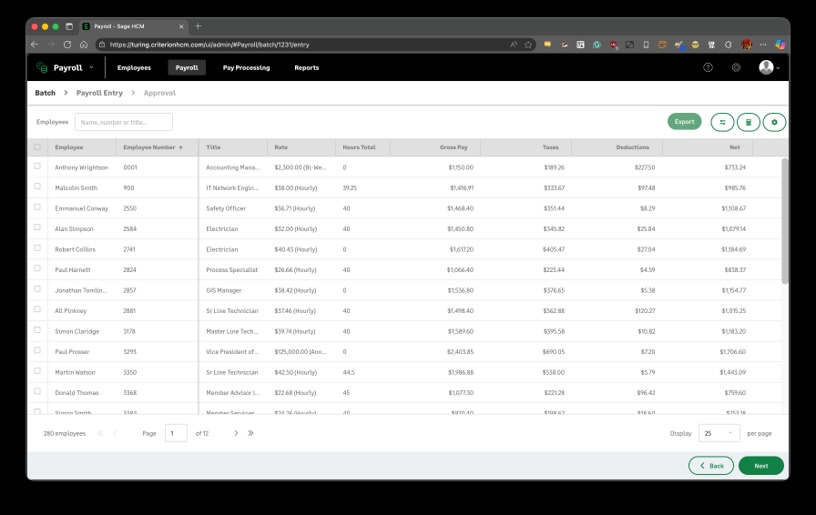
Sage’s AI-powered HCM Agent adds a governance layer to routine payroll workflows, assisting with preparation, validation and compliance checks while preserving human oversight of final approvals.
For manufacturers, where a single miscoded certification or missed overtime rule can trigger a compliance finding or erode a project margin, that assisted validation changes the risk profile of payroll processing in a meaningful way.
Analysis
What This Means for ERP Insiders
AI-assisted payroll validation raises the governance standard. Platforms that cannot deliver auditable, explainable AI in high-stakes payroll workflows will face displacement as manufacturing buyers prioritize compliance control over feature breadth.