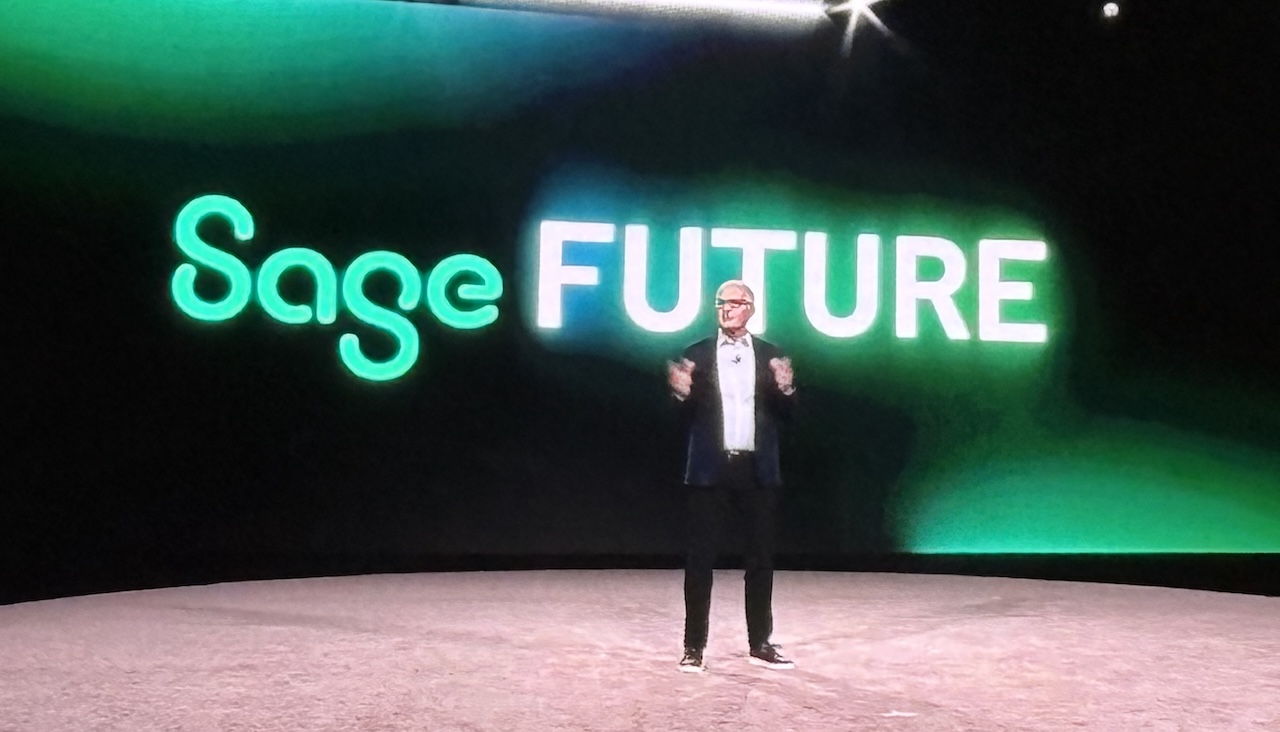
Sage Future 2026 opened in San Francisco with a clear thesis for finance and technology leaders High performance will come from AI embedded in ERP workflows, governed transparently and paired with nonnegotiable human accountability. Across keynotes and sessions, Sage executives, AWS leadership and New York Yankees CFO Scott Krug sketched a model where finance teams use agentic AI to accelerate decisions while keeping judgment and control firmly in human hands.
High Performance Finance Built On Trust, Control
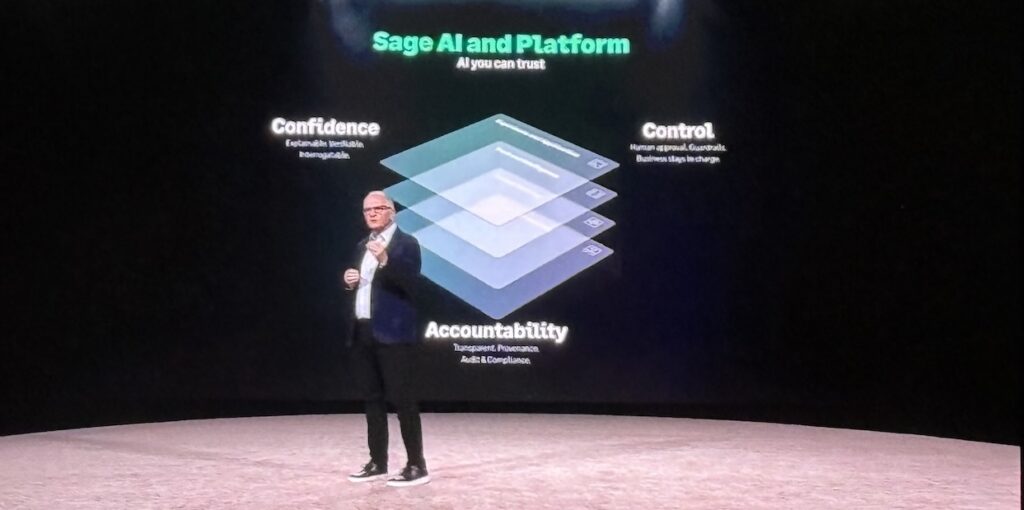
Sage CEO Steve Hare used the conference’s San Francisco setting to compare today’s AI rush to the city’s gold rush era, arguing that lasting value will come from those who build trusted infrastructure rather than chase hype. In finance, he noted, “nearly right is wrong,” making accuracy, auditability and explainability mandatory for any AI that touches system of record data or closes the books.
Sage is responding with what it calls “glass box AI,” combining a domain specific accounting and compliance LLM with proprietary data and embedding agents inside products like Sage Intacct rather than running AI as an external add on. Every recommendation is designed to be traceable, with clear logic and adherence to existing permissions so controllers and CFOs can interrogate outputs instead of trusting opaque models.
Hare stressed that finance judgment and accountability cannot be outsourced. “There’s huge potential in AI,” he says, “but there’s also huge accountability and responsibility. If anything, it becomes more important. They’re the ones building trusted systems capable of operating in the real world.”
For finance executives, that combination changes daily work patterns. Transaction level tasks such as reconciliations, exception checks and policy enforcement are increasingly handled by agents, while leadership attention shifts to scenario evaluation, policy tuning and cross functional alignment.
Analysis
What This Means for ERP Insiders
Finance leaders will orchestrate to AI. Sage Future shows CFOs using glass box agents and cloud ERP to reassign manual work to machines while elevating human judgment, risk decisions and cross functional leadership.
Partnerships Show AI In Production
To show AI moving beyond demos, Sage highlighted customers already using embedded AI to improve performance. At Byler Holdings, finance leader Rebecca Miller reports that AI infused workflows in Sage systems changed core processes, improved accuracy and freed more than 100 hours per month that had been spent on manual checks and adjustments. That time is now redirected toward analysis, planning and business partnering.
Hare also invoked the LPGA as a metaphor for modern finance, noting golfers can analyze every swing in great detail and learn more about their game than ever before.
“The data is extraordinary,” Hare says. “However, it doesn’t take a shot and definitely doesn’t sign the scorecard. Tools can get better, but the performance still belongs to the leader who uses them.”
For CIOs and enterprise architects, that partnership signals tighter integration between Sage workloads and AWS infrastructure and AI technology, including shared governance, logging and performance optimization for AI heavy finance applications. It also highlights an evaluation benchmark: ERP platforms that can pair domain specific AI with hyperscale infrastructure will be better positioned to support large scale, regulated finance operations.
Analysis
What This Means for ERP Insiders
Platform, infrastructure alliances will shape AI scale. The deepening Sage AWS collaboration signals that ERP vendors paired with hyperscale AI infrastructure will set the pace on performance, governance and innovation in finance workloads.
Yankees CFO Illustrates The New Finance Operating Model
Scott Krug, senior vice president and CFO of the New York Yankees, brought a practical lens to the keynote by charting the club’s finance evolution. In 2004 there was effectively no FP&A and little historical information in systems, which limited the organization’s ability to evaluate major initiatives such as a new stadium.
“Most significant transactions end up on the back page of the newspaper, on ESPN and more,” Krug says. “Our actions are reported to the public.”
Over two decades, the Yankees shifted to a forward looking finance model with budgets expanding from a single page to dozens of pages that now mirror the detail available to Fortune 500 executives. Adopting Sage Intacct in 2023 gave department heads and budget managers direct access to financial data, enabling continuous budget updates and real time visibility into spending against objectives.
Krug described his role as balancing financial discipline with business ambition, which he supports by understanding each department’s language and goals rather than acting as a reflexive “no.” With modern tools in place, that approach translates into more frequent, data driven conversations where leaders share accountability for trade-offs, supported by timely information rather than quarterly surprises.
Krug said the priority is to use tools that are safe and process enhancing so staff can spend more time on performance and judgment instead of data entry. He defined true efficiency as “what we can do because we used the tool,” capturing Sage Future’s broader message that the value of AI and ERP modernization lies in capacity to make better decisions, not in the technology itself.
For technology executives, the Yankees example underscores several best practices. System choices should prioritize self service transparency for line managers, continuous planning capabilities and tight integration between operational and financial data so high profile decisions, such as player transactions, can be evaluated in real time with full financial context. It also highlights the need for change ready cultures, where curiosity and flexibility are rewarded because “set it and forget it” is no longer viable in modern sports or finance organizations.
Analysis
What This Means for ERP Insiders
Outcome-centric metrics will define next-gen ERP success. Case studies like Byler Holdings and the Yankees indicate that AI and ERP investments will be judged on hours saved, decision quality and agility, not on generic automation claims.