Sage Future 2026 in San Francisco delivered a consistent message throughout the sessions, keynotes and booth visits: Artificial intelligence (AI) in ERP software is no longer a capability debate. The debate is focused on trust and transparency. The organization that operationalize it with discipline will outpace companies still treating AI as a feature than something to govern.
The three-day event brought Sage executives, customers, technology partners and analysts to examine how AI is delivering success in industries such as finance, manufacturing, non-profits, healthcare and construction, among others.
Regardless of whether it was a presentation, keynote or booth visit, the event’s central argument touched on the same topic: High-performance finance and operations run on trusted AI that’s embedded in ERP workflows and is accountable and transparent at every step.
Glass Box AI Becomes the Standard for Finance Leaders
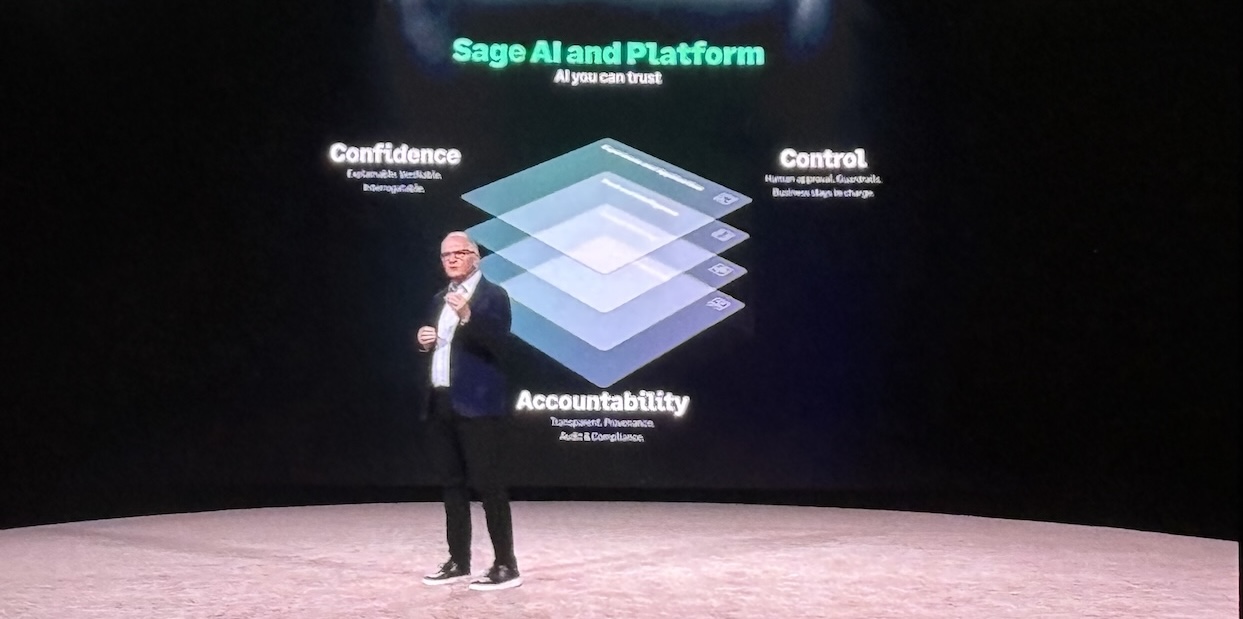
The most repeated phrase at Sage Future 2026 was “glass box,” which is the principle that every AI output in a financial workflow must be traceable, explainable and auditable by the people accountable for the numbers.
Sage CTO Aaron Harris framed the technical case, saying. “You won’t use AI if you don’t trust it,” noting that Sage AI Labs processed 40 million predictions in 2025 and has scaled to 400 million in 2026.
To manage that volume with financial-grade reliability, Sage built an “arbiter” layer into its platform architecture, sitting between the user and the AI to detect hallucinated content, prompt injection and toxic outputs before they reach financial workflows.
The arbiter also translates the specific linguistic context of finance, where the same word can have different meanings depending on whether it appears in a payables workflow or a revenue recognition schedule.
IDC analyst Kevin Permenter reinforced why explainability is not optional in a session that examined the gap between AI adoption intent and actual deployment confidence. “If I can’t figure out why it did what it did, then it’s not functional,” Permenter said. “It’s a paperweight.” He noted how trust, in his framing, “equals revenue,” and that platforms applying transparency as a surface-layer control rather than a core architectural principle will not survive the audit cycle.
Byler Holdings provided the clearest customer validation of what glass box AI delivers in practice. After deploying AI-infused workflows through Sage systems, finance leader Rebecca Miller reported the organization redirected more than 100 hours per month previously spent on manual checks and adjustments toward analysis, planning and business partnering. That shift from reconciliation to judgment work is the operational model Sage Future held up as the target state for finance teams in 2026 and beyond.
Analysis
What This Means for ERP Insiders
Glass box AI architecture is now the baseline evaluation criterion for enterprise ERP platforms. Vendors unable to demonstrate explainability embedded at the platform core, not applied as a surface layer, will face accelerating displacement as finance accountability standards tighten.
Partner Ecosystem Extends AI Transparency Across Workflows
The partner showcase at Sage Future 2026 demonstrated how the glass box principle extends beyond Sage’s own platform into the adjacent workflows that finance and operations teams use daily.
Ryan Donato, who handles Expensify’s strategic accounts and partnerships, described a hybrid contextual AI expense agent that creates an explainable trail through every transaction. “With the AI, it’s almost having like a conversation. Was that a travel meal? And it’s done in real-time fashion and it learns how I work,” Donato said. Expensify has been building its own AI model since 2016 and now uses the OpenAI enterprise model alongside it.
He said the biggest product shift came when customer feedback pushed the platform from traditional expense reporting toward a chat-focused interface that creates faster expense reports and closes accounts in a workflow that mirrors natural conversation rather than a form-filling exercise. Donato added
Rohit Kanwara, head of revenue for Zap Analytics, described the same transparency imperative applied to machine productivity data.
“We produce data models and sources where information comes from so people can see where the data exists,” Kanwara said, framing end-to-end process visibility as the prerequisite for any AI-assisted operational decision.
Cody Paranto, VP of sales for Routable, addressed the fraud dimension of AI trust, which he identified as the most underappreciated risk in high-volume payment workflows. “Fraud is more sophisticated than ever,” he said, noting that identity verification in mass payments is where the accountability question becomes immediate and financial.
Nate Curtis, senior manager of existing business sales for Avalara, drew the line between autonomous AI action and human confirmation:
“Agentic AI has taken big steps and is making decisions. We still want humans to confirm the work,” he said. That framing aligned with Sage’s own platform design where agents act within bounded, auditable parameters and escalate to human judgment at defined thresholds.
Nick Arkyns, an account executive for PairSoft, connected the transparency argument to the accounts payable workflows that remain among the most labor-intensive in finance. “We have an AI solution designed to decrease manual data entry using Sage Intacct,” he said, noting deployments across not-for-profit, healthcare and manufacturing environments where accuracy and audit readiness are non-negotiable.
Analysis
What This Means for ERP Insiders
Partner ecosystems must align on audit-first AI design to remain competitive. Sage Future’s partner showcase shows that ISVs building on ERP platforms must now match the governance, traceability and bounded execution standards set by the core platform to win regulated enterprise accounts.
Agentic ERP Changes Daily Operations From Manufacturing to Construction
The operational case for agentic ERP moved well beyond finance at Sage Future 2026, with sessions showing how AI-driven ERP architecture is changing daily work patterns on the production floor, in distribution centers and across construction job sites.
Sage staff architect director Gareth Guest described the four-stage arc of ERP intelligence and identified the inflection point where passive systems that record and report become active systems that reason and act. “The question isn’t whether AI is ready,” he said. “It’s whether your ERP is.”
His supply chain example was specific where an agentic ERP detects a component shortfall overnight, cross-checks production schedule impact and surfaces a revised plan before the shift starts, converting a morning crisis into a pre-shift planning adjustment. That shift from reactive to proactive is measurable in labor hours, on-time delivery rates and the cost of expedited material sourcing.
In food and beverage manufacturing, Sage X3 customers Yakima Chief Hops and Enzymedica demonstrated outcomes that technology executives can use as benchmarks. Enzymedica reduced mock recall response time from two hours to under 10 minutes after deepening its use of X3’s traceability capabilities, a 92% reduction in compliance response time that also reflects how integrated ERP data changes the risk profile of regulatory audits. Yakima Chief Hops reported zero major or minor non-conformances in five years of production audits, with lot-level traceability through X3 as the primary contributing factor.
Lumber co-founder Lou Perez described how the company brought the agentic argument to construction workforce management. “We automate compliance for construction companies,” he said, describing a platform that integrates directly with ERP systems to give field workers a digital credential wallet for certifications and licenses. The integration addresses the labor shortage challenge from a compliance angle. Their system reduces onboarding friction and credential management is automated. This allows field workers to be tracked in real time through a system that Perez said the construction industry has responded to as a significant operational improvement.
Scott Krug’s keynote address gave technology executives a long-cycle perspective on what the Sage Future vision looks like when fully realized. The Yankees’ finance transformation from a near-absent FP&A function in 2004 to a real-time, self-service financial model built on Sage Intacct illustrates that the outcomes Sage Future described are not theoretical.
Krug defined efficiency as “what we can do because we used the tool.” This formulation circles back to the event’s core message of AI and ERP’s modern value tied to the decisions it enables.
Analysis
What This Means for ERP Insiders
Agentic ERP adoption will be measured in operational prevention. Sage Future’s manufacturing and construction examples signal that ERP transformation success metrics are shifting from go-live milestones to measurable reductions in exceptions, delays and compliance incidents.