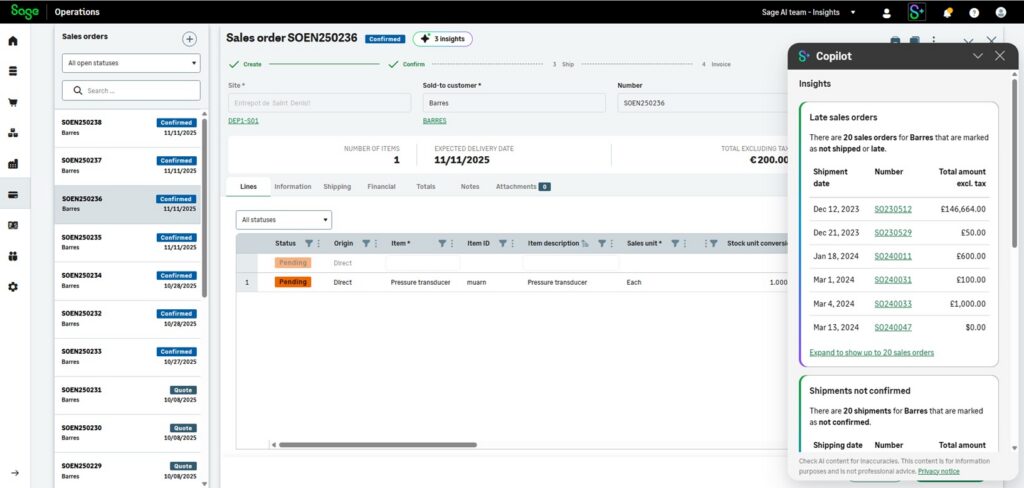

Sage released a set of updates to Sage Intacct, adding AI-powered anomaly detection to accounts payable automation and a new Lending Management module, along with additional updates to reporting, payments, and industry-specific workflows for construction and hospitality businesses. Sage says the release uses AI to strengthen financial controls and help finance teams identify potential issues earlier. Some capabilities are generally available now, while others, including Smart Reporting for Excel, the Customer Payments Portal, and Construction Billing, remain limited to Early Adopter programs in specific regions.
From Automation to Control: What Changed Between Releases
Sage Intacct’s May 2026 release, the second release of the year, expanded automation across accounts payable, expense management and financial reporting, with the stated aim of reducing manual work and improving accuracy. The August release builds on that foundation but shifts emphasis toward oversight. Sage frames the new capabilities as helping finance teams catch problems earlier in the process.
Sage cites its own research in the release as context for that shift: small and mid-sized businesses rank cybersecurity and data protection among their leading priorities for the next 12 months, and most describe themselves as unprepared or only in early stages of readiness for AI-related threats. Embedding anomaly detection directly into payables software follows a broader pattern among ERP vendors, which have increasingly added machine-learning-based fraud checks to transactional workflows.
AI-Powered Anomaly Detection Tightens AP Controls
The new Anomaly Detection feature for AP Automation surfaces unusual invoice activity earlier in the payment cycle, reducing the volume of invoices that require manual review. It flags invoices received from vendor email addresses the system does not recognize, giving administrators a chance to review and block suspicious senders before payment goes out. The feature is generally available globally to Sage Intacct AP Automation customers, making it the release’s most immediately usable control enhancement.
Lending Management Brings Loan Lifecycle Into Core Financials
Sage Intacct Lending Management allows lending organizations to manage the full loan lifecycle, from origination through payoff, inside the same platform used for core financial management. The module automates interest calculations and borrower statements, functions that have traditionally required a separate lending system running alongside the general ledger rather than inside it. Lending Management is generally available in the US.
Smart Reporting and the Customer Payments Portal: Connected Tools Still in Testing
Smart Reporting for Excel lets finance teams work directly with Sage Intacct’s reporting structures inside Excel, without recreating reports or relying on manual data exports. The tool keeps the underlying data linked to the Excel file so it can be refreshed, while preserving Sage Intacct’s existing permissions and access controls. It is available only through an Early Adopter program in the US and UK, not as a general release.
The Customer Payments Portal offers a self-service payment experience supporting multiple payment providers and methods, including payment links, scheduled payments, and saved payment details. Like Smart Reporting for Excel, it is currently limited to an Early Adopter program offered globally, not yet generally available. Testing platform-level features with a limited customer group before wider release is a common step across ERP vendors, allowing performance and permissions handling to be validated before broader rollout.
Construction and Hospitality: Deepening Industry-Specific Workflows
Construction Billing and Retainage Enhancements aim to simplify complex project billing and strengthen financial oversight for construction finance teams. The Retainage Enhancements are generally available, while Construction Billing remains in an Early Adopter program limited to the US, UK, Australia, and Canada.
Separately, a new integration called Connected to Craftable automatically synchronizes purchasing, sales, and inventory data with Sage Intacct for restaurants, bars, hotels, and other hospitality organizations, and is generally available in the US.
What This Means for ERP Insiders
AP review moves from manual checks to exceptions. Anomaly Detection’s general availability means finance teams can begin shifting reviewer time from routine invoice checks to flagged exceptions immediately. Teams evaluating similar controls within other ERP environments should weigh how exception-based review changes staffing needs in payables.
Early Adopter status limits near-term planning. Smart Reporting for Excel, the Customer Payments Portal, and Construction Billing remain restricted to limited regions and customer groups. Procurement and rollout timelines built around these specific tools risk premature commitments until broader availability is confirmed.
Vertical depth raises governance questions. Built-in construction and hospitality workflows reduce the need for third-party integrations but increase dependency on a single platform. Finance and IT governance teams should assess this tradeoff before consolidating vendor tools around one system.