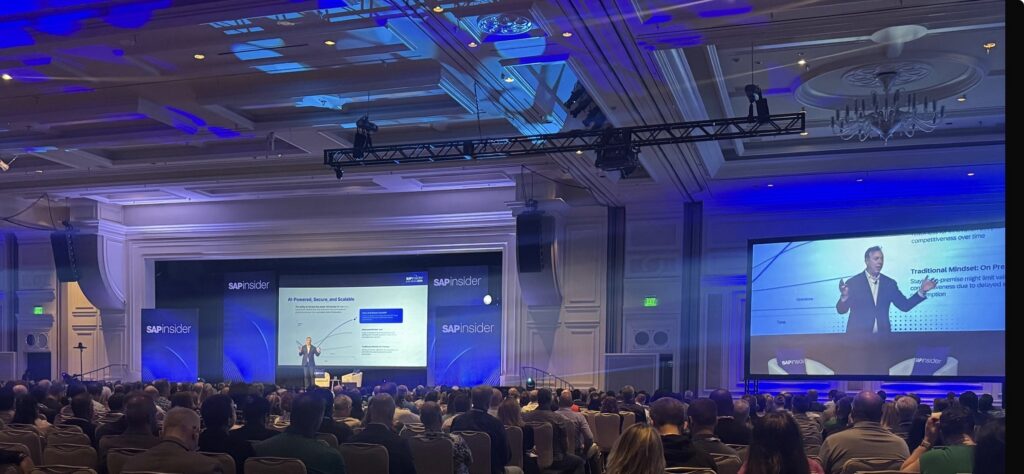


A CIO leadership forum opened the first day of SAPinsider Las Vegas 2026. The session brought together technology executives responsible for SAP strategy to discuss cost management, AI adoption, and the operational changes shaping enterprise decisions.
The forum was designed as a discussion among senior technology leaders. “Look around — everybody here is a technology company executive,” said James Bedard, President & CEO of SAPinsider, encouraging participants to exchange experiences and challenge assumptions across organizations.
Organizers structured the room and agenda to encourage open conversation among leaders responsible for both business and IT outcomes. The format builds on an executive discussion model SAPinsider introduced at a Technology Executive Forum last year and is now extending into its flagship events.
Business Priorities Reshape Decision-Making
The discussion turned to new research presented by Robert Holland, Chief Research Officer at SAPinsider, examining the priorities shaping technology leadership.
“We’re starting with the business challenges,” Holland told the room. “As technology leaders, you can’t make decisions in a vacuum. You have to work with your business teams.”
Holland said enterprise technology decisions increasingly follow business priorities rather than technology roadmaps alone. Operational efficiency and cost control ranked among the most common priorities cited by technology leaders, alongside driving new revenue and improving data-driven decision-making.
He added that the findings reflect the need for closer alignment between technology and business teams as organizations respond to shifting operational and economic conditions.
At the same time, many organizations are navigating tension between transformation initiatives and financial constraints. Leaders described the challenge of funding modernization while responding to ongoing pressure to manage costs and demonstrate measurable value from technology investments.
Core Challenges Shape Technology Decision-Making
Challenges discussed in the research included aligning IT and business stakeholders, managing cost pressures, and balancing innovation with operational stability.
AI emerged as another major theme in the discussion. Holland said many organizations are still experimenting with AI capabilities connected to SAP environments, often through pilot projects or targeted use cases rather than broad enterprise deployment.
Much of the current innovation is occurring in systems linked to SAP rather than directly embedded in core ERP processes.
Participants described how AI tools are beginning to change operational workflows, including use cases that streamline access to customer and transactional data while reducing manual preparation time for business activities.
The conversation also raised questions about how organizations prioritize security within broader transformation efforts.
Some attendees noted that cybersecurity did not rank as highly as expected in the research finding, prompting discussion about whether organizations are focusing first on business outcomes and ROI when evaluating new capabilities.
Others pointed to the risk that rapid innovation cycles can outpace governance processes. When IT cannot move quickly enough, they said, business teams may pursue their own solutions, increasing the risk of shadow IT and cybersecurity exposure.
SAPinsider Expands Executive Dialogue Beyond the Event
The discussion reflected the type of dialogue Bedard said SAPinsider will expand through a new initiative aimed at connecting technology leaders beyond the conference itself.
During the session, Bedard outlined plans to launch the Technology Executive Network, an effort designed to bring together executives responsible for enterprise transformation and SAP strategy in an ongoing forum for discussion and research collaboration.
The network will provide access to SAPinsider research, executive forums, and leadership programs throughout the year. Bedard said the goal is to create an environment where technology leaders can continue comparing strategies and sharing lessons outside the constraints of individual events.
Participants will be invited to additional executive gatherings, including future CIO programs and leadership forums organized by SAPinsider.
The initiative builds on the CIO Advisory Council that helps guide SAPinsider’s research and event programming. The broader network is intended to extend that collaborative model by bringing together a wider community of technology executives to exchange perspectives on SAP transformation, AI adoption, and enterprise technology leadership.
What This Means for ERP Insiders
Business priorities are playing a larger role. Technology decisions are increasingly shaped by operational efficiency, revenue goals, and data-driven outcomes rather than standalone IT roadmaps. This shift requires SAP initiatives to stay tightly aligned with business objectives and measurable impact.
Modernization projects face increased financial scrutiny. Organizations are pursuing modernization while under continued pressure to manage costs and justify investment decisions. That scrutiny does not remove the need to modernize, because technology, business demands, and operating models are continuing to evolve.
Networking is becoming critical for benchmarking and decision-making. The forum format emphasized peer dialogue as a way for technology leaders to compare strategies and test assumptions. That dynamic reflects a growing need for CIOs to benchmark decisions against real-world experience, not just vendor guidance.
This article was first published by SAPinsider on March 16, 2026.