
At SAP Sapphire, held in Orlando last month, much of the conversation centered on SAP’s Autonomous Enterprise, Joule Studio, AI agents, and the Business AI Platform. Yaad Oren is already looking past the current agent wave.
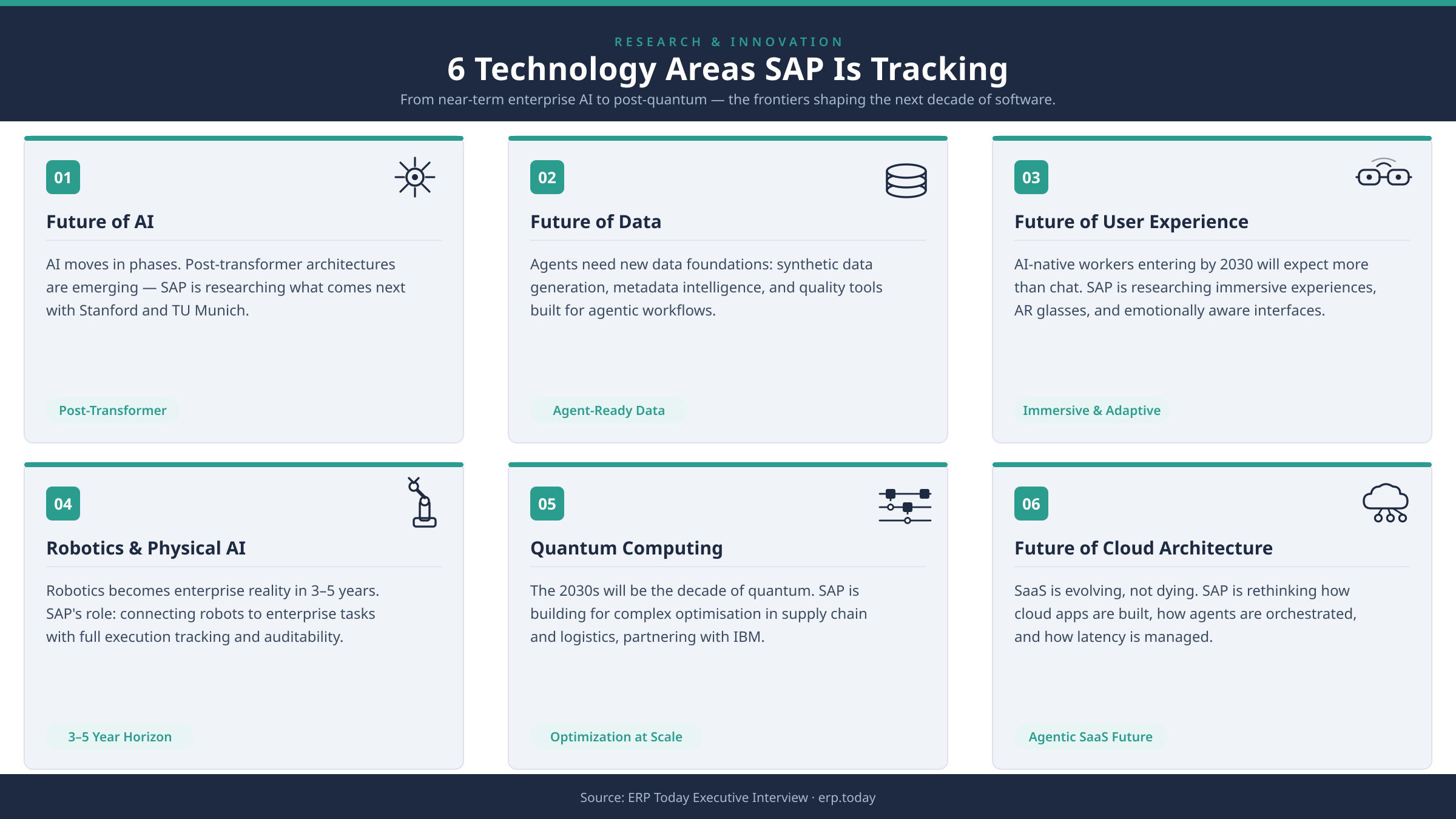
Oren is SAP’s Global Head of Research & Innovation and Managing Director of SAP Labs US. SAP Labs, he explained, continuously explores emerging technologies that could shape enterprise software five to ten years down the line. In a conversation with ERP Today, Oren described six areas SAP is tracking closely:
- the future of AI
- the future of data
- the future of user experience
- robotics and physical AI
- quantum computing
- the future of cloud architecture.
SAP and broader ERP customers need to act on today’s AI capabilities, he said, but they should also start looking at and forming a point of view on what comes next.
(This interview was edited for length and clarity.)
Q: How do you describe your role at SAP Labs US and in Research & Innovation?
YO: SAP Labs US builds products across AI, cloud, and many other areas. When we say “labs,” we mean development teams. SAP has more than 30,000 people based in the US, and around 6,000 of us are building product.
The other role I have reports into Philipp Herzig, SAP’s CTO. I drive a global organization called Research & Innovation. The name says what we do: We explore emerging technologies and try to apply them to product, while also looking at what could shape the IT industry five to ten years from now.
Some of what you heard at Sapphire, including the Autonomous Enterprise, AI agents, and Joule Studio, involved work my team helped with. But we are also looking at technologies that are further out.
Q: What are the main technology areas your team is tracking?
YO: We are looking at six areas.
The first is the future of AI. Today, the enterprise conversation is around the Autonomous Enterprise and what we believe are best practices for enterprise AI. But AI moves in phases. Ten years ago, there was another generation of AI. Then came generative AI. Five to ten years from now, there will be another disruption.
When ChatGPT came out in 2022, many people were surprised. But in research, we saw the direction earlier, when the 2017 “Attention Is All You Need” paper appeared and transformer architectures started to develop. Now, if you go to AI research conferences, you can see new architectures emerging again. They are not yet actionable for customers, but we are working on what we call post-transformer architecture with universities including Stanford and the Technical University of Munich.
The second area is the future of data. Everything is based on data, and the data platform will need more foundational services in the future. Customers may need synthetic data generation to train agents, new data quality tools, new metadata intelligence, and new ways to understand data generated by agents.
The third is the future of user experience. We are in a paradigm shift in how people interact with enterprise systems. Today that includes conversational interfaces, voice, and adaptive experiences such as spaces. My kids, for instance, are AI-native, not just mobile-native or digital-native. When they enter the workforce around 2030, they will expect a different way to interact with software. That’s why we are researching immersive experiences, glasses, and even interfaces with more emotional connection.
The fourth area is robotics and physical AI. We believe robotics and physical AI will become part of enterprise reality in the next three to five years. SAP is not building robots, but we are enabling the SAP layer that connects robots to enterprise tasks. A robot needs to be able to execute a task, report what it did, and make that auditable.
The fifth is quantum computing. SAP’s CEO [Christian Klein] has said the 2020s is the decade of AI and the 2030s will be the decade of quantum. It’s still early, but we are already working on optimization at scale. Quantum can help with complex optimization problems with many variables, which is highly relevant for supply chain, logistics, and similar use cases. We are collaborating with IBM and other partners in this area.
The sixth area is the future of cloud architecture. SaaS is not dead, but it’s evolving. As agents become more widespread, we need to think about how future cloud applications will be built, how agents will be orchestrated, and how we optimize latency and other architectural requirements.
Q: You mentioned the future of data. Does that include data about what AI agents are doing?
YO: Yes, that’s a big part of it. The Business AI Platform is about building agents, giving them context and reasoning, and governing them. Governance is very important, and it does not always get enough attention because it’s not as visible as the application experience.
With LeanIX, SAP has Agent Hub, which gives companies a registry of agents. That may sound simple, but many companies don’t have one. It’s important to know where the agents are, including agents not built by SAP. Through agent-to-agent protocols, SAP and non-SAP agents can be listed in one registry.
Signavio can also support agent mining, so companies can see agent behavior and trace it back. If agents are going to be everywhere, companies will need more innovation around how they govern agents, analyze behavior, manage exceptions, monitor generated data, and create trust.
One way to think about it is that companies need a blanket over all their agents. If anyone in any department can create an agent, how does the enterprise know that agent is part of the catalog? How can they trace it? That’s a future data and governance problem.
Q: How much do customer needs shape these research priorities?
YO: Customers are first and foremost. Every year in the first quarter, we run an exercise to understand our priorities. We talk to customers, especially innovative customers, about challenges beyond the next one or two roadmap cycles. We also talk to analysts, journalists, academia, venture capitalists, and startups. It’s useful to see where smart money is going and what researchers are working on.
No one has a crystal ball, so we look across many signals. Customers are a major part of that process.
Q: Have the priorities changed from last year to this year?
YO: The six strategic areas have not changed, but the emphasis inside them has.
AI is moving very fast, so the future of AI has become even more important. Data has also become more prominent because customers will need more tools than what the current industry data platform provides today. Physical AI is also becoming more important, though it is still more use-case-specific.
Inside AI, multiagent orchestration is advancing quickly. At Sapphire, we talked about assistants. “Assistant” is not a technical term; it’s a framing. Agents do the work, and assistants coordinate them. In finance, for example, one agent may look at open invoices, another may match invoices and accounts, and another may draft a communication. The assistant coordinates the process.
Q: How is AI changing the role of the software engineer?
YO: I still believe strongly in software engineering. The role will evolve, but in enterprise software, engineering remains critical.
It’s amazing what LLMs can do, and everyone should learn how to use them. But enterprise applications need to scale. They need verification, governance, security, and enterprise-grade quality. That’s very different from a consumer app.
Software engineers need to embrace AI tools and know how to work with them. They also need to know where they add value: verifying the code, making sure the right data is used, guiding agents, and ensuring the application works in an enterprise setting.
Q: How should customers, partners, and hyperscalers collaborate to push innovation forward?
YO: First, customers and leaders need to raise their heads and look at the horizon. They don’t need to buy anything related to every future technology today, but they should have an opinion about what’s coming in the next three to five years. They should talk to people in research, academia, startups, and the technology ecosystem so they aren’t surprised by the next shift.
Second, we collaborate through industry groups and partnerships. I’m on the board of several institutes, including the Silicon Valley Leadership Group, and I co-chair its physical AI and robotics work. We work with other companies to promote and understand these topics.
Third, we work directly with customers and partners on co-innovation projects. Bosch is one example. Bosch, Boston Dynamics, and SAP worked together on an inspection robotics use case. We’ve also worked with Accenture and Vodafone on robotics-related use cases connected to enterprise asset management.
Q: What advice would you give companies that want to build their own research and innovation capability?
YO: They need to understand that research and innovation require a different operating model.
My team fails often because we’re an incubation team. It’s similar to venture capital. A venture firm may have many investments, and one big success can make the portfolio. Our success rate is higher than that, but the operating model is different from a standard product organization.
We release many beta services and measure adoption. If something sticks and customers use it, we move it toward a product. That means companies need a different funding model, with more patient capital. The return may not come the same way it does when funding version 18 or 19 of an existing product line, but the upside can be much bigger.
Second, they need sponsorship from the C-level, ideally the CEO. If projects fail and there’s no executive sponsorship, people will ask why the work is continuing. You cannot stop in the middle.
Third, they need a strategy and a clear definition of success. It can’t be random experimentation. A company should know what it is trying to achieve, such as creating a new growth driver over the next few years rather than only extending the existing product line.
Finally, they need the right talent. My advice is to find the most curious people you have. You need people with deep technology skills, but also people who move fast, are passionate about technology, and want to learn across many areas.