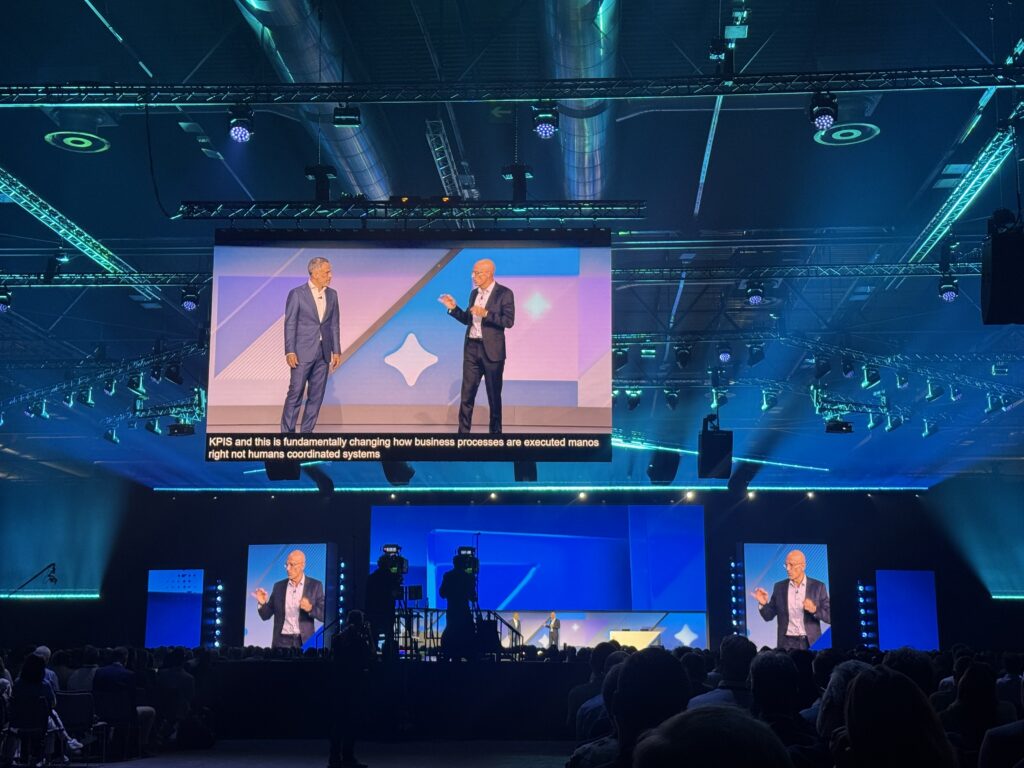

At this year’s Sapphire Orlando second keynote, SAP ground its autonomous enterprise message in customer transformation stories, arguing that AI value will depend less on isolated experimentation and more on readiness, standardization, data foundations, and the ability to modernize complex business environments without disrupting operations.
The keynote followed SAP’s broader announcements around Business AI, Joule, AI agents, and RISE with SAP by shifting the emphasis from product capability to transformation execution. SAP executives framed the message around helping customers create value while they transform, rather than waiting until cloud modernization or ERP migration is fully complete.
SAP Chief Customer Officer Thomas Saueressig said SAP wants to “make AI value real today,” including through RISE with SAP, MaxSuccess, and selected AI capabilities that can connect into hybrid landscapes and some on-premises systems.
The keynote also reinforced SAP’s investment in sovereign cloud and sovereign AI for regulated industries. SAP said it has committed more than $20 billion to ensure portfolio availability in sovereign cloud environments, including support for data sovereignty, operational sovereignty, technical sovereignty, and legal sovereignty.
Readiness Is the Real Transformation Metric
Lockheed Martin opened the customer segment with a challenge to conventional transformation language. Maria Demaree, SVP and CIO of Enterprise Business and Digital Transformation at Lockheed Martin, explained the company’s stance.
“Transformation is not the goal. Readiness is,” Demaree said. For Lockheed Martin, readiness means being able to move “with speed and clarity and confidence” across engineering, manufacturing, supply chain, and sustainment in support of national security and allied missions.
Lockheed Martin’s transformation, called OneLMX, is the largest transformational investment in the company’s history, according to Demaree. The challenge is not only the scale of a 120,000-person, 100-year-old enterprise, but the complexity of fragmented processes, disconnected systems, strict security requirements, and mission-critical operating conditions.
“We have disconnected systems and fragmented processes,” Demaree said. “Our customers need exponential speed and throughput.”
Lockheed Martin is using AI, SAP’s platform, and a model-based enterprise approach to connect the digital thread across design, build, and sustainment. Demaree said the goal is to reduce cycle times and improve responsiveness, because “readiness really depends on continuous, reliable performance.”
That message gave SAP a useful proof point for its broader AI argument. In the most sensitive environments, AI cannot be bolted onto unstable processes or fragmented data. “Transformation doesn’t start with technology,” Demaree said. “You have to do the work of rethinking your processes, how your decisions are made, how your operating model is going to work end to end.”
AI can be powerful, she added, but only when embedded into the foundation and owned by process leaders. “It’s not something you can ask the CIO to bolt on and expect it to scale.”
Airport Operations Show Agentic Model in Practice
The keynote then moved from aerospace and defense to airport operations, where Gustavo Sabato, CIO of Aeropuertos Argentina, described how the company built an AI-powered “snow agent” to manage winter disruptions.
Aeropuertos Argentina handles around 90% of commercial flights in Argentina, moves 43 million passengers a year, and manages more than 300,000 flights annually. Winter weather affects eight airports, 14,000 flights, and 1.4 million people, Sabato said. Historically, winter operations were manual and fragmented, creating operational costs, safety risks, and environmental impact from chemicals used to clear ice and snow.
The company built what Sabato called SNOW, or Smart Network Operating Winter, to orchestrate weather information, runway sensors, operational procedures, and maintenance processes. The system generates alerts, creates work orders, tracks execution, checks resource availability, and maintains communication between the control tower and operations teams.
“We pass from a reactive model to a proactive model,” Sabato said.
Aeropuertos Argentina expects a 16% reduction in cost and a reduction of 45 tons of CO2, according to Sabato. The broader significance for ERP leaders is speed. Sabato said the company began talking with SAP in February, started developing an MVP in March, and planned to begin implementation at two airports within weeks, with six more airports planned for the following winter.
That timeline supports SAP’s claim that customers can move from idea to impact faster when they have the right platform and clean foundations. Sabato said Aeropuertos Argentina upgraded from SAP R/3 to SAP S/4HANA in 2023, then implemented SAP BTP architecture and AI models on top.
“It will be faster and easy if you have a clean core,” he said.
Data Foundation Comes Before AI Scale
ExxonMobil brought the keynote’s most explicit data-foundation message. Bill Keillor, VP of ExxonMobil Global Services, said the company’s transformation began with the need to operate more nimbly in an industry facing more change than it had in the past.
ExxonMobil has operated for some 150 years and built significant process and IT complexity over that period. Keillor said the company needed a strategic shift to simplify its organizational structure, revisit processes, and address fragmented data.
“Every question was a science project,” Keillor said, describing the difficulty of accessing and using enterprise data across the business.
The company’s transformation is business-led and focused on standardization, process redesign, clean core, and migration from an on-premises data-center environment to the cloud through RISE with SAP. Keillor said ExxonMobil wanted to use technology “to do what it was designed to do,” rather than continuing to customize heavily around historical ways of working.
Keillor added ExxonMobil is experimenting with AI, but the transformation is “first and foremost about the data.”
“Data is the asset which has been trapped,” he said. “If we can’t get this foundation right, we will pay the price for that evermore.”
For ERP leaders, that point cuts against the idea that AI value comes from rapid tool deployment alone. ExxonMobil’s view is that clean core, upgrade stability, standardized processes, and governed data must come first so the company can absorb future innovation without turning every new capability into another heavy-lift implementation.
Keillor offered three leadership lessons for large-scale transformation: clarity of strategy, strong governance, and the right partners.
“There are lots and lots of decisions that need to be made, and they need to be made quickly,” he said.
Standardization Enables Agility at Levi Strauss
Levi Strauss & Co. brought the keynote’s clearest AI scale example. Jason Gowans, Chief Digital and Technology Officer at Levi Strauss, said the company has been transforming from a historically wholesale-focused denim business into a more direct-to-consumer enterprise.
“Half of the business now is direct to consumers,” Gowans said, noting that Levi’s operates online, through stores, across more than 100 countries, with more than 3,000 stores and more than 50,000 points of distribution.
That operating model requires speed, agility, and a common data foundation. Gowans said Levi’s previously had nine ERP instances around the world, making it difficult to understand business performance consistently. The company’s SAP transformation has centered on creating a common data backplane and holding to clean core principles.
Levi’s has also pushed aggressively into AI. Gowans said the company has more than 1,000 agents deployed across the business and has trained more than 4,000 employees hands-on with AI.
“It didn’t happen by accident,” he said. “We’ve been doing this now for more than two and a half years.”
One example came from wholesale order processing. Gowans said about 80% of wholesale orders flow automatically, but 20% remain manual, arriving through PDFs, email, and Excel. Those orders can be complex because of size, color, and style combinations. In the past, processing could take two to five days. With AI agents built on top of SAP, he said, the process now takes 20 to 30 minutes.
The Levi’s example also gave SAP a way to address a common transformation tradeoff: standardization versus agility. Gowans rejected the idea that the two are opposites. “Standardization and agility don’t stand in opposition,” he said. “Standardization is what allows us to move with agility.”
What This Means for ERP Insiders
The keynote closed by returning to a human and operational message: AI will not replace enterprise software but will be embedded inside the processes that run companies. SAP framed its role as helping customers keep critical operations resilient as technology changes faster than many organizations can absorb.
For ERP leaders, the keynote’s most important message was not that SAP has more AI capabilities. It was that SAP is trying to define the conditions under which enterprise AI becomes usable: clean core, standardized processes, trusted data, cloud readiness, sovereign deployment options, and transformation governance. Specifically:
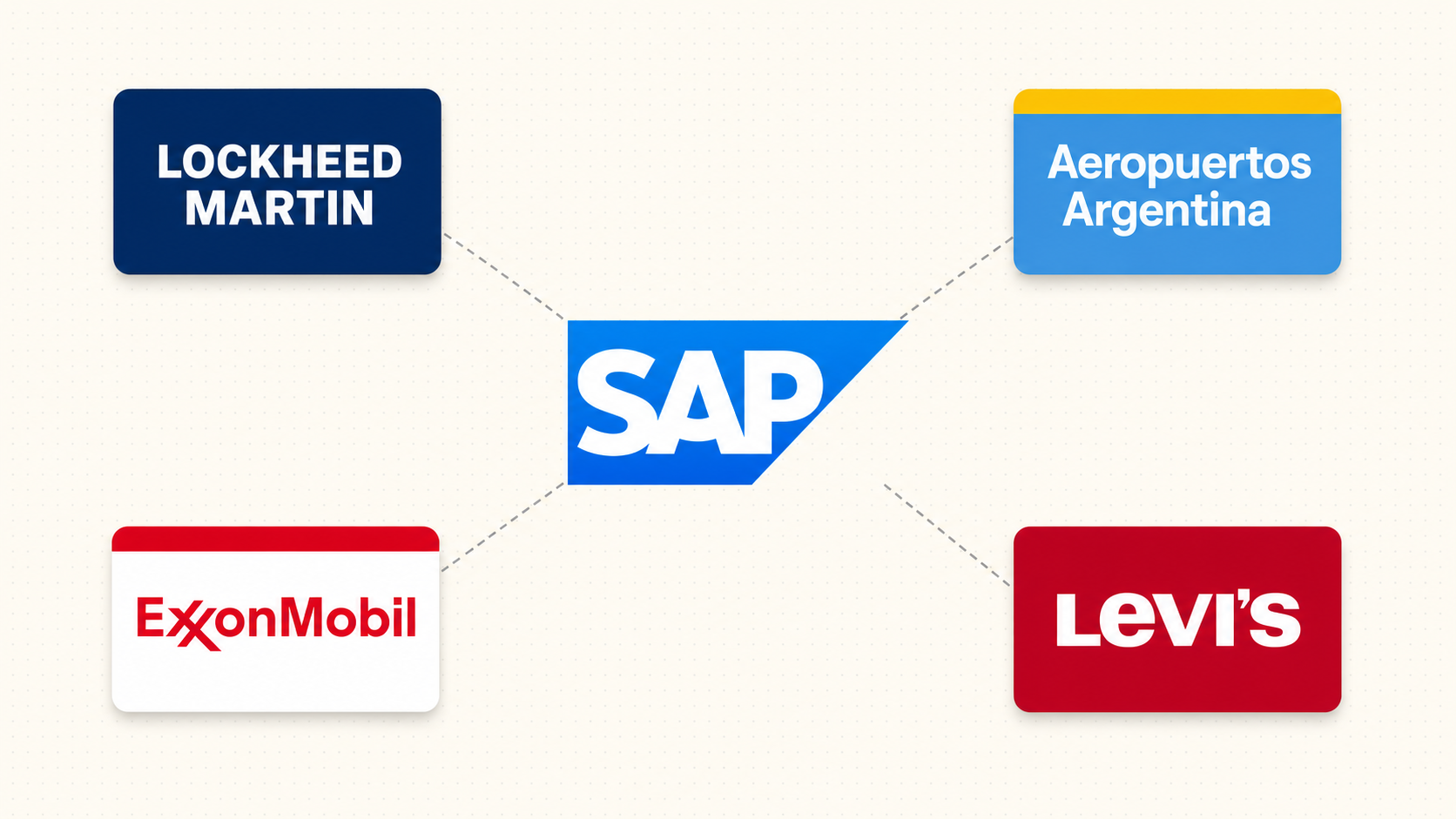
- AI readiness is an operating model test, not a software test. Lockheed Martin, ExxonMobil, Aeropuertos Argentina, and Levi’s all pointed to the same prerequisite: AI needs standardized processes, trusted data, and clear ownership before it can create enterprise value. CIOs and transformation leaders should treat AI roadmaps as operating model work, with process owners accountable for where agents are embedded and how decisions are made.
- Clean core is moving from technical doctrine to business acceleration. Aeropuertos Argentina’s rapid SNOW agent build and Levi’s agent scale show how standardized foundations can shorten the path from idea to execution. ERP program leaders should connect clean core work to business outcomes such as cycle-time reduction, order-processing speed, emissions reduction, and deployment velocity, rather than treating it as a purely architectural principle.
- ERP vendors are using AI to sell both transformation and transformation tooling. SAP is positioning AI inside business processes and inside the migration work required to modernize legacy estates. For ERP buyers, that raises a practical evaluation point: AI-enabled migration assistants, testing tools, custom-code analysis, and project intelligence should now be part of vendor and SI assessments, especially for organizations facing complex on-prem-to-cloud or multi-instance consolidation programs.