
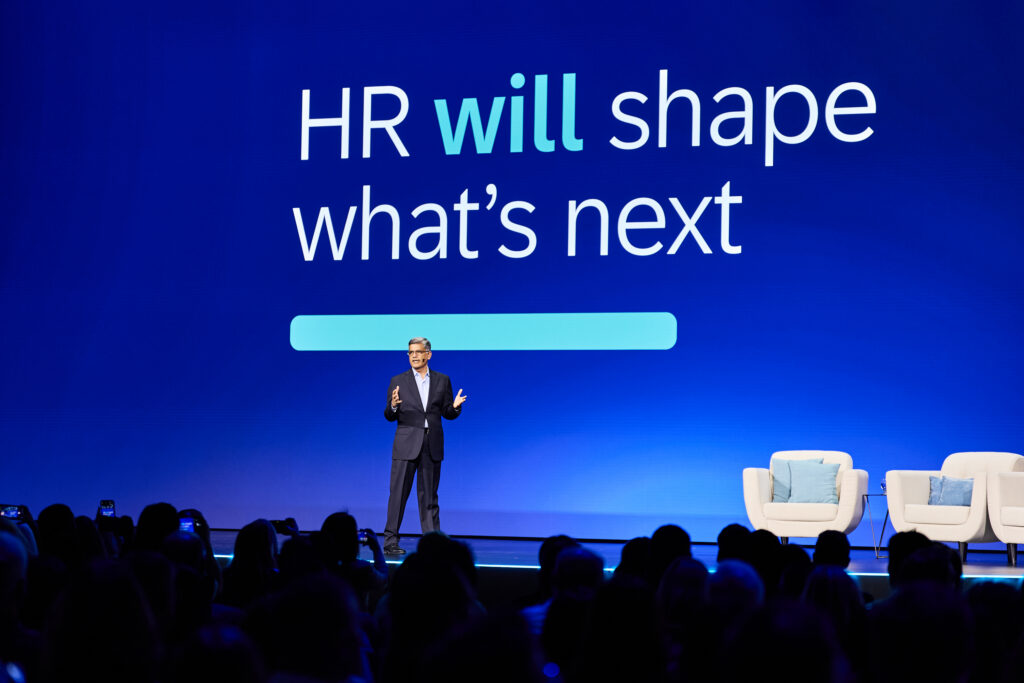
At SAP Connect in Las Vegas, SAP used its keynote session “SAP SuccessFactors: A New Era for HR with Autonomous HCM” to show how its HR software fits into that strategy. Autonomous HCM is the company’s term for HR processes in which AI automates end-to-end work, supports decisions, and helps optimize the workforce.
Over the hour, SAP leaders argued that HR’s role is moving from administering the workforce to helping redesign how work gets done as AI takes on more operational tasks. In live demos, Joule recommended actions and people approved them, a pattern SAP executives returned to throughout the session.
The session also carried news. SAP announced it intends to acquire TechWolf, whose platform maps employee skills from the work people do. SAP also named IBM, John Deere, Swiss Re, Wipro, and SAP itself as five customers that will implement connected SAP SuccessFactors agents at scale over the next eight months.
The Case SAP Made to HR Leaders
Lara Albert, chief marketing officer for SAP SuccessFactors, opened by describing how business changes increasingly show up in the work people do. She pointed to a chief HR officer at a global consumer brand whose customers had begun finding products through AI. As a result, the role of the company’s physical stores changed, and growth came to depend on new skills across the workforce.
Questions about how roles should change and what skills people need are business questions, Albert said, and executives increasingly look to HR to answer them.
HR also has more time to take them on. AI is absorbing operational work in areas such as payroll, service delivery, and recruiting. Most executives in SAP’s research said their organizations aren’t strategically redeploying that freed capacity.
Siva Sundaresan, general manager and chief product officer for SAP SuccessFactors, laid out SAP’s sequence for using it: automate operational work first; redesign tasks, roles, and teams around new business needs; then reinvent how people are hired, developed, moved, measured, and rewarded. He described the three as connected, with automation as the starting point.
From Single Tasks to Connected Agents
SAP’s next step for SuccessFactors is moving its AI from individual tasks to work that spans several HR processes. The live demos showed Joule working one task at a time, such as diagnosing a problem or drafting a plan, with a person approving the result.
The harder problem sits in the handoffs between those tasks. Rebecca Carr, president of HCM Products and CEO of SmartRecruiters at SAP, said customers don’t lack features. Their problem is “the space in between those features,” where a workforce plan changes but hiring and development don’t move with it.
SAP is building agents that share one understanding of a company’s people, work, and business. In Carr’s example, one agent updates a role, another adjusts pay, and a third assigns training, with people approving the important steps.
Connected agents also raise the stakes on data. An agent acting across roles, pay, and training needs an accurate picture of what employees can do, and Sundaresan said results depend on grounding AI in process knowledge, trusted data, and governance.
That is the role SAP assigned to TechWolf. Its platform infers skills from the work people perform and keeps that view current, and SAP plans to build it into the core of SuccessFactors once the deal closes.
What IBM and SAP Say Connected Agents Require
SAP’s plan assumes organizations are ready for agents that act across HR processes. The two customers on stage described what that readiness takes, and both started with the work itself.
Jon Lester, vice president of HR technology at IBM, called IBM’s approach “AI first,” meaning HR processes are rethought from scratch with AI built into the design. He said IBM’s fast move to SuccessFactors left customizations the company now plans to unwind.
Gina Vargiu-Breuer, chief people officer and labor director at SAP SE, framed HR’s role in business terms. “The people agenda is now the implementation plan for the business agenda,” she said. Drawing on SAP’s own use of AI in recruiting, she advised organizations to redesign the work before designing agents, train people to decide where their judgment still applies, and settle access and decision rights from the start.
The five-customer program is meant to show whether connected agents hold up at enterprise scale. IBM, John Deere, Swiss Re, Wipro, and SAP will work on that with SAP over the next eight months.
What This Means for ERP Insiders
Redesign the work before adding agents. Map how a process should run, remove workarounds, and decide where human judgment applies before activating AI. Teams gain a clear basis for deciding what to automate and what people keep.
Treat skills data as a business input. As SAP connects agents across roles, pay, and training, and adds TechWolf’s skills intelligence, the quality of skills and role data will shape the recommendations HR approves. Keeping that data current gives teams recommendations they can act on with more confidence.
Track the five-customer program. IBM, John Deere, Swiss Re, Wipro, and SAP will implement connected SuccessFactors agents over the next eight months. Following what they report gives HR leaders real-world evidence before committing at a similar scale.