
Enterprise resource planning (ERP) systems are now integral to modern businesses in a way they weren’t 15 years ago. They’re no longer just about improving efficiency or streamlining processes; ERP systems play a key role in decision-making and help companies achieve their fiscal goals. As a result, choosing an ERP implementation partner now assumes an added significance with considerable impact across an organization’s functions.
Whether a small business is looking to trim costs or a diversified enterprise is looking to consolidate its software stack and improve collective productivity, finding the right partner can help accomplish those goals and get more out of an ERP investment.
What is an ERP Implementation Partner?
It could be argued the term “ERP implementation partner” is misleading in how it only implies support during the rollout of the new system. An effective ERP partner’s role begins before the planning stage and lasts as long as the ERP system does.
What to Expect From a Partner Across the ERP Lifecycle
Pre-deployment phase
- Extensive enterprise-wide consultation to understand goals and requirements
- Detailed implementation and support roadmap with buy-in across departments
- Software development and customization to suit unique business requirements
- Rigorous sandbox testing prior to taking the new system live.
Deployment phase
- Calibrated, seamless deployment that minimizes disruptions and downtime
- Proactive communication and collaboration to resolve any issues, system glitches, and queries
- Extensive staff training to acclimatize team members to the new system, with both in-person and virtual support resources.
Post-deployment phase
- Rapid communication and timely resolution of challenges that result from a deployment
- Indefinite post-live support that helps a business scale new developments years after deployment.
A quality ERP partner adopts a business’s goals as their own. The deployment of the new system is an event in the partnership instead of the entire partnership.
Three Common ERP Implementation Challenges
While an ERP system can be a powerful tool to support an organization, there are challenges to its implementation. Three of the most common are:
- Internal resistance: Acclimatizing to a new system can often be a challenge to employees who have become accustomed to the old way of doing things. As a result, the leadership may encounter resistance when looking for company-wide buy-in.
- Data migration: A big part of adopting a new software is migrating data from an existing system or systems to the new one. Data integrity is crucial to ensuring there are no disruptions to the business.
- Customization: An ERP system will often need to be customized to ensure it aligns with the unique needs of an organization. This requires specialist expertise and proven experience in the space.
Five Things an ERP Implementation Partner Brings to the Table
A business should be able to count on their ERP partner as a consultant and reliable sounding board, instead of as just another vendor. The right consultant can mean the difference between a smooth transition that delivers continuing dividends over years to come and a failed, glitchy migration that can’t recoup the investment made in it.
1. Takes an industry-led view of the business. An effective ERP partner will always aim for a holistic view of the business. They will analyze the business’s history, current position in the market, and future goals, then correlate that to the ERP configuration.
A good ERP partner will often bring industry-specific expertise to the job, giving them unique insights into what works for a particular industry and how best to align a new ERP system to the client’s needs.
A business should expect to receive plenty of questions concerning operations and strategy. Those evaluating an ERP partner should also expect them to challenge preconceived notions on how best to implement the change and point out an approach that works for someone else isn’t necessarily the best way forward for the business adopting the ERP system.
2. Looks to create business value whenever possible. A good partner is always on the lookout for ways to create more bottom-line impact for their clients. Far from being the be-all and end-all of a partnership, the ERP deployment is just another part of it. Everything from the recommended roadmap to the software customization, the implementation, and post-live support is all carefully calibrated to boost productivity for the business.
Businesses adopting an ERP can expect process and cost efficiencies in a number of areas. This includes rationalizing software expenditures with one ERP system, improved automation, and a corresponding impact on efficiency across departments, generating actionable insights to support decision-making, as well as a predictable, fixed-fee structure for the ERP partner themselves.
3. Aims for a long-term partnership. A run-of-the-mill ERP vendor will look to implement system deployment with minimum disruption to meet their contract service-level agreements (SLAs). A true partner looks to support a business in its goals indefinitely.
An ERP partner’s job begins right from the consultation stage to creating the deployment roadmap, implementing software development, deploying the software, training and extending to long-term post-live support.
With a partner, a business can ask them whether the ERP system can scale to future business expansions and expect to receive an informed response. With an ERP partner, a business can return to them a few years after deployment when they have a new business process and ask for help customizing the system to accommodate those operations. A partner is invested in an organization’s long-term success and will help in any way they can to help that organization achieve it.
4. Offers continuous, collaborative support. A key part of the partner’s job is to ensure the new ERP system has company-wide acceptance. To that end, they will demonstrate a collaborative approach that seeks to understand the requirements — and reservations — of team members across departments and look to resolve them.
They won’t mind being held accountable, at least in part, for the results of the implementation. A respectable ERP partner will always be available to a business for consultation, especially in time-sensitive situations, to help resolve issues and prevent downtime for the organization.
5. Minimizes risks during and post-implementation. Any new system or software adoption is a challenging prospect for a business. An organization can certainly expect this to be the case with an enterprise-wide system such as an ERP.
When a business adopts a new system, it’s changing processes and workflows and asking employees across the board to adapt to a new way of working. A partner is cognizant of this and will take steps to mitigate any risks that come with implementation.
This includes extensive pre-deployment consultation with employees to understand how processes work in different departments. They also must carefully customize the ERP software to account for those requirements. The partner will implement rigorous, controlled testing of the new system before it goes live and provide comprehensive training to staff members to help them adjust to the new system.
Finally, they also will be alert to developments once the system goes live and respond rapidly if any issues do crop up. A holistic approach such as this helps reduces ERP adoption or migration risks.
Five Things to Prioritize When Choosing the Right ERP Partner
Implementing a new ERP can be a transformative step for an enterprise. Consequently, there are a number of considerations that should go into selecting the right ERP partner for a business.
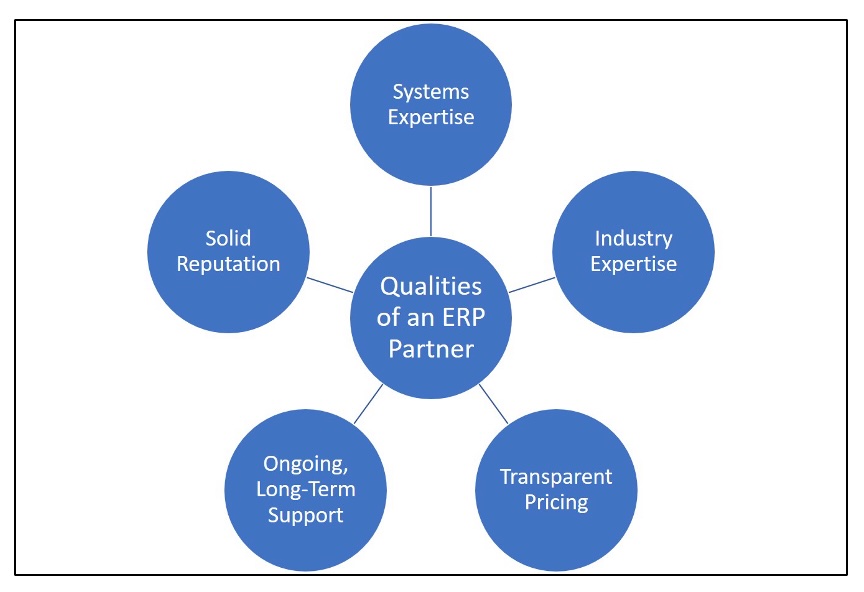
1. Systems expertise. Often, an ERP partner will have specialist experience with certain systems and brands above others depending on the industry. Regardless of which system they prefer, the ERP partner has deep experience with prevalent software.
They also should understand related enterprise systems, including customer relationship management systems, HR and recruitment systems, and supply chain software, to name a few.
This allows them to gain a better understanding of how the business processes are structured and, more importantly, enable them to better migrate the business to the new system.
2. Industry expertise. Organizations adopting an ERP should look to find partners who have proven expertise in their specific industry. Many industries such as energy, financial services, construction and manufacturing, to name a few, can benefit from specialist knowledge.
Engaging a partner who understands a particular area of business can help them implement features in the new system that provide continuing benefits to the organization over time.
Businesses should be sure to ask the partner for examples of industry-specific ERP implementations and review the results of those projects to understand if they’re a good fit for the organization.
3. Pricing. This is often a problem in the ERP implementation space. As deployments progress, unexpected issues may come up, lengthening the timeline or requiring more complex customizations. An organization may also have post-deployment issues or new requirements they need support for. This tends to have a corresponding effect on pricing. This can be a problem for businesses with strict ERP budget allocations. A business should look for ERP partners that provide transparent, fixed-price fees that can be relied on and budgeted for throughout the engagement.
4. Change management support. Much of the success of ERP deployment is in the preparation that’s been put in beforehand.
- Does the partner implement extensive sandbox testing to enable a seamless migration?
- Do they provide sufficient staff training, both in-person and via virtual resources, to acclimatize them to the change?
- Do they offer proactive support during and after deployment to address any glitches or queries?
Organizations should ensure the partner guarantees these services and is willing to deliver them as contractual obligations during the engagement.
5. Track record. With ERP implementation, as with any partnership, the deployment only tells part of the story. Businesses should investigate their potential partners’ track records to see how much their support has benefited their clients’ bottom line.
ERP partners also should be screened based on industry reputation. Ask for and follow up with client references to learn about how effective the relationship has been. An organization shouldn’t hesitate to reach out to multiple departmental heads within a client company, if they have to, to assess the enterprise-wide impact of the partner’s support.
Maintaining an Open Mind, Approach
Businesses should treat an ERP implementation partner as a business consultant and expect the results they would from a consultancy. This makes them far more likely to find partners that meet those requirements.
As part of this process, businesses should also be open to suggestions from their partners, even if unconventional. What works for one business may not necessarily work for another, and a partner will have the expertise to help enterprises navigate unfamiliar territory.
A partner is supposed to be in it for the long haul. They should be willing to share accountability for the results of an implementation, not just now, but years from now. While this may cost more than an organization would pay for an average vendor, the positive fiscal impact it creates for the business will more than make up for it.
Editor’s Note: What This Means for ERP Insiders
Partner economics shift toward lifecycle revenue models. The emphasis on indefinite post-deployment support and value creation beyond go-live signals system integrators and implementation partners must restructure engagement models away from project-based fees toward managed services and continuous optimization contracts.
Change management capabilities become competitive differentiators for implementers. As internal resistance and user adoption emerge as primary implementation risks, users must invest in organizational change management methodologies, not just technical delivery expertise.
Industry verticalization intensifies across the implementation ecosystem. There is a growing prioritization of industry-specific expertise over generic ERP knowledge. This reflects customer demand for partners who understand sector-specific workflows, regulatory requirements and business models.