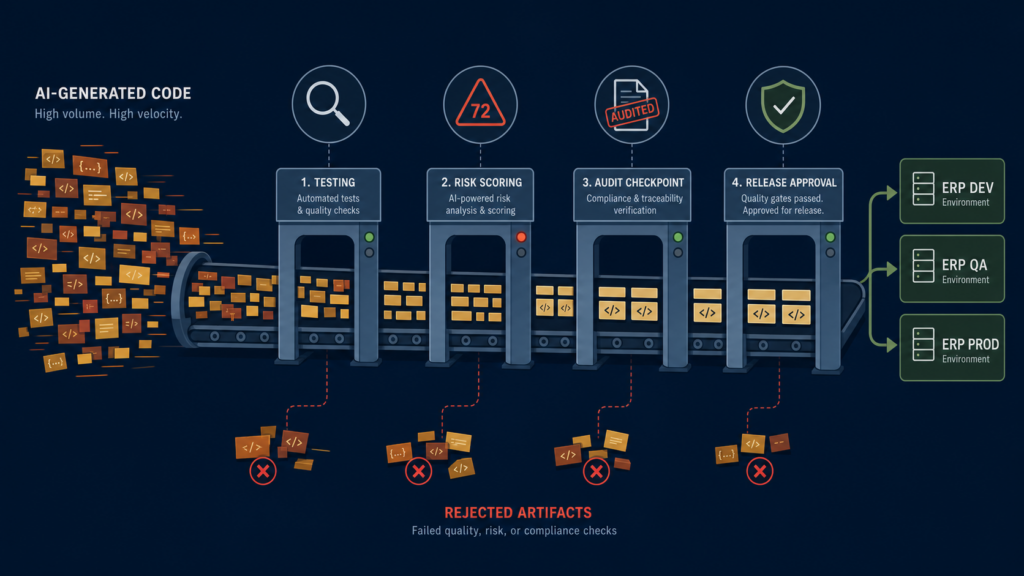

AI can generate more tests, but regulated ERP teams will judge it by the evidence it leaves behind.
Tricentis has won a major expansion of its existing software licensing contract with the State of California, opening its full agentic quality engineering platform, including the new AI Workspace, to state and local agencies. For SAP quality teams, the more relevant point is governance. AI-supported testing will be judged not only by how quickly it produces test assets but also by whether teams can retain approvals, audit trails, and compliance evidence for SAP change control.
On June 16, Tricentis announced a major expansion of its software licensing program (SLP) contract with the State of California. The company has been an approved vendor of the California Department of General Services since 2020. The expansion lets state and local government users procure the complete Tricentis Agentic Quality Engineering Platform, including the recently introduced Tricentis AI Workspace, through a simplified process with pre-negotiated terms.
The scale gives the deal weight. Tricentis says it already serves over 10 California state and local agencies across revenue, healthcare, transportation, financial, and public-safety services, reaching more than 39 million residents. This is an expansion of an existing footprint, not a first foothold.
How the California Deal Raises the Governance Bar
The contract is not a technical endorsement, a product certification, or a product launch. It is a context point for SAP teams because public-sector procurement brings evidence, traceability, and control into the buying discussion. Those themes are familiar to SAP customers in pharma, financial services, utilities, and other audit-sensitive sectors.
Tricentis frames AI Workspace as a single, unified control plane for designing, deploying, governing, and scaling AI agents that perform quality engineering work, serving as the system of record for how AI operates within software delivery while enforcing policies, approvals, and auditability. That positioning matters because AI-supported testing introduces both productivity potential and review risk in SAP environments.
The fine print is clear: AI capability alone is not enough. Governed AI capability determines whether testing output can fit SAP release and change-control processes.
Public-Sector Procurement Puts Evidence First
For an SAP program manager, the practical issue is not whether a tool can generate more tests. It is whether the team can show what was tested, who approved it, which change it supported, and whether the evidence is defensible.
Ben Baldi, Tricentis Senior Vice President of Global Public Sector, put the question of trust at the center: “Public sector entities cannot take full advantage of AI’s ability to accelerate software creation without ensuring the utmost trust.” He added that California government teams “can now meet the demand for AI innovation confidently” while leaders “deliver the best citizen experience with less risk and the highest quality.”
Participation in a public-sector channel does not prove product fit for every regulated SAP environment. It does bring procurement readiness and governance context into the conversation.
AI Testing Needs Audit-Ready Controls
The platform spans nearly 200 ERPs and packaged applications, with named agents across the portfolio: Agentic Test Automation (Tosca), Agentic Test Creation (qTest), Agentic Quality Intelligence (SeaLights), and Agentic Performance Testing (NeoLoad). That breadth is exactly why governance matters. SAP landscapes are integrated business-process environments with transports, segregation-of-duties reviews, non-SAP dependencies, and release gates.
AI does not reduce that integration surface area. It can increase testing activity across it. The operational question is whether that activity becomes reviewable evidence or simply more noise. AI-supported testing becomes audit-ready when a reviewer can understand, approve, trace, and defend the output. Documentation, the part of innovation that files receipts, still matters.
Release Governance Is a Pressure Point
The friction is unlikely to appear in the demo. It is more likely to surface in the transport review, the change advisory board, the SoD checkpoint, or an audit request that asks which test version corresponds to which approved SAP change.
AI-supported generation of test variants for procurement, finance, or order-to-cash workflows may be useful. But the release manager still needs to explain which tests ran, why they were selected, which risks they covered, and how the results map to the approved change. Without that governance layer, AI-supported testing can accelerate activity without improving confidence in releases.
What This Means for ERP Insiders
ERP teams need an evidence model before AI testing scales. Tricentis AI Workspace positions itself as a control plane for policies, approvals, and auditability, but the burden of proof still sits with the organization. AI-generated test assets should link to an approved change, an audit trail, and a release process before they expand across modules or business processes.
AI testing pilots must prove defensibility, not just speed. The California expansion signals procurement readiness, but it does not certify audit readiness for every enterprise environment. CIOs and quality leaders should test AI-supported quality engineering in real release scenarios and measure success by traceability, approval quality, risk coverage, and audit evidence as much as test volume.
Governance leaders should treat AI agents as part of the release process. Tricentis’ named agents across Tosca, qTest, SeaLights, and NeoLoad can support quality engineering, but they still need human checkpoints, change-management design, and clear ownership. Regulated ERP environments will only benefit if AI testing activity strengthens release confidence instead of creating more artifacts for teams to explain later.
Editor’s note: This article was originally published on SAPinsider on 6/19.