
AI has made software easier to produce. Tricentis’ latest Quality Transformation Report shows how little that changes if enterprises cannot prove what they release.
The company’s second annual report, released on June 3, found 60% of organizations still deploy untested code into production. The number is only slightly lower than the 63% reported in 2025, but the reason has changed. Last year, organizations were more likely to describe untested code as an accident. This year, they admit more of it is deliberate: 32% cite leadership pressure to prioritize speed over quality, while 30% say AI-generated code volume has become too large for teams to test fully.
That finding should land well beyond QA and DevOps teams. ERP programs now run on frequent application updates, integrations, extensions, data pipelines, automation scripts, configuration changes, and AI-generated artifacts. When code moves faster than testing, the risk does not stay inside engineering. It reaches finance closes, payroll runs, supply chain workflows, customer portals, regulatory reporting, and the systems leaders depend on to run the business.
Has Untested Code Become Accepted Risk?
Tricentis surveyed 2,501 technology, engineering, QA, DevOps, and executive respondents across the US, UK, Ireland, Germany, Japan, and Singapore. The respondent mix gives the findings more weight than a QA-only pulse check. This is a view into how executives and delivery teams are managing software quality as AI increases the volume and velocity of change.
The clearest signal is not just that untested code is still reaching production. It is that many organizations now appear to treat untested code as a tradeoff they can manage. That changes the nature of the problem. Quality teams are no longer only catching accidental defects at the end of a release cycle; they are absorbing business pressure to ship faster than the testing model can support.
That pressure is especially risky in sectors where software errors carry immediate business consequences. Tricentis found more than half of organizations across every major industry surveyed deploy untested code, including 64% in financial services, 63% in retail, and 58% in energy and utilities. A failed workflow in those environments can affect transactions, customer access, regulatory reporting, service reliability, or security posture.
The financial impact is also hard to dismiss. Tricentis said one in five organizations report losing more than $1 million annually because of poor software quality, while 45% estimate annual losses between $500,000 and $1 million. The leading drivers were security and compliance failures, followed by technical debt and rework.
For ERP leaders, the warning is direct. A failed integration, broken approval workflow, inaccurate report, or regression inside a core process can quickly become a business disruption. AI-generated code increases the volume of change, but it does not reduce the obligation to prove which changes are safe enough for finance, payroll, procurement, supply chain, customer billing, and regulatory reporting.
Is Trust Another Release Risk?
Tricentis also found a clear split between executive and practitioner confidence.
More than four in five CEOs said they are highly confident in AI-driven systems and tools. Only 56% of QA and DevOps professionals said the same. The gap is even sharper around readiness to operationalize and govern AI agents across the software development lifecycle: 44% of C-level executives said their business is very prepared, compared with 23% of QA and DevOps professionals.
That disconnect creates a release risk of its own. Senior leaders may read AI adoption as progress while practitioners see more code, more tools, more exceptions, and less time to validate what is changing. Without shared quality metrics, both sides can believe they are right until a failed release proves otherwise.
The agentic AI findings show the same tension. Tricentis said 83% of organizations trust agentic AI to make release decisions and 82% say they are prepared to operationalize and govern AI agents at scale. Operational barriers tell a different story: tool sprawl, skills gaps, security concerns, data quality issues, rising code volume, and unclear quality metrics remain widespread.
Only 35% of organizations say they feel fully prepared to govern AI agents at scale. Trust in AI agents making release decisions also fell from 48% to 34% year over year. The market may be excited about autonomous testing and AI-assisted release management, but practitioners are signaling that trust is fragile.
Analysis
What this means: The C-suite needs a better quality signal than release speed. Tricentis’ report shows executives are more confident in AI-driven systems than the QA and DevOps teams closest to the work. That gap will keep widening unless leaders review defect risk, test coverage, release readiness, and production impact with the same seriousness they bring to delivery timelines.
AI Code Needs Proof Before Production
AI-generated artifacts are already appearing around ERP projects: integration code, test scripts, configuration documentation, data-mapping logic, workflow automation, report changes, and deployment playbooks. Some of that work may come from vendors, some from systems integrators, some from internal teams, and some from developers using general-purpose AI tools.
The source matters less than the validation path. Any change that touches SAP, Oracle Fusion, Workday, Microsoft Dynamics, Infor, Sage, or adjacent applications needs release evidence that business owners, auditors, and technology leaders can trust.
Traditional testing models were already under pressure from cloud release cycles and agile delivery. AI adds a volume problem. More code can be generated, changed, and proposed than teams can manually review. That makes risk-based, automated, continuous testing more important, especially around critical business processes.
This is where Tricentis is positioning its agentic quality engineering platform. The company introduced Tricentis AI Workspace in March as a control plane for coordinating AI agents across testing, automation, performance, and quality intelligence, with governance, approvals, and auditability embedded into execution. The platform spans nearly 200 ERPs and packaged applications, as well as web and custom apps.
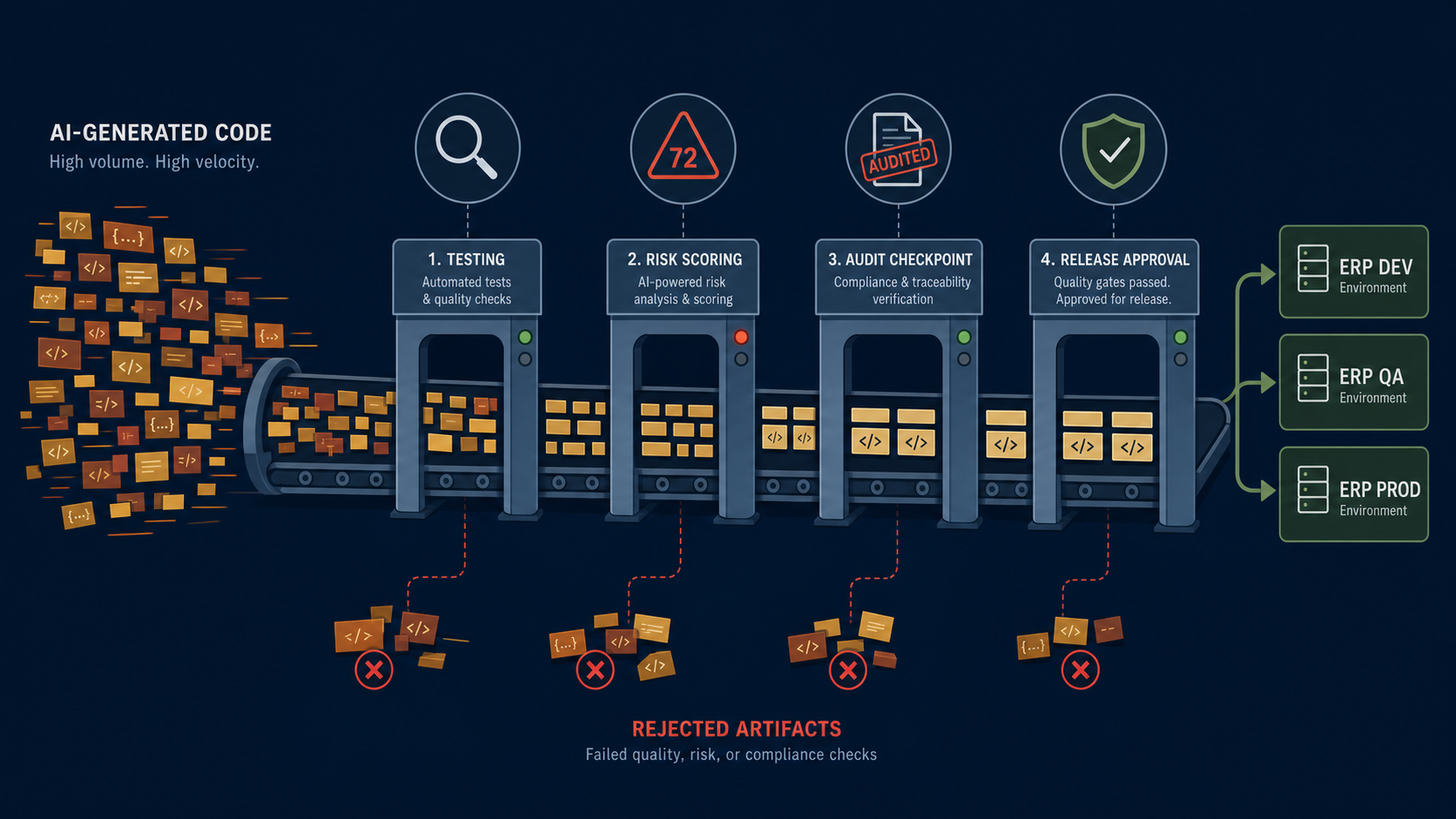
AI-era delivery needs a quality layer that can scale with AI-era development. Faster code generation only helps the business if testing, risk scoring, performance validation, and release readiness can accelerate without losing oversight.
Analysis
What this means: AI-generated ERP work needs a presumption of risk. Integration code, configuration changes, test scripts, automation logic, and data mappings can now appear faster than release teams can validate them. The safer operating model is to assume AI-generated work is incomplete until it has passed tests tied to the business process it could disrupt.
Sponsor Industry‑Grade Research
From Testing Report to Go-to-Market Push
Tricentis is translating the report’s findings into partnerships and public-sector access.
On June 10, KPMG in India and Tricentis announced a strategic alliance to support enterprise-scale quality transformation. The alliance combines KPMG India’s quality engineering capabilities with the Tricentis Agentic Quality Engineering Platform, with both companies pointing to risk-based, continuous testing models aligned with DevOps and continuous integration / continuous deployment environments.
That partnership gives the testing story a transformation-services layer. Large ERP and cloud programs rarely fail because a tool is unavailable. They fail when delivery models, quality processes, governance, data, and operating responsibilities do not change together. KPMG’s role suggests customers will need advisory and implementation support to move from traditional testing toward AI-assisted quality engineering.
Tricentis also announced on June 16 an expansion of its State of California software licensing program contract. The expanded contract gives California state and local government users access to Tricentis’ complete agentic quality engineering platform, including AI Workspace, through a simplified procurement process with pre-negotiated terms.
The public-sector angle is interesting because government software environments combine legacy systems, citizen-facing services, compliance requirements, budget pressure, and rising demand for faster digital delivery. If AI-generated code and agentic testing enter that environment, procurement convenience is not the main story. The larger issue is whether agencies can innovate faster while preserving auditability, accessibility, security, and service continuity.
Analysis
What this means: Testing vendors now have to prove how their own AI is controlled. Tricentis’ AI Workspace, KPMG India alliance, and California contract show quality engineering moving toward AI-assisted platforms that coordinate testing, approvals, and audit evidence. Buyers need to know when an agent recommends, when it acts, when a human steps in, and how the system proves what happened after the release.
Get Our Free Weekly Newsletter
Boardroom Needs Release Evidence
Tricentis CEO Kevin Thompson framed the Quality Transformation report around a shift from AI adoption to trust, control, and confidence in what organizations release at scale.
The first wave of AI in development focused heavily on productivity. The next wave has to focus on proof. That requires quality metrics the C-suite and delivery teams can share. Release velocity alone is incomplete. Defect escape rates, test coverage against business-critical processes, change risk, automation reliability, agent performance, security validation, and production incident impact all need a place in executive review.
AI can help with that work, but it cannot be allowed to mark its own homework without controls. Agentic testing and AI-assisted release decisions need human oversight, policy enforcement, audit trails, and clear limits on when an agent can recommend, act, or escalate. The companies that solve this will be the ones that can release change faster while proving it is safe enough for the business to run.