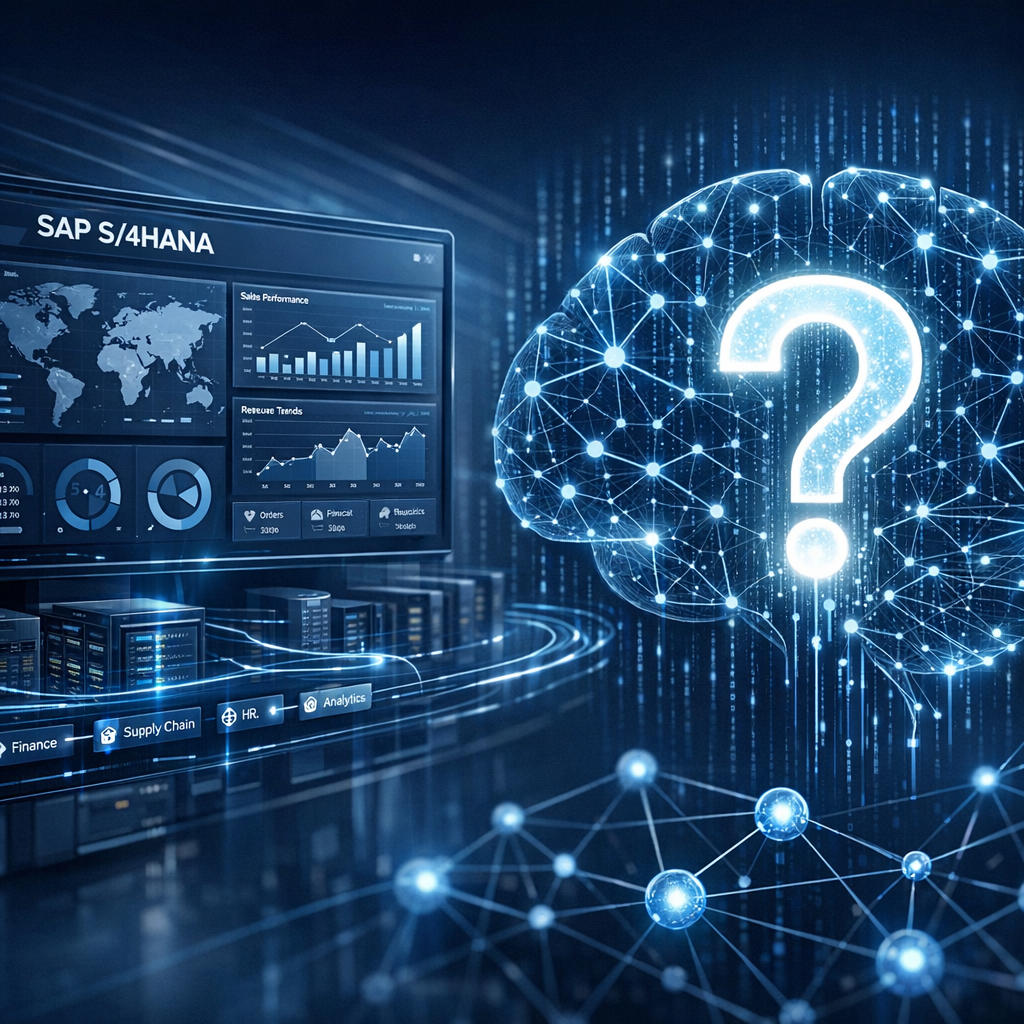
Completing an SAP S/4HANA migration is a major milestone. It is not the same thing as becoming AI-ready.
That distinction is becoming harder for ERP leaders to ignore. SAP customers are under pressure to modernize before maintenance deadlines, move toward clean core, evaluate Joule and other embedded AI capabilities, and show measurable value from AI programs that may already be running in pockets across the business.
The gap is visible in the numbers. A SAPinsider benchmark found 91% of organizations are using AI at some level, but only 17% have embedded it in core workflows. That 74-point gap is not simply a roadmap issue. It reflects unresolved work around data foundations, semantic consistency, cloud maturity, governance, and skills.
The FAQ below addresses the questions ERP leaders are most likely to face after migration, when the system of record has been modernized but the enterprise is still not ready to run AI at scale.
Frequently Asked Questions: AI Readiness Post-Migration
Q: We just completed our SAP S/4HANA migration. Why are we still not AI-ready?
Because migration modernizes the system of record. It does not automatically modernize enterprise knowledge.
After go-live, critical business history often remains spread across retired SAP systems, non-SAP applications, documents, data warehouses, cloud platforms, and local reporting environments. Customer contracts, procurement decisions, engineering records, financial transactions, and exception histories may still sit outside the new S/4HANA core.
Clean core can sharpen this issue. Keeping SAP S/4HANA lean often means historical data and legacy complexity stay outside the new system by design. That is good ERP discipline, but it creates a separate AI readiness requirement. Organizations then need a governed data layer where historical and operational context can be accessed securely and used consistently.
DuPont’s work with Data Migration International is one example of this foundation-building. The company decommissioned 17 SAP systems and governed more than 50 TB of enterprise data within 12 months. The lesson is not that every company needs the same program. It is that AI readiness requires deliberate work to archive, govern, and activate enterprise data beyond the migration itself.
Q: What is the difference between an ERP system of record and an AI-ready data foundation?
An ERP system of record captures transactions, workflows, controls, and financial truth. It tells the business what happened and governs what can happen next inside the application. An AI-ready data foundation does something different. It prepares, joins, secures, and contextualizes information from ERP and adjacent systems so analytics tools and AI applications can use it responsibly.
Those two layers need to work together, but they are not interchangeable. A company can have a clean SAP S/4HANA environment and still lack the data model, semantic layer, permissions structure, and cross-system context needed for AI. If AI is treated as a post-migration add-on, teams often discover too late that the data foundation required for production use was never built.
Q: We have clean ERP data. Is that the same as having AI-ready data?
No. Clean ERP data means transactions are accurate and structured inside the system. AI-ready data means business meaning travels with the data when it moves across systems, analytics environments, and AI workflows.
That difference matters because common business terms can vary across the enterprise. “Customer,” “margin,” “available inventory,” “order,” and “supplier risk” may mean different things in ERP, CRM, warehouse systems, procurement platforms, or reporting tools. Humans often understand those differences from experience. AI agents do not unless the meaning has been modeled and governed.
Clean transactions are necessary, but they are not enough. AI needs governed, semantically consistent, cross-system data. Without that layer, organizations risk building AI tools that return plausible answers that do not reflect how the business actually operates.
Q: What is a data lakehouse, and why does it matter before deploying AI agents?
A data lakehouse combines the flexible, high-volume storage of a data lake with the reliability, structure, security, and governance associated with a data warehouse.
For ERP leaders, the lakehouse matters because it can become the governed layer where data from ERP and adjacent systems is prepared for analytics and AI. It is not a replacement for ERP. It is the layer that can help ERP data become usable outside the transaction system.
The stakes rise with agents. Unlike static reports, agents may query data more autonomously, combine information across systems, and recommend or initiate actions. Without governance, that creates identity, permission, audit trail, and decision-quality risks across sensitive business data such as suppliers, pricing, contracts, payroll, payments, inventory, and customer commitments.
A lakehouse may provide access to data, but access is not the same as understanding. Without a semantic layer, an agent may query the wrong table, join incompatible data, or produce an answer that sounds right but does not match the business definition. That is why ERP data strategy and AI agent strategy need to be developed together.
Q: Our cloud migration is done. Does cloud maturity still matter for AI?
Yes. Finishing a cloud migration is not the same thing as reaching cloud maturity.
NTT DATA research across more than 2,300 senior decision-makers in 33 countries found only 14% of enterprises have reached a cloud-evolved state where cloud delivers measurable, compounding business value. The same research found that 88% of respondents said their current cloud investments are putting AI, cloud-native, and modernization initiatives at risk.
The distinction is important. A lift-and-shift migration may move systems to the cloud, but it may not create the architecture needed for AI-ready data, scalable integration, automation, observability, or cloud-native development. As Melissa Itoh, Principal Solution Architect for SAP BTP at NTT DATA Business Solutions, noted in ERP Today coverage, many organizations apply the same lift-and-shift mindset to data that they apply to ERP. That may help with compliance, but it often does not prepare the business for analytics or AI.
Nokia’s multi-year RISE with SAP agreement shows how strategic cloud decisions can become part of the AI foundation. The company is hosting S/4HANA on Microsoft Azure while consolidating finance, logistics, master data governance, extended warehouse management, global trade services, and advanced available-to-promise into one landscape. The hyperscaler decision is not just a hosting preference. It shapes migration risk, data strategy, and the pace at which AI-enabled capabilities can be adopted.
Q: What does the AI-ERP reality gap look like in practice?
It looks like confident AI strategies that do not translate into scaled production use. Many ERP environments carry years of customization, technical debt, process variation, and fragmented data models. Those landscapes were not designed for the level of automation, intelligence, and orchestration that enterprise AI now requires.
The Infor Index captured the disconnect clearly. More than half of 1,000 decision-makers across the US, UK, Germany, and France said they cannot scale AI beyond early deployment, yet 80% said they have the internal capability to do so. That is a confidence gap.
The risk is not theoretical. The Stanford AI Index 2026 documented 362 notable AI incidents in 2025, up from 233 in 2024. As AI moves deeper into enterprise processes, weak controls, poor data quality, and unclear governance become operational risk.
Mukesh Kumar, Premium Engagement leader and Midwest AI Champion at SAP America, put the issue bluntly in ERP Today’s coverage of GenAI in ERP: “In public, every leader has an AI strategy and a confident roadmap. But the honest version can be heard in the room—many pilots, very little in production.”
Q: We have been piloting AI for two years. Why has it not moved into production?
Pilots usually stall when they are not tied to funded processes, measurable outcomes, clear governance, and production data.
Many organizations get early value from off-the-shelf tools, then they hit a ceiling. The blocker is rarely the model alone. It is usually the missing operating foundation around data ownership, semantic consistency, exception handling, human review, security, and process accountability.
The Infor Index refers to this pattern as “pilot purgatory.” Experiments proliferate, but they are not tied to end-to-end processes or operating structures that allow scaling. Teams can demonstrate AI, but they cannot govern it in the workflow where business value or risk actually occurs.
The practical test is simple: Can the use case be tied to a process owner, a budget, a measurable outcome, a governance model, and a production path? If not, the pilot is likely to remain an experiment.
Q: What should the first AI use case in an ERP context look like?
The first use case should be specific, measurable, and tied to a real process constraint.
ERP Today’s coverage of GenAI in ERP highlighted a global agricultural company in Argentina that faced a regulatory requirement to post and invoice in the same calendar month as delivery. A 15-person customer service team was manually processing complex, multi-language, multi-format sales orders. To close the books on time, the team had collapsed multi-line dealer orders into single product lines, which matched totals but lost line-item detail and led to an internal audit finding.
The solution used SAP Build Process Automation, SAP Document AI, and SAP Cloud Connector to automate extraction, validation, routing, and posting against live S/4HANA master records, with human review for exceptions. By Q4 2025, 5,780 sales orders had been processed; 70% flowed fully automated; manual effort per order fell 90%; 1,050 person-hours were saved annually; month-end close improved by two days; and 30% more transaction volume was absorbed without adding headcount.
The important lesson is not the tool stack alone. The use case had a clear compliance driver, measurable financial and operational value, live ERP integration, human-in-the-loop controls, and inherited SAP IAM and master data rules. Governance was designed into the workflow from the start.
Q: What skills does an ERP team need to run AI in production?
Production AI requires different skills from ERP migration. Teams need to know how to configure, govern, and monitor AI features inside live business processes. They need to define what “correct” looks like in a regulated workflow, identify when outputs drift, manage exceptions when agents misfire, and decide where human review is required.
ERP Today’s coverage of the AI skills gap called this the “silent tax” on SAP transformation. The same reporting noted 55% of organizations had deployed SAP S/4HANA or SAP Cloud, but only 34% had fully transitioned, while only 17% had embedded AI in core workflows despite rising Joule adoption plans.
Armstrong World Industries provides a useful operating example. Brent Lewis, Senior Manager of Data & AI, told ERP Today that Armstrong restructured its team to support Databricks, design pilots, push them into production, and own the operating model, not just the technical deployment.
That is the skills shift ERP teams need to plan for. AI readiness depends on product knowledge, data literacy, process ownership, governance design, exception management, and business accountability.
Q: How do we assess actual AI readiness, not just migration status?
Start with these four questions that migration status cannot answer:
First, where does critical business history live, and can future AI tools reach it in governed form? If the answer is limited to what moved into SAP S/4HANA, the enterprise data foundation is incomplete.
Second, is the cloud foundation mature enough to support AI at scale, or has the business only moved systems to cloud infrastructure? NTT DATA’s research suggests most enterprises have not yet reached a cloud-evolved state.
Third, does data carry business meaning outside the transaction layer? AI needs to understand what terms such as margin, customer, inventory, shipment, and supplier mean across ERP, CRM, analytics, and operational systems.
Fourth, can the team configure, govern, and trust AI in live processes, or only demonstrate it? Armstrong benchmarks its AI maturity through a crawl-walk-run model, with two use cases in production, a target of six by the end of 2026, and a goal of “running” by 2028. That specificity is what a real readiness assessment looks like: staged, measurable, and tied to production.
What This Means for ERP Insiders
- Migration completion should trigger a new readiness review. ERP leaders should not treat SAP S/4HANA go-live as proof that the business is ready for AI. The first post-migration assessment should identify where historical business context sits, which data was intentionally left outside the clean core, and whether that information can be governed and activated for future AI use cases.
- Data architecture is part of AI governance. Lakehouses, semantic layers, integration patterns, identity controls, and data ownership rules are no longer background technical decisions. They determine whether AI can use ERP data safely and whether agents can produce answers that reflect how the business actually works.
- Cloud maturity needs its own scorecard. A cloud-hosted ERP does not automatically create a cloud-evolved enterprise. ERP teams should assess whether cloud investments support scalable data access, AI deployment, observability, integration, security, and modernization, rather than assuming the hosting decision has solved the AI foundation problem.
- Pilots need a production exit path before they begin. Any ERP AI pilot should have a named process owner, a measurable business outcome, a data source strategy, a governance model, exception handling, and a funding path. Without those conditions, the pilot is likely to add activity without changing the operating model.
- Semantic consistency will decide which agents can be trusted. AI agents will expose every inconsistent definition in the enterprise data model. ERP teams should prioritize the business terms that matter most in finance, procurement, supply chain, HR, and customer operations, then define where those terms are governed and how agents are allowed to use them.
- Skills planning has to move beyond tool training. Production AI requires teams that understand data foundations, process design, human review, model monitoring, governance, and exception ownership. ERP leaders should assess whether their teams can operate AI in live workflows, not only whether they can activate features.
- The strongest first use cases will be narrow, governed, and measurable. ERP teams should start where there is a clear process constraint, compliance consequence, or measurable financial impact. Broad AI strategies may win internal attention, but focused use cases are more likely to reach production and prove value.