
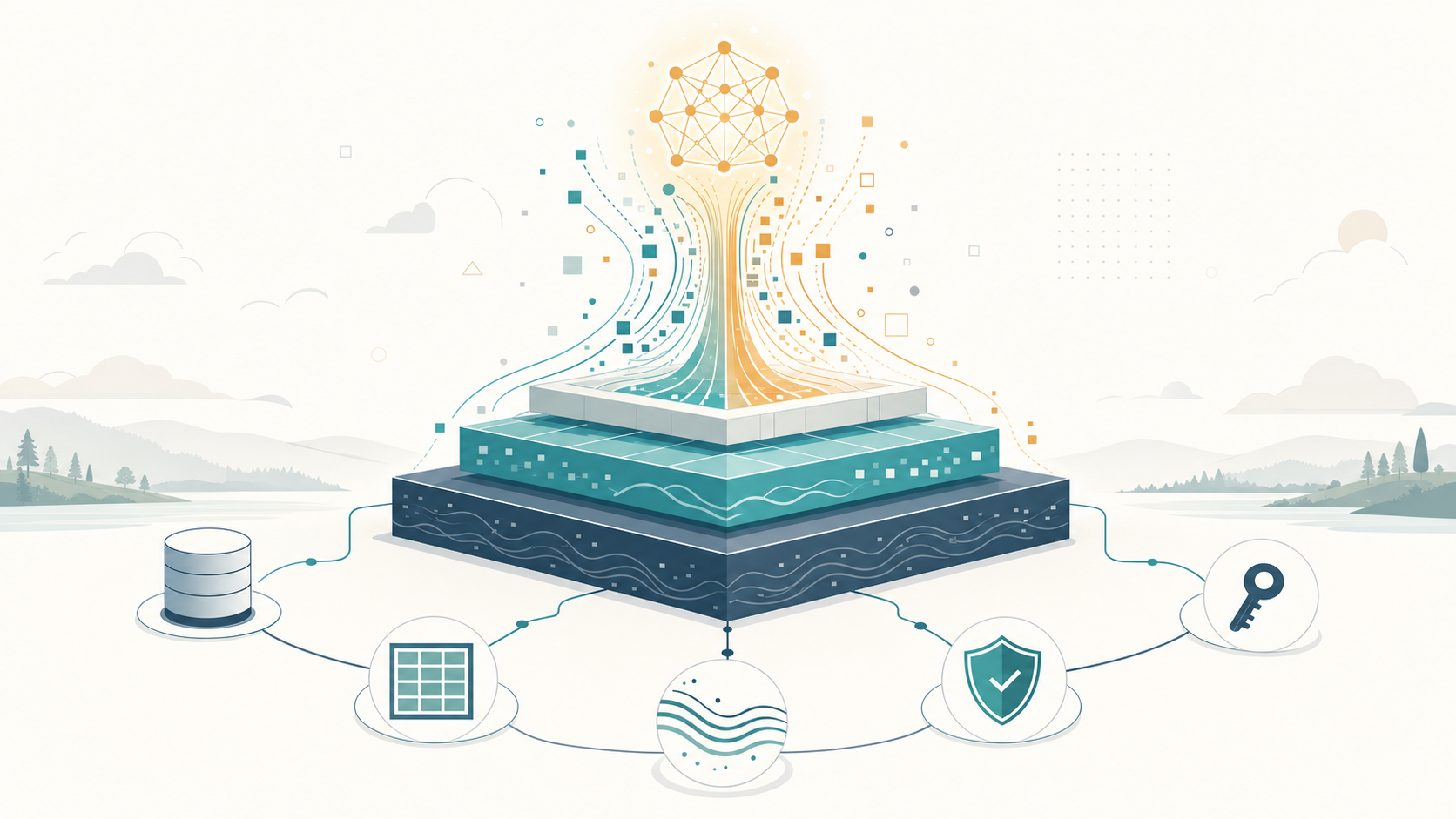
Data lakehouses are moving from data architecture jargon into the center of enterprise AI strategy.
A June 24 CIO.com feature argues that lakehouses are becoming foundations for enterprise AI because they combine the flexible storage of a data lake with the reliability, structure, security, and governance of a traditional data warehouse. That combination is becoming more important as companies try to give AI systems and agents access to business data from ERP, CRM, HR, supply chain, finance, customer, service, and operational systems.
For ERP leaders, the key point is straightforward: AI agents need business context before they can make useful decisions. The lakehouse is increasingly where companies are trying to assemble that context.
Data Lakehouses Explained
A data lake can store many types of raw data at scale, but without enough discipline it can become difficult to govern or trust. A data warehouse provides structured, reliable data for reporting and analytics, but it has historically been less flexible for the mix of structured, semi-structured, unstructured, streaming, and AI-ready data companies now want to use.
A lakehouse tries to bridge that gap. It gives organizations a central place to store and govern different kinds of enterprise data while supporting analytics, machine learning, retrieval-augmented generation, and agentic AI workloads.
That does not make the lakehouse a replacement for ERP. ERP systems remain the systems of record for transactions, controls, workflows, and financial truth. The lakehouse becomes the governed data foundation where information from ERP and adjacent systems can be prepared, joined, secured, and understood by analytics and AI applications.
Get Our Free Weekly Newsletter
AI Agents Change the Lakehouse Conversation
Lakehouses were already useful for reporting, analytics, forecasting, and machine learning. AI agents raise the stakes.
In older analytics models, data typically flowed into dashboards or to analysts working under defined access rights. In early retrieval-augmented generation, or RAG, use cases, developers often built specific pipelines to retrieve approved information and insert it into prompts for a defined workflow.
Agentic AI changes that model. When AI agents can access data more autonomously through tools such as Model Context Protocol (MCP) servers, organizations need to think differently about identity, permissions, audit trails, observability, and prompt filtering.
The CIO.com article points to Docusign using Snowflake to support agentic AI ambitions, including internal AI agents and machine learning models. The company is proceeding cautiously, especially when exposing anything sensitive such as customer data.
That caution resonates with ERP teams. ERP data includes suppliers, pricing, contracts, payroll, payments, inventory, demand, production, cost centers, margins, and customer commitments. Letting AI agents query that information without strong controls can create security, compliance, and decision-quality risks.
A lakehouse can help by centralizing data access, governance, and auditability. But it only helps if organizations define what agents are allowed to see, what actions they can take, which data is safe to retrieve, and how every interaction is logged.
Semantic Context Is Becoming the Hard Part
A lakehouse can give AI access to data, but access is not the same as understanding.
The next challenge is the semantic layer, meaning the business context that explains what data means across systems. A customer, order, product, margin, available inventory, booked revenue, or supplier can have different meanings depending on the ERP module, CRM system, warehouse application, planning tool, or reporting environment.
Humans often know those differences from experience. AI agents do not unless the meaning is modeled, governed, and made available to them.
CIO.com cites Gartner’s view that universal semantic layers will become critical infrastructure by 2030. The reason is practical. Without semantic context, an AI agent may query the wrong table, join incompatible data, misread a metric, or generate an answer that sounds plausible but does not match how the business actually operates.
For ERP leaders, this is where lakehouse strategy becomes business strategy. The question is not only whether the company can move ERP data into a modern data platform. The question is whether the company can preserve process meaning, policy, master data rules, and finance-grade definitions once that data leaves the ERP system.
SAP is making a similar argument through SAP Business Data Cloud, which it positions as a way to connect SAP and third-party data while preserving business context for analytics, applications, and AI agents. That message reflects a broader market reality: enterprise AI needs governed data, but it also needs data that still carries business meaning.
Lakehouses Need Cost and Control Discipline
The CIO.com article also highlights an important operating risk: AI data access can become expensive and inefficient if teams do not design carefully.
Lemongrass, for example, is using lakehouse data to support AI use cases but is careful about what data gets sent to large language models, CIO.com reported. Sending too many rows, too much customer information, or poorly scoped data into an AI prompt can raise cost, privacy, and reliability problems.
That is an underappreciated ERP issue. ERP data can be large, sensitive, and highly interconnected. An AI agent does not need every transaction to answer every question. It needs the right slice of governed data, with the right context, at the right level of detail.
The most mature strategies will not treat the lakehouse as a dumping ground for everything AI might want. They will define serving layers, vector indexes, access policies, semantic models, data products, and cost controls around specific business use cases.
That means ERP leaders should care about lakehouse architecture before agents scale. Once agents are embedded into planning, finance, procurement, manufacturing, HR, and customer workflows, the cost of fixing weak data foundations will rise quickly.
Sponsor Industry‑Grade Research
Lakehouses Will Shape ERP AI Readiness
Major vendors are already converging around the lakehouse model.
Databricks built its platform around the lakehouse concept and Delta Lake. Microsoft Fabric uses Delta Lake as the default table format for its lakehouse. Snowflake has moved from its warehouse roots toward a broader data cloud and open lakehouse model, including support for Apache Iceberg. SAP is positioning Business Data Cloud as the business-data foundation for AI and intelligent applications.
The shared direction is clear. Enterprise AI needs more than application features. It needs governed, contextual, cross-system data.
For ERP teams, the lakehouse becomes one of the places where AI readiness will be won or lost. A strong ERP system can still feed weak AI if data is poorly modeled outside the transaction layer. A modern lakehouse can still produce weak AI if semantics, governance, lineage, and permissions are treated as afterthoughts.
The practical question for ERP leaders is not whether they need to become data architects. It is whether they understand enough about the lakehouse to challenge AI roadmaps, ask the right governance questions, and protect the meaning of ERP data as it moves into AI-driven workflows.
What This Means for ERP Insiders
AI agents will stress-test ERP data foundations. Lakehouses are becoming the place where companies assemble the governed business context agents need to work across finance, supply chain, HR, customer, and operations data. ERP leaders must evaluate whether their data architecture can support AI access without weakening security, lineage, or process control.
Semantic discipline will separate useful AI from risky automation. Agents need to know what business data means, not just where it lives. Organizations should treat definitions for customers, orders, margins, inventory, suppliers, and costs as AI-critical assets that must be governed across ERP, lakehouse, analytics, and planning environments.
Governed data access will define agentic ERP readiness. As agents move from answering questions to retrieving data and triggering workflows, identity, permissions, audit trails, cost controls, and human review become core operating requirements. ERP teams need to build those controls before agentic use cases expand into business-critical decisions.