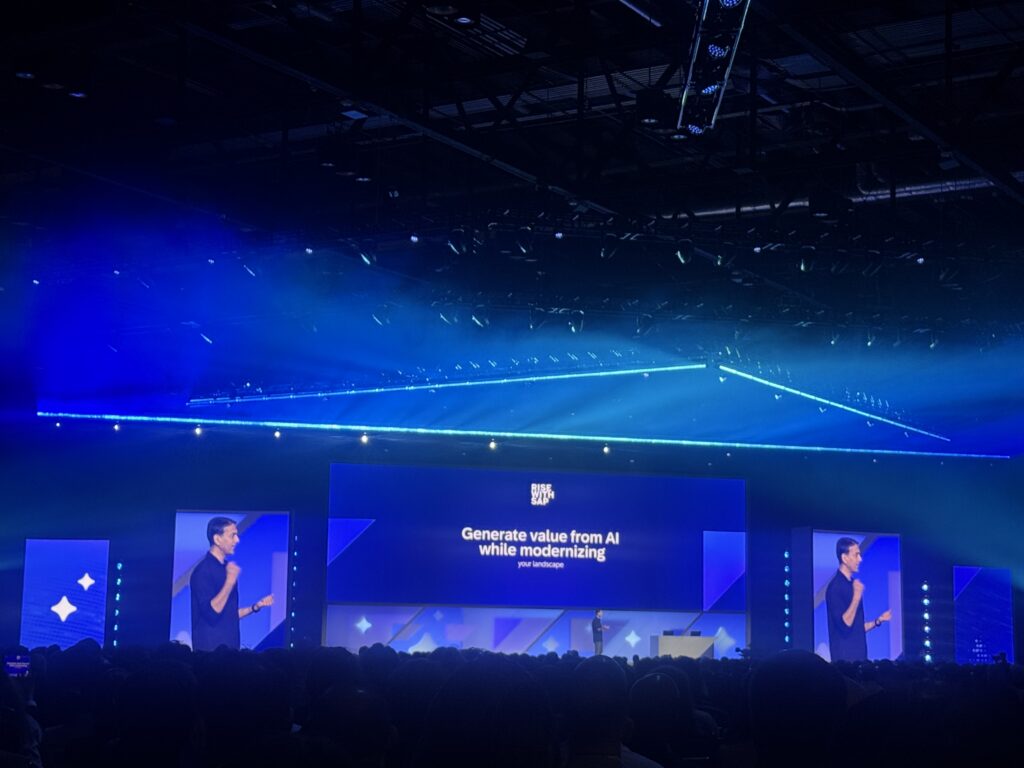

The opening keynote at SAP Sapphire 2026, led by SAP CEO Christian Klein, opened and closed with the provocative question: “Will SAP be a software company in the future?” By the end, SAP’s new version of Joule answered: “SAP is becoming a business AI company.”
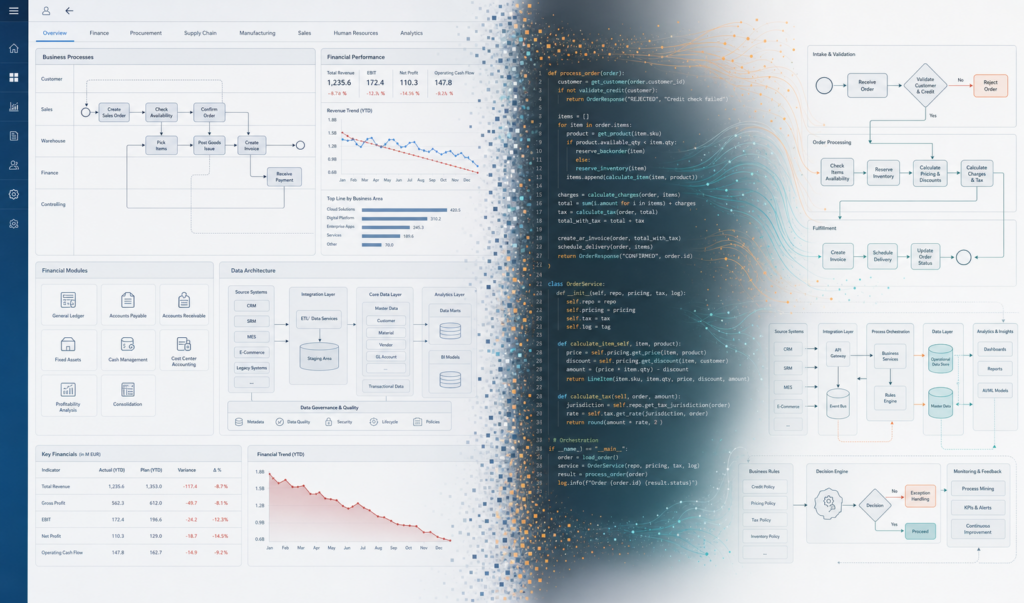
In a nutshell, the hour and 30 minutes long keynote with various presenters did not present AI as another feature layer on top of ERP. Instead, SAP put forth a new agentic stack built around business data, agent development, agent governance, and a reworked application portfolio. That stack is called the Autonomous Suite.
The AI conversation has gone beyond copilots and assistants, toward a broader claim that enterprise applications themselves will reason, recommend, and act inside finance, spend, supply chain, HR, and customer workflows. For ERP Today readers, the question now is whether SAP is still primarily selling applications, or whether it is trying to own the control layer that sits above applications, data, process logic, and, increasingly, execution.
Analysis
What this means: Modernization now sits inside SAP’s AI value story. SAP is no longer treating migration and AI as separate conversations. By tying hybrid assistants and AI-powered migration tools to the same platform pitch, SAP is telling customers they do not need to finish modernization before starting to extract AI value. That message will resonate, but it will also raise the bar on SAP to deliver credible results in mixed estates.
SAP’s New Foundation Starts with Data and Context
Agents fail when enterprise data is fragmented, inconsistent, or trapped in disconnected systems. SAP’s answer to that known challenge is to keep pushing its business data layer and context model across SAP and non-SAP estates, with the explicit goal of giving agents a single business context rather than another integration patchwork.
“No AI agent can compensate for a bad data landscape,” Klein said, positioning SAP’s data layer as the prerequisite for everything else announced on stage.
The data story expanded in several directions. SAP said customers can already use hundreds of managed data products out of the box. It also introduced a data-products generation agent to help customers model additional data products faster. Klein then pointed to broader federation ambitions across cloud and legacy environments, open table format support after a pending acquisition closes, and a data foundation designed to let agents reason across information “from any source, any environment.”
For SAP, data interoperability is part of its agent platform story, not just a Business Data Cloud story. SAP is not only saying that good data improves analytics. It is saying its future agents need a governed business context layer that spans process, master data, policies, and transactions. That shifts the value proposition from application record-keeping toward orchestration grounded in enterprise context.
Joule Studio 2.0 Becomes SAP’s Agent Factory
The next announcement was the expansion of Joule Studio into Joule Studio 2.0. Philipp Herzig, SAP’s CTO, presented it as the place where customers and partners can identify, design, and “build agents for specific business outcomes.”
In a demo, he showed a process consulting agent finding a pricing and purchasing issue with an estimated margin impact of nearly $24 million, then proposing a sales pricing validation agent as the solution. From there, Joule Studio 2.0 generated a product requirements document, technical specifications, workflow logic, evaluations, and orchestrated multiple agents together. The first customers will begin receiving this generation of Joule Studio starting in June, Herzig said.
With this announcement, SAP is shifting the AI build conversation from generic prompting to packaged enterprise engineering. Joule Studio 2.0 as an intent-based, model-agnostic system contextualized in business data and process is able to target SAP or third-party environments. As such, the claim is that it will get customers to a governed business outcome faster, with SAP semantics, SAP process knowledge, and enterprise controls already built in.
Analysis
What this means: SAP is pushing beyond core ERP into AI control layers. The keynote showed a company moving beyond applications into data context, agent development, governance, and execution control. That gives SAP a bigger role in enterprise architecture than software delivery alone and puts it in closer competition with platform, data, and AI control-layer vendors. For ERP product leaders and enterprise architects, the implication is that future platform decisions will turn less on feature breadth alone and more on who governs how AI is built, trusted, and executed across the business.
SAP Is Packaging the ‘Autonomous Suite’

Returning to the stage, Klein said SAP’s “system of execution” is changing into an “autonomous suite” across core business domains, with agents and assistants embedded throughout.
Muhammad Alam, SAP Product and Engineering, said SAP has already built 224 agents and 51 assistants across four business processes, and the number will grow monthly. These assistants are mapped to roles, can be human-triggered or system-triggered, are tracked for business impact, and can be extended through rules, workflows, and code from the same experience shown in Joule Studio.
That portfolio-level move carries weight, as SAP essentially is reorganizing the suite around role-based assistants and outcome-driven agents. Finance gets assistants for close, controlling, and related workflows. Spend gets sourcing and buying assistants. Supply chain gets need-to-deliver assistants. HR gets recruiting and career development assistants. Customer-facing functions get assistants across sales, service, offers, and marketing.
This is where the “Will SAP be a software company?” framing starts to make sense. SAP is not abandoning software, but it is making software less visible by embedding more execution into agents that work across the application estate. If that model works, customers will interact less with static workflows and more with role-based systems that decide, recommend, escalate, and act.
Memory, Governance, and Industry AI Also Shine
Another announcement centered around “company memory,” which SAP positioned as a way to capture the operating knowledge that rarely sits neatly inside transactional data. That includes the process logic buried in policies, procedures, chat threads, approvals, exception handling, and other unstructured sources that usually live outside the formal system. Agents often fail not because the master data is wrong, but because the real decision logic of the company lives in tribal knowledge, side documents, and a handful of experienced operators. SAP is trying to turn that invisible layer into something agents can actually use. Company memory will extract that knowledge into a context layer agents can use to understand what to do, what not to do, and how the business has handled similar situations before.
Governance was another point discussed, which suggests SAP understands where the market is running into trouble. Enterprises can build pilots faster than they can govern them, especially once assistants and agents start spreading across business functions and external platforms. SAP’s answer is a central governance layer for discovering, managing, verifying, observing, and optimizing agents across the landscape. Customers reportedly will be able to define architectural boundaries, verify that only approved agents operate in the environment, monitor behavior, and connect activity back to business outcomes. Alam made clear this is meant to govern SAP and non-SAP agents alike, not just the assistants it ships itself. That is a necessary step if SAP wants customers to view its platform as the enterprise control layer for AI rather than just another vendor-specific framework.
The keynote then closed by bringing industry depth back to the center of the story. Sebastian Steinhaeuser, SAP’s COO, said SAP’s long-standing strength in vertical process detail is now becoming “industry AI,” with domain-specific agents and assistants tailored to sector workflows. “Real enterprise transformation requires deep industry expertise,” he said, before highlighting examples in life sciences, consumer products, and retail, Once major enterprise platforms have a catalog of general-purpose agents, differentiation will come from how well those systems understand regulated, high-variation, industry-specific work. SAP is betting that vertical process depth, combined with company memory and governance, will matter more than raw agent count.
For ERP leaders, this is important because it shows where SAP thinks differentiation will come from: the process edge in regulated, high-variation, or industry-specific work. That puts pressure on Oracle, Workday, Microsoft, and Salesforce to answer the same question in their own domains.
Analysis
What this means: The real differentiator may be memory and governance, not the agent count. SAP’s 224 agents and 51 assistants make headlines, but the more consequential pieces are company memory, the AI governance layer, and the business context model beneath them. Those are the parts that determine whether agents can operate reliably in regulated, high-variance enterprise environments. For CIOs, risk leaders, and enterprise architects in such industries, those layers will push AI-driven operations beyond pilots and into production.
Sponsor Industry‑Grade Research
The Market Wants AI Value Now
The keynote also addressed a problem that many customers will care about more than the platform story. Most customers, especially large enterprises, will not move into a clean, fully modernized AI-ready estate overnight. Many enterprises are still midway through modernization and cannot wait for perfect system landscapes before using agents.
SAP said a significant percentage of its new assistants and agents will work in hybrid ways, with the ability to connect to cloud systems, on-premises environments, and older ERP estates. It also said thousands of customers are already using AI-powered ERP migration tools that produce up to 30% efficiency gains today, and that new AI assistants can reduce migration effort by up to 50%.
SAP Sapphire 2026 kicked off staking a clearer position in the market. SAP is still anchored in applications and ERP, but it is now trying to define value in the layers that sit across them, including business context, agent governance, company memory, and execution. That is a logical direction, especially as enterprise buyers start asking harder questions about how agents are built, governed, and connected to real process outcomes. It also sets a high bar for SAP itself. The company now has to show that these pieces work together in production, that governance can scale, and that autonomous suite is more than a broad label for embedded assistants and agents.