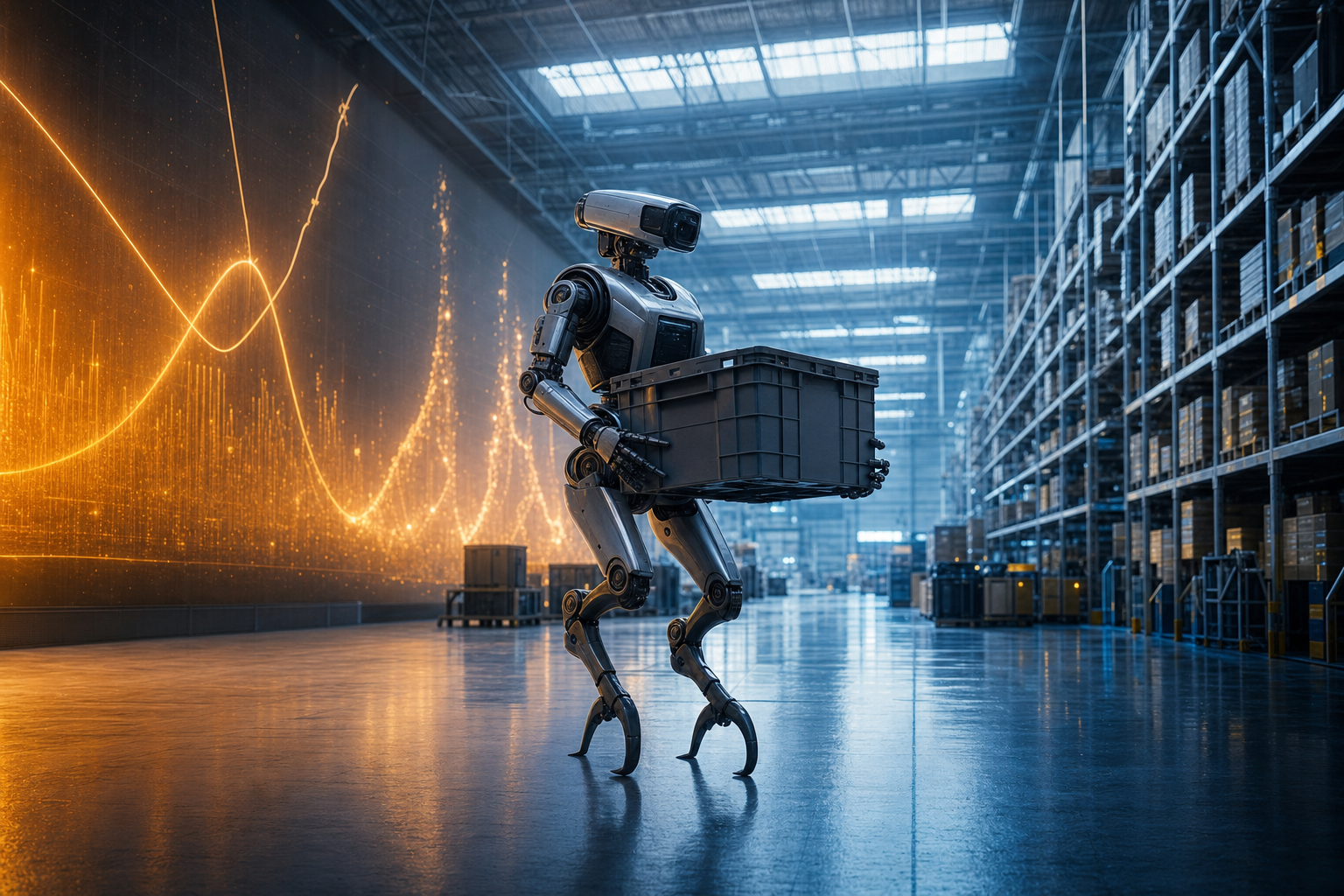

Agility Robotics is taking humanoid warehouse labor to the public markets. The Salem, Oregon-based robotics company announced plans to go public through a merger with Churchill Capital Corp XI, a special-purpose acquisition company (SPAC), in a deal valuing Agility at $2.5 billion. If completed, the transaction would make Agility the first US-listed pure-play humanoid robotics company.
The company’s flagship robot, Digit, is designed to move totes and perform repetitive material-handling work in warehouses and industrial facilities. Agility says Digit is already commercially deployed with customers including GXO, Schaeffler, Toyota, and Mercado Libre.
The transaction is expected to generate more than $620 million in gross proceeds, including Churchill cash and a private investment led by Foxconn. Agility says it will use the capital to expand deployments, scale production of its next-generation Digit v5 robot, and continue product development.
This is where the ERP and supply chain angle becomes more relevant. Agility is not going public on the promise that humanoids can dance, flip, or mimic people. It is asking investors to believe humanoid robots can become a practical answer to labor shortages, warehouse throughput pressure, reshoring, and supply chain resilience.
Analysis
What this means: Humanoid robotics is moving from demo theater to operational finance. Agility’s public-market test will force investors and customers to look past the spectacle of physical AI and ask harder questions about deployment cost, uptime, safety, throughput, labor savings, and integration into real warehouse workflows. The robotics story now has to survive the same ROI scrutiny as any other supply chain technology.
Warehouse Labor Thesis
Agility’s pitch is built around work that is repetitive, physically demanding, and hard to staff. CEO Peggy Johnson told investors demand is being driven by companies reshoring production, older workers retiring, and younger workers avoiding repetitive manual jobs. Digit is aimed at that labor gap, with a focus on moving bins, totes, and materials in warehouse and manufacturing environments built for people.
That is how Agility’s design differs from the more humanlike robotics prototypes attracting public attention. Co-founder and chief robot officer Jonathan Hurst told investors the company did not set out to build a machine that looks like a person. Digit has birdlike legs and gripper-style hands because the design is meant to fit the work.
Agility is also preparing Digit v5, which it describes as an AI-enabled, cooperatively safe humanoid robot designed to work alongside people. The company says it has more than $300 million in multi-year contracted Digit v5 orders, subject to contractual milestones, across a pipeline of more than 30 customers.
That order book gives Agility a visible customer demand story tied to industrial work, something many humanoid companies still lack.
Public Markets Meet Physical AI
The public listing will also test whether investors are ready to value humanoid robotics as a commercial category.
The sector has been filled with large private valuations, high-profile demos, and bold claims about the future of physical labor. Forbes noted Agility’s listing would provide one of the first audited public benchmarks for the humanoid robotics market, giving investors a clearer look at revenue, deployment costs, margins, production scale, and customer adoption.
For ERP leaders, physical AI is getting closer to the enterprise software conversation. In a recent ERP Today Q&A with SAP Labs, SAP’s AI roadmap extends into the longer-term question of how AI could interact with physical operations, including robotics, industrial environments, and the systems that coordinate work. Agility’s listing gives that idea a near-term market test in warehouses and industrial facilities, where physical AI has to prove it can operate safely, integrate with workflows, and deliver measurable productivity gains.
That scrutiny cuts both ways. Agility can point to real deployments, including reported work at GXO and Schaeffler facilities. Per Forbes, Digit has logged 65,000 hours in real-world operations.
But SPACs bring their own baggage. The route can move faster than a traditional IPO, but it also comes with a mixed market history and fewer disclosure requirements before the deal closes. The challenge for Agility will be showing that humanoid robots can move from early customer deployments to repeatable, profitable scale.
Analysis
What this means: Physical AI is about to get a public scorecard. Private robotics valuations have been easy to inflate because the market has had few clean financial benchmarks. If Agility completes the listing, customers and competitors will get a clearer view of whether humanoid robots are scaling as products, services, or expensive pilots with uncertain payback.
The ERP Integration Question
For supply chain and manufacturing leaders, the robotics question does not end with the hardware.
A humanoid robot working inside a warehouse has to fit into the operating system around it. That means work orders, inventory moves, warehouse management, labor planning, safety protocols, exception handling, maintenance schedules, and performance reporting. In many organizations, those workflows connect back to ERP, WMS, manufacturing execution, transportation, and analytics systems.
Digit’s value will depend on whether it can become part of that operating fabric. A robot that moves totes still needs to know which tote to move, where it belongs, what priority applies, what happens when the location is blocked, and how the completed task gets reflected in business systems.
The next generation of physical AI will need integration with the systems that already run warehouses and plants. ERP and supply chain teams will have to decide how robotic work is assigned, measured, costed, and governed. Labor planning will also change if robots become another capacity pool alongside employees, contractors, automated systems, and third-party logistics partners.
The supply chain benefit is real only if the work shows up in the system of record.
The Supply Chain Reality Check
Agility’s move comes as humanoid robotics companies race to define the category.
Tesla continues to promote Optimus as a long-term robotics opportunity. Unitree is pursuing a listing in China. Other companies are targeting industrial, logistics, and general-purpose physical work. But Agility is taking a narrower path: worker-bee robots for material handling and industrial operations.
That focus may be an advantage. The first market for humanoids is unlikely to be every task everywhere. It is more likely to be dull, repetitive, physically taxing work where labor is scarce, workflows are structured, and ROI can be measured.
For ERP and supply chain leaders, that makes the Agility listing worth watching. It will show whether public investors believe the labor gap in warehouses and factories is large enough, urgent enough, and economically measurable enough to support a humanoid robotics company.
It will also test how quickly physical AI can be adopted. If robots become part of warehouse staffing, companies will need new ways to plan work, measure utilization, calculate cost per task, manage downtime, and blend robotic labor with human teams.
The warehouse robot may look like the story. The bigger story is whether physical AI becomes a manageable line item in the supply chain operating model.
Analysis
What this means: Robotic labor will need ERP-grade measurement. If humanoids become part of warehouse and manufacturing capacity, companies will need to track cost per task, uptime, exception rates, safety incidents, throughput, maintenance, and labor substitution with the same discipline they bring to human staffing and automation assets. The market will not scale on vision videos; it will scale on operational math.