
Enterprise leaders have spent the past two years talking about generative AI strategy. But what is actually running inside live ERP operations today?
 That question is where Mukesh Kumar spends much of his time. Kumar is a Premium Engagement leader and Midwest AI Champion at SAP America, and he also sat on the Technical Review Committee for SAP Sapphire and the ASUG Annual Conference. In his work with customers, he sees a pattern that should sound familiar to most ERP leaders: AI ambition is high, but production adoption remains narrow.
“There is a distinct gap right now, and it’s wider than most people admit,” Kumar said during a conversation with SAPinsider. “In public, every leader has an AI strategy and a confident roadmap. But the honest version can be heard in the room—many pilots, very little in production.”
Most ERP are living that distinction. The organizations making progress are not starting with an enterprise-wide AI mandate. They are finding a specific process where manual work creates cost, delay, audit exposure, or regulatory risk, then building automation around that problem using systems and controls the business already trusts.
As Kumar put it, “ambition is set at the enterprise level, but value only shows up at the process level.”
Why OCR and RPA Stall in Complex ERP Processes
Document processing is one of the most common places enterprise AI starts, but it is also one of the places where older automation approaches show their limits.
Traditional optical character recognition (OCR) can extract information from documents, but it often depends on fixed templates. When a vendor changes a format, a scan is messy, or a document arrives in a different language or layout, the automation breaks. In ERP workflows, extraction is only the first step. The system still needs to understand whether a customer, material, tax ID, quantity, or delivery reference matches the records inside the ERP system.
Kumar said that is where OCR alone falls short. It can capture a field, but it cannot reliably map that field to the right internal business partner or master record in the ERP system without additional validation.
The common workaround is to layer robotic process automation (RPA) on top. That can move data across screens, but it also adds a second toolchain, another set of credentials, and another governance model. In Kumar’s view, that approach often creates a maintenance burden rather than a durable automation layer.
“Now you have two tools, two governance models, two sets of credentials, and a pipeline that breaks every time SAP ships an update,” he said. “That is not automation but a permanent maintenance contract you’re funding.”
A Compliance Problem Became the AI Use Case
Kumar recently designed and deployed an automation framework for a global agricultural company facing a complex sales-order problem in Argentina.
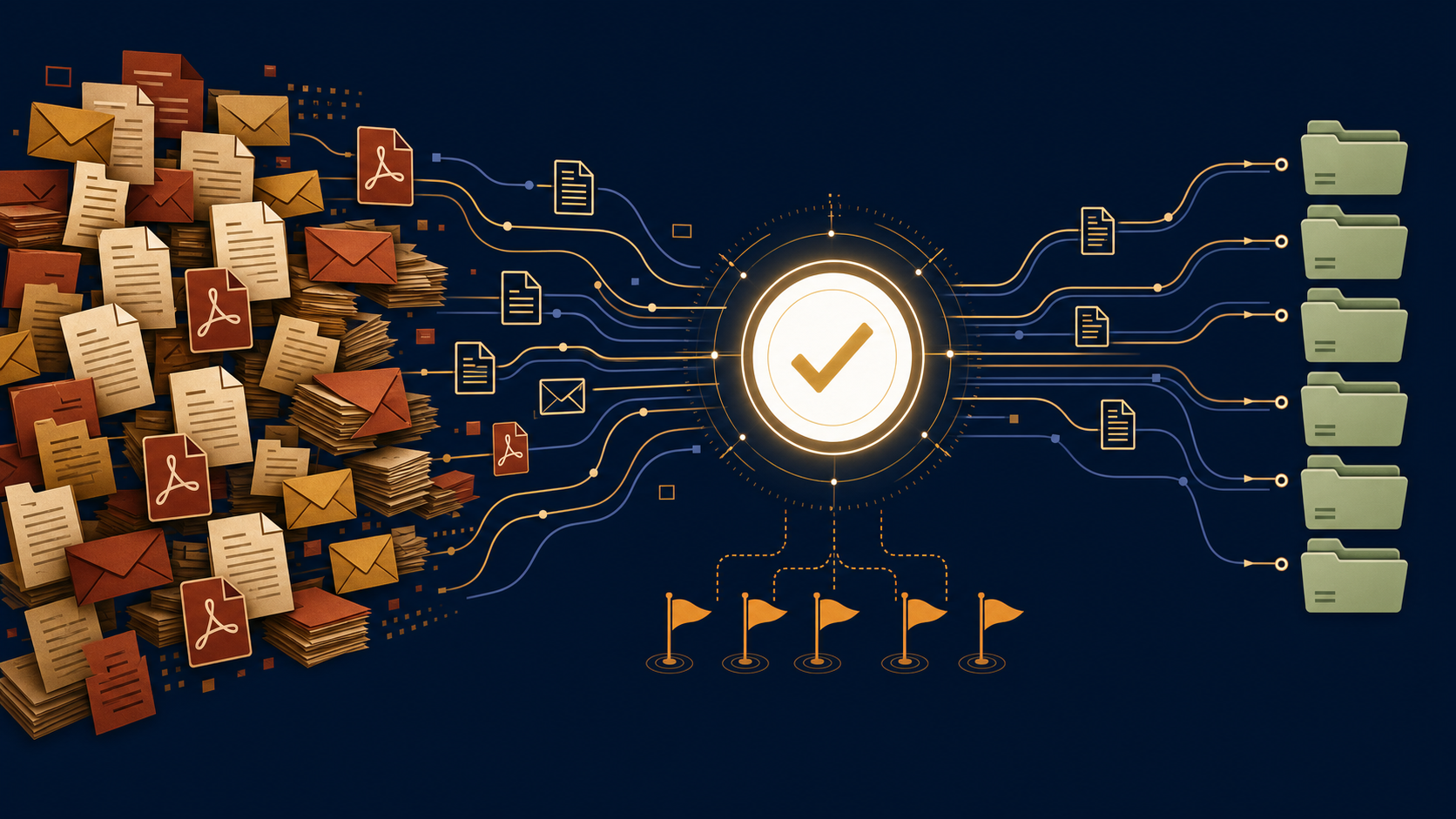
During peak season, consignment sales orders arrived by email as PDFs, scans, and photos of handwritten sheets in multiple languages. Argentine regulations required chemical orders to be posted and invoiced in the same calendar month in which they were delivered. The company’s 15-person customer service team was under pressure to keep pace, and the manual process created a risky shortcut: multi-line dealer orders were collapsed into a single product line so the team could close the books on time.
The totals matched, but the line-item detail did not. That triggered an internal audit finding.
The project did not begin as an AI experiment. It began as a mission to remove regulatory exposure from a live business process. Kumar’s team built an intelligent automation framework on SAP Business Technology Platform to preserve a clean core while using SAP Build Process Automation to monitor inboxes and SAP Document AI as the extraction layer.
The key design choice was contextual extraction. Instead of telling the system where to find data on a fixed document template, the team created a custom schema that told the model what to find: customer, material, quantity, and other order details. That let the framework keep working even when dealers changed layouts or sent imperfect documents.
The framework then validated extracted data against live SAP S/4HANA master records through the SAP Cloud Connector, using existing identity and access management (IAM) controls and standard APIs. The custom schema, validation logic, and master data mapping rules were original work, while the platform foundation used native SAP capabilities.
Analysis
What this means: Live ERP data should shape the automation design. Kumar’s framework validated incoming order data against SAP S/4HANA master records in real time and routed exceptions to a human instead of guessing. ERP leaders should stop treating perfect master data as the entry requirement for AI and use controlled production workflows to surface, prioritize, and fix the data issues that affect real transactions.
Sponsor Industry‑Grade Research
Production Metrics Replaced Pilot Claims
Sandbox numbers do not carry much weight, per Kumar. “Production numbers are the only ones that matter,” he said.
The framework went live in Q3 2025, and by Q4 it had processed 5,780 sales orders; 70% of consignment sales orders flowed through the automated pipeline. Manual effort per order fell by 90%. The same 15-member team absorbed a 30% increase in transaction volume without adding headcount. The company saved 1,050 annual person-hours and closed month-end two days faster.
The compliance result was just as important as the productivity gain. Because the automation preserved every original line item as submitted, it eliminated the shorthand entry practice that caused the audit finding. The process now created a cleaner end-to-end audit trail.
The operating model also stayed familiar. The team did not have to learn a new front-end application. Users kept working through email, while the automation layer handled extraction, validation, routing, and posting behind the scenes.
Governance Has to Be Designed In
For ERP leaders, the most relevant part of the project is not just that AI reduced manual work, but that the framework was built inside governance structures Finance already trusted.
Kumar’s team kept one manual checkpoint: a human-in-the-loop step for validation exceptions. That checkpoint was not treated as a weakness. It gave the model a way to learn from edge cases during the pilot and gave Finance a clear control point before automation acted on uncertain data.
“Governance is designed in, not bolted on,” Kumar said. “Because we built on existing IAM and standard SAP S/4HANA APIs, every transaction inherits the same controls that Finance already trusts.”
That is the difference between AI that creates a new audit problem and AI that helps resolve one. Any automation touching financial transactions, regulated orders, customer records, or master data needs explainable controls, exception handling, and traceability from the start.
Kumar sees the next stage becoming more agentic. The team is prototyping an AI agent that can triage validation exceptions, propose fixes, and route only the genuinely ambiguous cases to a person. The direction is more autonomy, but within the same platform governance.
“That’s where production generative AI is heading in 2026,” he said. “More autonomy under the exact same platform governance.”
Analysis
What this means: Finance needs governance built into the first release. AI that touches orders, invoices, contracts, payments, or close processes must inherit identity, access, approval, API, and audit controls from the systems the business already trusts. ERP and finance leaders should require human checkpoints, traceable exceptions, and clear evidence trails before expanding automation across mission-critical processes.
Get Our Free Weekly Newsletter
Start with the Fundable Problem
For ERP leaders building AI roadmaps, Kumar’s advice is to start with one use case that has a measurable financial or compliance consequence.
“An enterprise-wide AI strategy that is not anchored to a funded, measurable process is just a very expensive opinion,” he said. “Pick the most fundable use case, not the fanciest one.”
That line is worth applying across ERP automation. Many organizations are waiting for perfect data, a fully defined AI operating model, or an enterprise-wide architecture before moving any use case into production. Kumar’s example points to a different sequence. Choose a high-friction process, validate data against live systems, keep humans in the loop where uncertainty remains, and use production transactions to expose the issues that actually matter.
The agriculture company’s automation project did not start because someone wanted an AI showcase. It started because a business process carried regulatory risk and manual work could no longer scale. AI became useful because it solved a specific ERP problem with measurable consequences.
Analysis
What this means: ERP teams should anchor GenAI to a funded operational problem. The strongest AI use cases will not begin with broad strategy language or generic productivity goals. CIOs and transformation leaders should identify processes where manual work creates cost, delay, compliance risk, or audit exposure, then build AI around the business case already strong enough to justify investment.