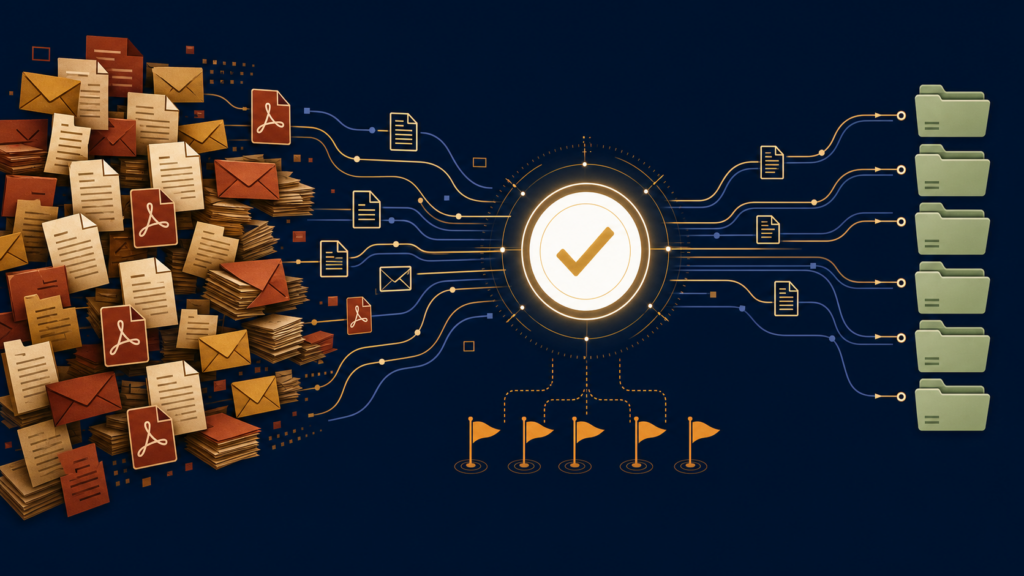
Enterprise AI is moving closer to the work. For the past few years, most of the value has come from helping people find information, spot issues and decide what to do next. The harder test begins once AI can act on those decisions. What authority should it have and who remains accountable?
That matters in ERP, supply chain, enterprise asset management and field service because these systems sit inside the processes that keep operations moving. When an agent can update a workflow, trigger the next step or complete an approved action, the discussion moves from insight to execution.
I have been writing about ERP moving from a system of record toward an execution layer in Why ERP Became The Execution Layer, Not Just The System Of Record. The harder part is everything that happens between seeing a condition and acting on it. The system needs the right operational context, clear decision rights and enough control to carry that decision into the workflow without creating a new problem.
That is where IFS Loops, the company’s agentic AI platform, enters the discussion. The question is not whether a Digital Worker can automate another task. It is whether IFS can connect trusted enterprise and industrial context with defined authority, coordinated execution and a measurable business result. That’s what I want to explore more during IFS Unleashed.
Systems Of Record Still Anchor Execution
AI does not make ERP less important. As agents take on more work, the systems underneath them matter more because they hold the transactions, permissions, rules and operating history that explain how the company works. An agent needs to know what is real before it can change what happens next.
Consider a manufacturer where a critical press begins running hotter and vibrating more than normal, but output remains within specification. The alert alone does not tell the business what to do. The decision depends on asset history, recent maintenance, open work orders, the production schedule, available spare parts and the customer order tied to the line.
That is what makes the system of record more valuable when AI can act. The agent is not just reading a temperature or vibration alert. It needs to understand what is happening around the asset, what the plant has committed to produce and which actions are permitted. Trusted context is the currency for enterprise AI because acting on the signal alone can create a second problem.
Trusted Context Reaches The Shop Floor
On the shop floor, the same signal can mean something different depending on the work being performed. Equipment condition, safety, maintenance history, production priorities, product quality and customer commitments all shape the decision.
Take the press example further. If vibration increased after a product changeover and historical data shows the pattern normally settles, the best decision may be to keep running and monitor it. If the pattern resembles a prior bearing failure and a replacement part is available, the better decision may be to inspect the machine at the next planned changeover, reserve the part and protect the customer order before the line fails.
IFS’s ERP, enterprise asset management and field service applications provide much of the operational context. Loops adds Digital Workers with configurable actions, permissions and governance controls. The test is whether those pieces work together well enough for an agent to understand the impact of a decision on the asset, production plan, service requirement and customer commitment.
I recently discussed a similar issue with Epicor CEO Vaibhav Vohra. He noted that even customers running the same software footprint can define processes and transactional data differently. An agent can understand an application and still misunderstand the business. More data does not guarantee a better decision if the definitions and operating rules around it are incomplete.
Decision Architecture Defines AI Agent Boundaries
Once an agent can update a transaction, trigger a workflow or make an approved change, the enterprise has to decide who or what can make which decisions. I describe this as decision architecture. It defines authority, escalation, reversibility and accountability before an action carries an operational or financial consequence.
I explored this in How AI Agents Are Changing ERP And What CIOs Need To Know. A system may identify a supplier delay, prepare a purchase order change or recommend moving production. That does not mean it should execute every step. The business still has to define where the agent can act, where a person needs to approve and who owns the outcome.
The shop floor makes those boundaries easier to see. An agent may open an inspection task automatically, while stopping the line may require an operations manager. Reserving a spare part may be routine, while moving a production order can affect labor, freight, inventory and customer commitments. Those decision rights need to be set before the agent is asked to act in real time.
IFS describes a progression from assistance toward more independent Digital Workers. The point is not autonomy for its own sake. Authority should expand only when the workflow is understood, results are consistent and trust is earned. People should remain accountable for exceptions and higher risk decisions. An audit trail should capture the inputs, approvals and actions needed to investigate the outcome.
IFS Loops Moves From Insight To Execution
Most enterprises already know when something is wrong. Dashboards, alerts, analytics and copilots surface the issue. The gap often appears after the alert, when a supplier is late, a machine shows signs of failure or a customer order is at risk and someone still has to coordinate the response across systems and teams.
IFS Loops is designed for that handoff. Digital Workers can carry an approved response through workflows and execute authorized actions in enterprise systems. The key is whether each action stays inside the business rules, approval limits and operating conditions that apply to the work.
Kitron Group offers an early production example. IFS says the manufacturer is rolling out purchase-to-order Digital Workers across all 13 sites by the end of 2026, while keeping existing business rules, guardrails and approval processes in place. During the rollout, one Digital Worker surfaced a part number error that had gone unnoticed for roughly a decade. The example shows an agent exposing a data issue within an established workflow. The next question is whether that improves accuracy or reduces rework over time.
The shop floor makes the consequences more immediate. In the press example, a Digital Worker could carry an approved maintenance decision into the workflow by coordinating the work order, parts requirement, technician availability and production plan. That reduces manual coordination without giving the agent unlimited control.
Kodiak Gas Services provides a business outcome example. Its Material Replenisher Digital Worker gives more than 800 field technicians access to live inventory, warehouse location and ordering information across roughly 150 warehouses. Kodiak estimates that if half of its technicians use the agent once per day, it could return more than 90,000 hours to the workforce and deliver about $3 million in projected annual ROI. That ties the technology to capacity and financial value rather than an agent count.
How To Measure Whether AI Execution Improves Business Outcomes
Measurement has to stay tied to the operation. Cycle time, throughput, capacity, service, downtime, asset utilization, inventory, working capital, operating cost and margin tell us more than an agent count. A Digital Worker that completes thousands of tasks but creates more exceptions or slows decisions has not improved execution.
The workforce outcome matters too. Industrial companies are dealing with lean teams, retiring experts and pressure to preserve institutional knowledge. A maintenance expert should not spend time rebuilding an asset history across several systems if a Digital Worker can assemble the context reliably. A planner should not spend hours chasing routine exceptions that fit established rules.
That is why I see Industry 5.0 as an operating model rather than a technology label. The issue is how people and Digital Workers divide the work, how knowledge is preserved and where human judgment remains essential. Technology enables transformation. People determine the outcome.
What IFS Needs To Show At Unleashed
These examples leave an important question unresolved. IFS describes its Industrial AI Harness as the context and control structure around Digital Workers. The issue now is how consistently that model holds up in production.
At Unleashed, I want to see which workflows customers trust Digital Workers to execute today, why those were chosen first and what had to be true before authority expanded. I also want to understand how Loops behaves when work crosses IFS and other systems. If an action completes in one system but fails in another, who detects the mismatch, who corrects it and who owns the outcome?
The workforce result is just as important. If a Digital Worker takes over routine work in procurement, planning, service or maintenance, what does the employee do differently the next day? Returned hours only create value if that capacity improves decisions, service, throughput or another part of the operation.
Digital Workers have to use the right context, stay within defined authority and improve outcomes the business already measures. If customers cannot point to a meaningful change in how the business operates, the technology has not earned a larger role.
Trust is earned in production. Results set the boundary for what AI can do next.