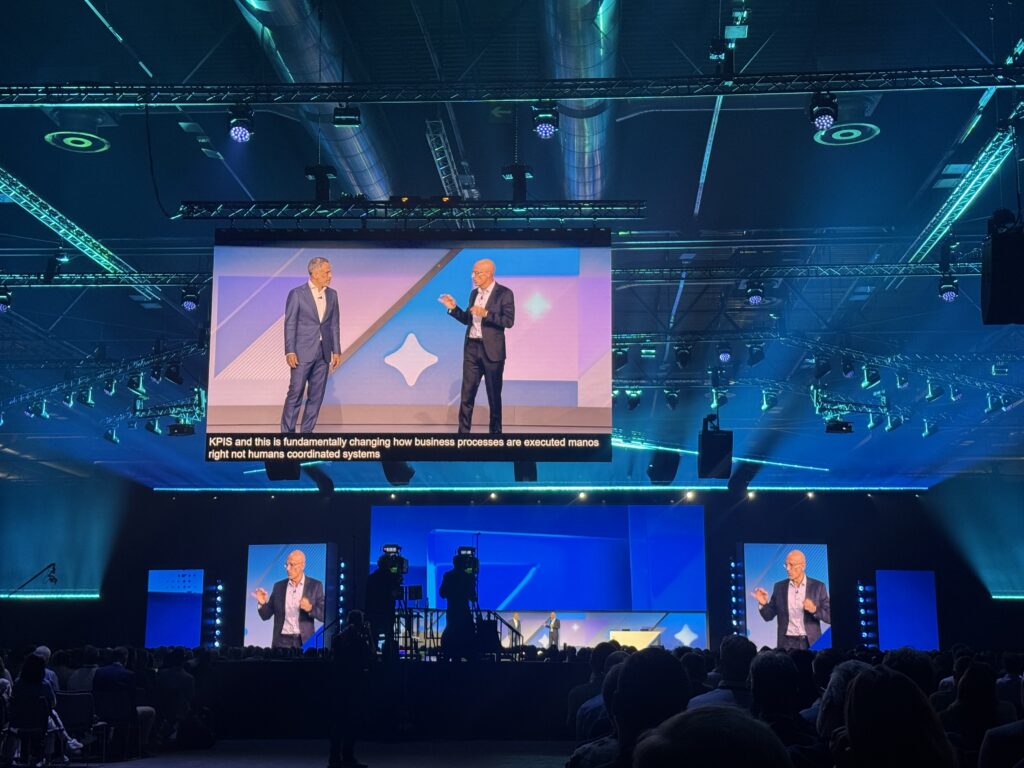


Over the past year, the way organizations talk about AI has changed, according to Jesper Schleimann, Head of Business AI for SAP in EMEA.
“The conversation has moved from ‘What can AI do?’ to ‘How do we fundamentally change the way we work and operate our business with AI?’” he said. “The fundamental shift is from AI as a productivity tool to AI as an operating capability of the enterprise.” Customers, he added, are asking how AI can help their entire organization operate more intelligently.
Schleimann, the author of The Intent-Driven Organization, will give the keynote “From Intent to Outcome – Autonomous Enterprise” at SAPinsider Copenhagen 2026 on Tuesday, November 17, from 9:00 to 10:00 AM in Vandsalen at the Tivoli Hotel & Congress Center.
In an interview ahead of the event, he described the organizational challenge of putting AI to work and what leaders can do about it.
AI Exposes How Organizations Are Built
The organizational challenge shows most clearly, he explained, once AI moves past IT-led experiments and analytics and starts executing business processes. With agents making decisions, coordinating work across departments, and carrying out transactions, “existing organizational structures can become a constraint.”
He points to how organizations have been designed: “We have spent more than a century designing organizations around human labor, with functional departments, reporting hierarchies, and KPIs optimized for human execution.”
He calls this Organizational Friction, which he describes in his book as the barriers that keep intelligence from becoming business outcomes.
“You cannot unlock the potential of autonomous AI simply by adding technology to an organization designed exclusively around human execution,” he said. Structure still has a job, though: “Hierarchy remains essential for accountability, but execution must increasingly be orchestrated across organizational boundaries.”
Organizations making real progress are redesigning work around outcomes and “rethinking responsibilities, decision rights, incentives, and human-AI collaboration.”
Autonomy Should Be Earned Through Evidence
Deciding what to delegate to AI, and under which conditions, will be “one of the most important leadership capabilities in the age of autonomy,” Schleimann noted.
His answer is a method he calls Autonomy Zones, which can be used by leaders to define “the appropriate level of AI autonomy based on uncertainty, business consequences, reversibility, and evidence of reliable execution.”
Routine and predictable work can increasingly go to AI, he said. People remain more directly involved where uncertainty is high, consequences are significant, or ethical and regulatory considerations demand human judgment. Deciding how much work to delegate, he argued, “should be a matter of autonomy earned through evidence.”
He calls this leadership discipline Trusted Execution, in which leaders authorize, control, verify, and calibrate the work delegated to AI, and describes the goal as “the highest appropriate level of autonomy that can be trusted.”
Work Can Start From the Outcome a Person Wants
When asked what building work around intent looks like in practice, Schleimann described a manufacturer with a time-critical customer order.
Today, filling it often means numerous handovers and approvals, as predefined activities run across customer service, inventory, procurement, logistics, and finance. Tomorrow, he said, an employee could simply state the desired outcome: “Fulfill this customer order by Friday, meeting our service levels, profitability targets, and compliance requirements.”
In SAP’s Autonomous Enterprise, SAP Joule could then orchestrate specialized AI agents to evaluate inventory, coordinate fulfillment, and execute authorized transactions, escalating exceptions that require human judgment.
“Intent becomes the organizing principle of work,” he said. People then focus on setting direction and boundaries, while exercising judgment and overseeing execution. He calls the sequence – understand, decide, execute, and learn – the Intelligence Loop, with evidence validating outcomes and enabling continuous improvement.
Accumulated Learning Becomes the Advantage
Looking ahead to 2027, Schleimann explained, organizations need trusted business context, effective AI governance, and repeatable ways to scale successful use cases.
What interests him most is “the emergence of insights and intelligence across the organization that compounds over time.” Organizations should “systematically retain validated outcomes, decision patterns, business context, and proven execution methods,” he added, so that each AI interaction does not start from zero, and he calls the accumulated organizational learning Intelligence Capital.
Executives should ask, he said, “What am I building and learning through AI today that will make my organization more intelligent tomorrow — and that competitors cannot easily replicate?” Models can be acquired and technology copied, he noted, but “accumulated organizational intelligence is much harder to replicate.”
“The defining competitive advantage will not be who uses the most AI,” he concluded, “but who builds the organization that learns and improves the fastest.”
What This Means for ERP Insiders
AI programs become organizational design programs. Rethinking responsibilities, decision rights, and incentives is progress made well beyond a technology roadmap. Companies that plan those changes alongside the technology are less likely to see existing structures become a constraint.
Delegating to AI becomes a leadership decision. Deciding what to delegate, and under which conditions, is a leadership capability, which makes it a decision for company leadership as well as IT. Organizations that treat it that way can match the autonomy AI receives to what is at stake in the work.
What an organization learns from AI becomes its advantage. The outcomes, decision patterns, and methods it retains from its AI work are assets that competitors cannot easily copy. Companies that retain what their earlier AI work validated can build each later effort on proven ground.
This article was first published by SAPinsider.