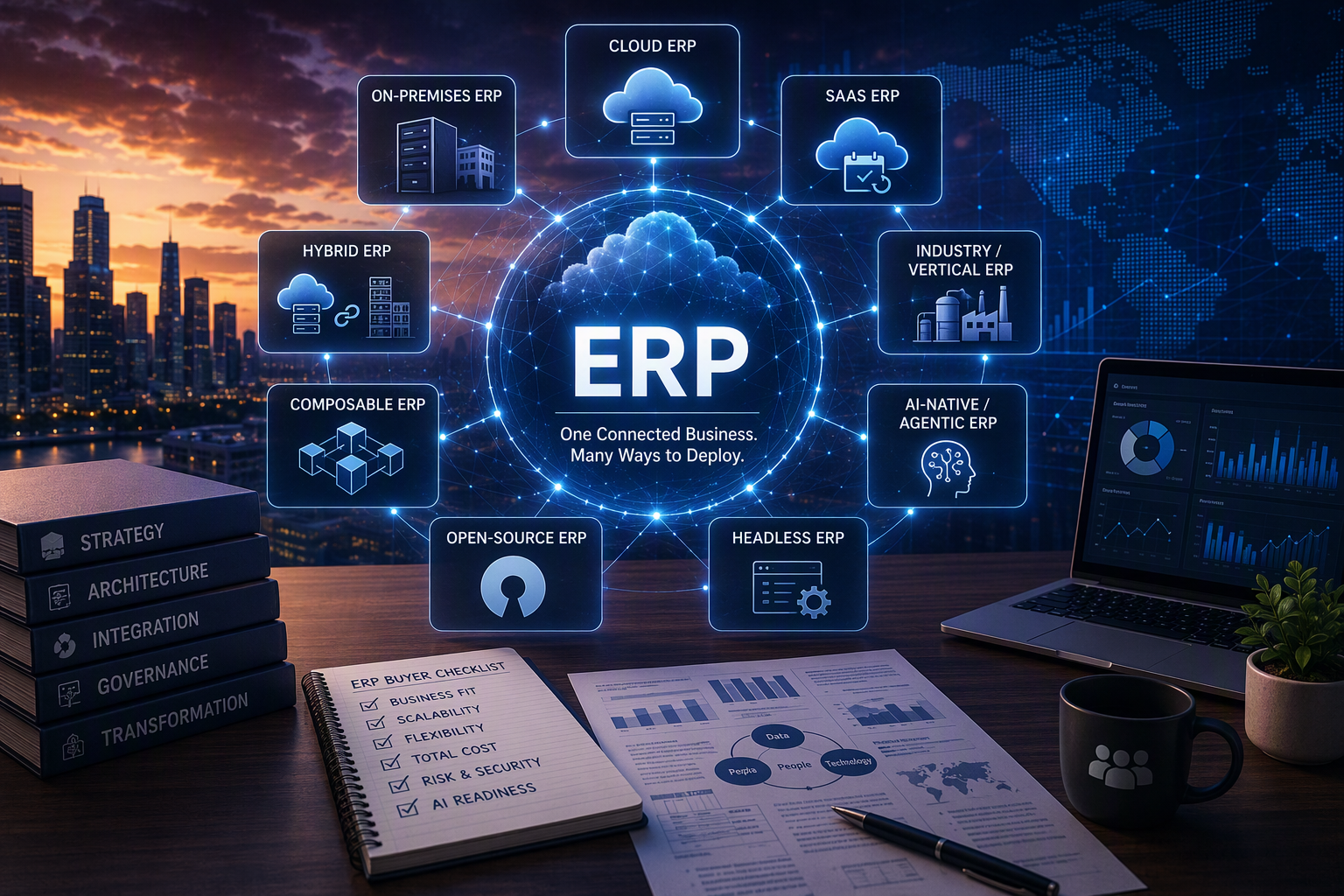
“Enterprise Resource Planning” has become a catch-all phrase for many different software models. Buyers now hear about cloud ERP, SaaS ERP, on-premises ERP, hybrid ERP, composable ERP, vertical ERP, open-source ERP, AI-native ERP, and agentic ERP, often in the same conversation.
Those terms are related, but they do not mean the same thing. Some describe where the system runs. Some describe how it is paid for and updated. Others describe architecture, industry fit, or how much intelligence is embedded into the workflow.
This FAQ breaks down the main ERP system types, deployment models, and architectural styles enterprise buyers are most likely to encounter.
What Is ERP?
In practical terms, ERP is the core set of business applications used to connect and manage processes such as finance, procurement, inventory, supply chain, manufacturing, projects, HR, sales, service, and reporting. A traditional ERP system gives organizations a shared data foundation and common process model. Instead of every department running on separate tools and spreadsheets, ERP is meant to give the business one trusted operating backbone. Modern ERP systems are expanding beyond transaction processing. They increasingly include analytics, automation, embedded AI, workflow orchestration, and industry-specific capabilities.
What Are the Main Types of ERP Systems?
The main ERP categories can be grouped in four ways.
- ERP can be categorized by deployment model: on-premises, cloud, SaaS, private cloud, public cloud, or hybrid.
- ERP can be categorized by business fit: generic ERP, industry-specific ERP, vertical ERP, or specialized ERP for a sector such as manufacturing, healthcare, energy, retail, professional services, or higher education.
- ERP can be categorized by architecture: monolithic ERP, modular ERP, composable ERP, two-tier ERP, or headless ERP.
- ERP can be categorized by intelligence model: traditional ERP, AI-augmented ERP, AI-native ERP, or agentic ERP.
The right question is not “which type is best?” but “which model fits the organization’s operating model, risk tolerance, data strategy, industry requirements, and modernization timeline?”
What Is On-Premises ERP?
On-premises ERP is deployed and managed in the organization’s own data center or in infrastructure it controls directly. Historically, this was the default ERP model for large enterprises.
The appeal is control. Organizations can manage infrastructure, security, customizations, integrations, upgrade timing, and data location more directly. That can be important for highly regulated sectors, complex legacy environments, or businesses with specialized operating requirements.
The trade-off is maintenance. On-premises ERP can carry higher infrastructure costs, more upgrade complexity, heavier customization debt, and greater dependence on internal skills. It can also make AI, analytics, and process automation harder to scale if the system has been heavily customized over many years.
What Is Cloud ERP?
Cloud ERP is delivered through cloud infrastructure rather than a traditional customer-managed data center. The application may be run in a public cloud, private cloud, vendor-managed cloud, or hybrid environment. Cloud ERP usually gives organizations faster access to updates, broader accessibility, more scalable infrastructure, and a cleaner path to analytics and AI. It can also reduce the burden of maintaining hardware and legacy infrastructure.
But cloud ERP is not one thing. A cloud ERP program may involve a standardized SaaS product, a private cloud version of an enterprise suite, or a hosted version of an older ERP environment. Buyers need to understand what is actually changing: infrastructure, licensing, application architecture, update cadence, process model, or all of the above.
What Is SaaS ERP?
SaaS ERP stands for software-as-a-service ERP. In this model, the vendor delivers the ERP application as a subscription service. The customer accesses the system through the cloud, while the vendor typically manages updates, security patches, application availability, and platform maintenance.
The strongest SaaS ERP argument is speed and standardization. Customers can adopt new functionality more regularly, avoid major technical upgrades, and benefit from a vendor-managed release cycle.
The trade-off is flexibility. SaaS ERP usually limits deep customization because the vendor needs to keep customers on a common product and update path. That can be positive if the business wants standard processes. It can be difficult if the organization has years of highly specific workflows that do not map cleanly to the SaaS model.
Get Our Free Weekly Newsletter
What Is the Difference Between Cloud ERP and SaaS ERP?
Cloud ERP describes where and how the ERP is hosted. SaaS ERP describes a software delivery and commercial model. The model also changes the cost equation, with many traditional ERP environments built around upfront licensing and infrastructure costs while SaaS ERP shifts more of the spend into subscription and operating costs.
All SaaS ERP is cloud-based, but not all cloud ERP is SaaS. A company can move an ERP system to cloud infrastructure without adopting a true SaaS application model. It might still be running a highly customized application in a hosted environment, with upgrades and operations that look more like legacy ERP than modern SaaS.
That distinction matters because “moving to the cloud” does not automatically mean simpler processes, continuous innovation, or lower long-term complexity. Buyers should ask whether the project is a hosting change, a software replacement, a process standardization program, or a full operating model transformation.
What Is Public Cloud ERP?
Public cloud ERP runs on shared cloud infrastructure operated by a hyperscaler or software vendor. The infrastructure is shared across customers, though data and application access are logically separated and secured.
Public cloud ERP is often attractive because of scalability, speed, standardization, and access to frequent innovation. It can be a strong fit for organizations willing to adopt standard processes and reduce customization.
The challenge is fit. Public cloud ERP may not support every industry-specific or company-specific process in the same way as an older customized environment. For complex enterprises, the evaluation needs to focus on which processes can standardize and which require extensions, adjacent applications, or a different deployment model.
Sponsor Industry‑Grade Research
What Is Private Cloud ERP?
Private cloud ERP gives an organization a more dedicated or controlled cloud environment than public cloud. For example, an environment on a hyperscaler that is only accessible by a single client or tenant. It can be attractive for organizations that want cloud modernization but still need more control over configuration, security, compliance, data residency, or operational timing.
Private cloud ERP is common in large enterprise modernization programs where the organization wants to move away from traditional infrastructure without accepting every standardization trade-off of public cloud SaaS.
The risk is that private cloud becomes a halfway house. If a business keeps every customization, process exception, and integration pattern from its old environment, it may reduce infrastructure pain without simplifying the ERP operating model.
What Is Hybrid ERP?
Hybrid ERP combines more than one deployment or application model. An organization might run core finance on cloud ERP, keep manufacturing or student systems on legacy platforms, connect SaaS applications for HR or procurement, and maintain industry-specific systems around the edges.
Hybrid ERP is common because most organizations do not modernize everything at once. It can reduce migration risk and allow different parts of the business to move at different speeds.
The challenge is integration. Hybrid ERP only works if data governance, process ownership, security, reporting, and integration architecture are strong enough to hold the landscape together. Otherwise, hybrid becomes another name for fragmentation.
What Is Two-Tier ERP?
Two-tier ERP means an organization uses one ERP system at corporate headquarters and another ERP system for subsidiaries, divisions, geographies, or acquired businesses.
A common example is a global company running a large enterprise ERP at headquarters while using a lighter cloud ERP system for smaller business units. This can help the organization avoid forcing every subsidiary into the same heavy operating model.
Two-tier ERP can work well when the business needs local agility and corporate control at the same time. It becomes risky when the two tiers do not share clean master data, reporting standards, controls, or integration rules.
What Is Industry-Specific ERP?
Industry-specific ERP is designed around the processes, data, compliance needs, and operational realities of a particular sector. Manufacturing ERP, food and beverage ERP, healthcare ERP, energy ERP, construction ERP, and professional services ERP all solve different problems.
A generic ERP system may handle finance, procurement, and reporting well. But a food company may need lot traceability, shelf-life controls, catch weight, recalls, and quality holds. An energy company may need asset lifecycle management, field work, commodity exposure, or regulatory reporting. A university may need student records, financial aid, advising, grants, and degree progress.
Industry-specific ERP reduces the gap between standard software logic and real operating requirements. The buyer question is whether the vendor has enough depth in the workflows that create the most risk, cost, or differentiation for the business.
What Is Vertical ERP?
Vertical ERP is closely related to industry-specific ERP. The term usually refers to ERP designed for a narrow industry vertical rather than broad cross-industry use.
For example, a vertical ERP product may be built specifically for food manufacturing, distribution, healthcare, construction, retail, or industrial services. It may include preconfigured workflows, industry data models, compliance capabilities, and terminology that fit the sector.
Vertical ERP can shorten implementation time and reduce customization, but it can also narrow the vendor shortlist. Buyers should test whether the vertical depth is real product capability or mostly marketing language.
What Is Modular ERP?
Modular ERP breaks ERP capabilities into connected modules such as finance, procurement, manufacturing, supply chain, HR, projects, service, analytics, or planning.
Most modern ERP suites are modular to some degree. Organizations can implement core modules first and expand over time. This can reduce implementation risk and help businesses prioritize the functions with the strongest value case.
The key issue is whether the modules truly work together. Modular ERP is valuable when data, workflows, security, reporting, and user experience remain connected. It is less valuable when each module becomes another silo.
What Is Composable ERP?
Composable ERP is an architectural approach that lets organizations assemble a business application landscape from interoperable components rather than relying entirely on one monolithic suite.
In a composable model, the ERP core may remain responsible for financial governance and transaction integrity, while specialized applications handle billing, planning, customer engagement, industry workflows, analytics, or automation. APIs, integration platforms, data products, and process orchestration become critical.
Composable ERP can increase flexibility and help organizations adopt best-of-breed capabilities. It also increases architecture responsibility. The more composable the stack becomes, the more important integration discipline, data governance, security, and ownership become.
What Is Headless ERP?
Headless ERP separates the user experience and workflow layer from the ERP transaction core. The ERP remains the system of record, but users may interact through portals, mobile apps, AI agents, workflow tools, or industry-specific interfaces rather than the traditional ERP screen.
This approach can help organizations extend the life of a legacy ERP core or modernize user experience without immediately replacing the full system. It can also support AI-driven workflows that orchestrate actions across multiple systems.
The risk is control. If the headless layer becomes too detached from the ERP core, organizations may create new governance, audit, security, and process-consistency problems. Headless ERP needs strong APIs, permissions, observability, and business rules.
What Is Open-Source ERP?
Open-source ERP gives organizations access to software with code that can be inspected, modified, or extended under an open-source license. ERPNext and Odoo are common examples in the open-source ERP conversation.
The appeal is flexibility, lower licensing cost, and control. Open-source ERP can be attractive to smaller and mid-sized organizations, especially when they have technical capability and want to avoid traditional enterprise software lock-in.
The trade-off is responsibility. Open-source ERP still requires implementation, support, security, governance, integrations, and process design. The software may be less expensive to acquire, but the total cost depends on how much the organization needs to configure, customize, maintain, and support.
What Is AI-Native ERP?
AI-native ERP describes ERP systems designed with AI built into the product architecture, user experience, and workflow model from the start rather than added later as a separate feature.
An AI-native ERP system may use AI to automate finance workflows, identify anomalies, summarize transactions, recommend actions, assist users, or orchestrate processes. The key distinction is that AI is not only a reporting layer. It is embedded into how users work and how decisions are guided.
Buyers should be careful with the term. AI-native can mean very different things across vendors. The important questions are where the AI runs, what data it uses, whether it can explain recommendations, how permissions are enforced, and whether humans remain accountable for high-risk actions.
What Is Agentic ERP?
Agentic ERP uses AI agents to monitor conditions, recommend actions, or execute tasks across ERP workflows. An agent might flag a pricing issue, monitor order exceptions, prepare a journal entry, check supplier risk, assist with inventory decisions, or coordinate steps across finance, supply chain, and service systems.
The promise is that ERP moves from passive recording to active guidance. Instead of waiting for users to find problems, agents can identify risks, surface exceptions, and help resolve them in the flow of work.
The risk is governance. ERP agents need clear permissions, audit trails, escalation paths, testing, and human oversight. The more an agent can do, the more important it becomes to prove what it saw, what it recommended, what it changed, and who approved the action.
Which ERP Model Is Best?
There is no universal best ERP model. The right choice depends on business size, industry complexity, regulatory exposure, process maturity, customization debt, data quality, growth strategy, and appetite for change.
A fast-growing midmarket company may benefit from SaaS ERP because it needs standardization and speed. A complex manufacturer may need industry-specific ERP. A regulated enterprise may choose private cloud or hybrid ERP. A global business may use two-tier ERP. A company with many specialized systems may move toward composable ERP. An organization with a stable but aging core may explore headless ERP as an interim step.
The best ERP model is the one that improves the operating model without creating hidden complexity elsewhere.
What Questions Should ERP Buyers Ask?
ERP buyers should start with the business problem, not the software label. The most important questions are practical.
- Which processes need to standardize?
- Which workflows are truly industry-specific?
- Which customizations still create value?
- Which integrations are business-critical?
- Which data must be trusted for AI and analytics?
- Which functions need to move now, and which can wait?
They should also ask how the vendor handles updates, security, customization, data ownership, AI governance, partner support, and long-term cost. A modern ERP system is not only a technology purchase. It is a decision about how the business will operate, govern data, and adapt over time.
The ERP vocabulary will keep changing. The core buyer discipline should not. Define the operating model first, then choose the ERP system that can support it with the least avoidable complexity.