Public Sector

Oracle and AWS Cloud Database
Oracle Takes On the Federal Government’s HR Patchwork
The US Office of Personnel Management (OPM) has awarded Oracle a $395.8 million Federal HRIT Modernization contract to deliver the federal government's first government-wide HR platform using Oracle Fusion Cloud HCM, designed to replace more than 100 separate agency systems and consolidate workforce management for 2 million civilian employees.
Trusted AI
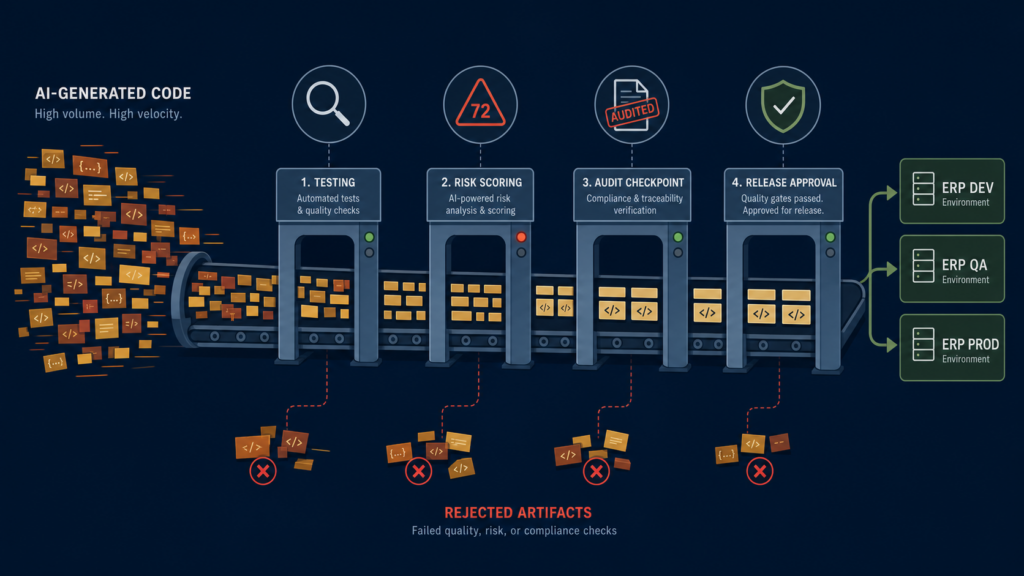
Tricentis California Deal Puts AI Testing Governance in the Spotlight
Tricentis has expanded its software licensing contract with California to offer its AI-driven quality engineering platform to state agencies, while emphasizing that AI-generated testing must be governed by evidence and compliance, essential for SAP teams in regulated environments.
Workday Is Testing How Much Enterprise AI Should Be Allowed to Do
Workday’s Q1 results showed agent adoption momentum. The follow-up question is whether Sana, Microsoft 365 Copilot, the Agent System of Record, and federal HR automation can prove that enterprise agents can act inside governed workflows without eroding control.
SAP NS2 defense
SAP NS2’s FedRAMP+ IL5 Authorization Opens a New Cloud ERP Path for Defense Programs
The recent FedRAMP+ IL5 authorization by SAP NS2 enables US Department of War organizations to deploy SAP S/4HANA Cloud and SAP BTP in a secure cloud environment, simplifying compliance for defense ERP modernization and addressing the complexities of operating within stringent regulatory frameworks.
ERP migration
Jefferson Parish Sets July 1 Go-Live for Infor Public Sector ERP
Jefferson Parish, Louisiana, is set to implement its Infor Public Sector ERP system, BRIDGE, on July 1, marking a transition from its legacy financial management system to improve operational efficiency, with a significant blackout period and new supplier portal mandates affecting finance and procurement activities.
CERN Launches HCM and ERP Overhaul Affecting 35,000 People
CERN has initiated HCM and ERP transformation projects to streamline and modernize its administrative systems for approximately 35,000 staff, aiming for completion by 2028 and 2029 respectively, in order to enhance efficiency and facilitate innovation.
European Union flag in front of modern glass office buildings symbolizing cloud sovereignty and digital regulation in Europe.
Europe’s Tech Sovereignty Package Puts Cloud, AI, Chips and Open Source Under One Policy Roof
The EU's new European Technological Sovereignty Package aims to reduce reliance on non-EU digital infrastructure by promoting domestic capabilities in semiconductors, cloud, and AI through the Chips Act 2.0, Cloud and AI Development Act, and an emphasis on open source strategies, while also addressing energy constraints and competitiveness in the technology sector.
public sector ERP modernization AI readiness
ERP Technical Debt Is Blocking Public Sector AI. Here Is How to Address It
With nearly half of UK government technology spend consumed by maintaining legacy systems, DXC Technology's Derek Allison examines why ERP modernization, cloud adoption, and interoperability are now the critical foundations for closing the gap between AI ambition and operational reality in public services.
Deutsche Telekom German Sovereign AI Contract
SAP and Deutsche Telekom Put Sovereign AI at the Center of German Public Administration
Germany is implementing a public-sector AI strategy through a new SAP and Deutsche Telekom platform designed to deliver secure AI services and infrastructure for federal, state, and municipal administration, marking a significant shift towards shared digital infrastructure and sovereignty in AI governance.
EU flag displayed on the glass exterior of the European Parliament building, representing ERP governance questions around the EU AI Act delay.
What the EU AI Act Delay Means for ERP Governance
The EU AI Act delay eases some near-term compliance pressure, but ERP teams still need to build governance evidence around how AI is used across business processes.
Sign at the National Institute of Standards and Technology (NIST) campus, highlighting the agency behind CVE and NVD vulnerability standards.
What NIST’s CVE Shift Means for ERP Security Teams
NIST is changing how CVEs are enriched in the National Vulnerability Database, reducing the consistency of risk signals used to prioritize vulnerabilities. For ERP security teams, the shift increases reliance on vendor guidance and system-specific context to assess exposure.
ERP Today 2025 Awards: Transformation at Any Scale Drives Outsized SMB Impact
EPSS won the SMB Transformation Project of the Year for its impactful digital transformation in Ethiopian public health logistics, while Venture was recognized as a runner-up for its partnership project modernizing Biffa's operations with a focus on sustainability.
ERP Today 2025 Awards: Operational Innovation Expands Beyond Traditional Boundaries
Inetum won the Operational Innovation of the Year Award for its successful SAP S/4HANA Public Cloud implementation with Erri Berri, enhancing efficiency and agility, while Solvoz secured the runner-up position for its Mawared MENA platform, which digitizes procurement processes in humanitarian operations.
Large warehouse with organized rows of boxes representing structured procurement workflows and supply chain coordination.
Why Procurement Platforms Are Now Judged on Adoption and Workflow Execution
Procurement platforms are no longer judged on features alone. This analysis shows how adoption, workflows, and governance now define platform value, with Scanmarket by Unit4 as a leading example.
Office environment representing France’s tech dependency plan and shift from Windows to Linux across public sector IT systems.
How France’s Tech Dependency Plan Could Influence ERP Decisions
France’s tech dependency plan requires ministries to map reliance across infrastructure, AI, and core systems, introducing new scrutiny that may influence ERP evaluation and system design.
Sovereign AI Gains Ground in Asia as Control, Compliance, Infrastructure Collide
Sovereign AI is gaining traction in Asia as governments, like India and Singapore, prioritize local control over AI infrastructure and data governance, prompting enterprises to adapt their systems and strategies to comply with varying regulations and infrastructure conditions across the region.
U.S. Department of the Treasury building in Washington, D.C., before regulators met to discuss AI cyber risk in financial systems.
Claude Mythos Preview Shows How AI Collapses the Distance Between Discovery and Exploitation in Financial Systems
Claude Mythos Preview is prompting regulators and banks to reassess cyber risk as AI accelerates vulnerability discovery and exploitation across interconnected financial systems.
Internal Revenue Service building exterior illustrating IRS impersonation scams and tax season fraud risks in 2026.
Tax Season Scams 2026: How IRS Phishing, Fake Tax Messages, and AI Fraud Threaten Businesses
Tax season scams in 2026 are expanding beyond individual taxpayers into broader business risk. IRS impersonation, fake tax messages, QR codes, and AI-enabled fraud are targeting tax professionals, payroll teams, and organizations handling sensitive financial and employee data.
High-rise office buildings in La Défense business district in Paris, representing enterprise technology and infrastructure environments.
France Defines a New Model for Managing Technology Dependencies
France’s move to Linux is part of a broader program to reduce technology dependencies across government systems. The shift introduces a structured approach to dependency mapping that could influence how ERP environments are evaluated over time.
Digital image of computer functions over person typing at a laptop.
How AI Is Forcing ERP Vendors to Rethink the Human Side of Transformation
Research indicates that 88% of chief human resource officers believe AI accelerates the readiness of early-career talent, placing pressure on ERP vendors to enhance their platforms for intuitive AI experiences, while also emphasizing the need for clear governance to mitigate risks.
Abu Dhabi skyline with modern high-rise buildings along the waterfront
UAE Approves SAP for e-Invoicing, Expanding ERP’s Role in Compliance Architecture
The UAE has pre-approved SAP as an e-invoicing service provider, becoming the first ERP vendor in the framework. The decision places ERP systems within compliance architecture ahead of the 2027 mandate.
Inside the Global Data Center Investment Surge and Why It Matters for ERP Leaders
Recent massive investments in data centers by major tech companies signify a transformative buildout of global computing capacity, driven by the demands of enterprise AI, geographic strategic importance, and energy constraints, reshaping how cloud and AI services will be delivered in the future.
Paris, France_SAP sovereign cloud France
SAP Targets Regulated ERP Workloads with Sovereign Cloud Launch in France
SAP’s sovereign cloud launch in France with Bleu reflects a broader shift in Europe, where ERP and cloud strategies are increasingly shaped by regulatory requirements, data sovereignty, and compliance mandates.
Diagram representing a structured ERP delivery framework with interconnected processes and system components.
Unit4 Makes Success4U Default Delivery Model for ERP Deployments
Unit4 is making its Success4U framework the default delivery model for ERPx and existing ERP deployments. The model packages implementation services, advisory guidance, and outcome-based service packages into a single subscription designed to simplify ERP adoption and optimization.
European Economic and Social Committee building in Brussels representing EU cloud sovereignty and data governance policy.
‘Sovereignty Washing’: Why Cloud Sovereignty Claims Don’t Always Match Reality
As concerns about data sovereignty grow across Europe, many cloud providers now promote “sovereign cloud” solutions. But legal jurisdiction, technology dependencies, and supply-chain relationships can complicate these claims. This article explores the emerging phenomenon of sovereignty washing and explains how organizations can evaluate whether cloud services truly meet sovereignty requirements.
Johor Bahru skyline and transport infrastructure near Singapore, a fast-growing hub for hyperscale data center development in Southeast Asia.
AI Is Redrawing Southeast Asia’s Data Center Map
AI infrastructure investment is rapidly reshaping Southeast Asia’s data center geography. As hyperscale providers expand across Singapore, Malaysia, Indonesia, and emerging markets, the region is evolving into a distributed infrastructure network that will increasingly influence cloud availability, AI compute capacity, and enterprise ERP deployments.
US Air Force Awards Oracle $88M to Expand Cloud One Modernization with OCI, AI Database
The US Department of the Air Force has awarded Oracle an $88 million task order to provide Oracle Cloud Infrastructure services, enhancing cloud modernization efforts and expanding access to AI-enabled database capabilities in classified environments.
European Union flag in front of modern glass office buildings symbolizing cloud sovereignty and digital regulation in Europe.
Why Inetum Sees Control—Not Infrastructure—as the Real Sovereignty Challenge
ERP modernization in Europe now unfolds under sovereignty expectations. Data control, hybrid architecture, and governance-by-design increasingly determine whether AI-enabled systems can withstand regulatory scrutiny and scale with confidence.
Bharat Mandapam New Delhi lit at night during India AI Impact Summit highlighting AI infrastructure and enterprise platform strategy discussions.
At the India AI Impact Summit, SAP Makes the Case for Platform-Centric AI
As infrastructure pledges dominated the India AI Impact Summit, SAP focused on platform-centric AI, positioning Business AI inside enterprise systems rather than competing in the compute investment cycle.
Bharat Mandapam in New Delhi illuminated at night during the India AI Impact Summit 2026.
India AI Impact Summit: Capital, Compute, and Execution Align
The India AI Impact Summit 2026 centered on infrastructure scale, hyperscaler investment, indigenous AI models and enterprise delivery alignment rather than new software releases.