

An ERP program is not complete when the system goes live. It is complete when the organization can keep operating, deciding, and changing without relying on the program team to remember how things work.
That is an awkward test because a program can close successfully against its stated scope. The system is live. Users have been trained. The delivery partner has handed over its work. The steering group has accepted the final status report. Then, six months later, a finance director asks why a control was changed, an operations leader needs to alter a workflow, or the business acquires another company. The answer may sit in a former program member’s memory, a supplier’s working papers, or an inbox that nobody knows to search.
The missing asset is not another project plan. It is the organization’s own ability to absorb and govern the next change.
The Program Is Bounded. The Need to Change Is Not
ERP delivery standards are designed for a bounded piece of work. They help a team define scope, make decisions, manage risks, test a release, and hand over a system. Change-management standards help people prepare for a new way of working. Both remain necessary.
The organization, however, does not return to a stable state after go-live. A finance system may need new controls after an audit. A new sales channel may alter order management. An acquisition may bring an unfamiliar chart of accounts and a different approval structure. Each new demand meets the decisions, working knowledge, and capacity left by the previous program.
Consider a company that has just replaced its finance platform. During the program, the team made a sensible exception to an approval route so month-end could continue. Two years later, the internal audit team asks why the exception still exists. The implementation partner has moved on. The business analyst who understood the trade-off has left. The system record shows what was changed, but not who accepted the risk or what would have to be true before the control could return.
The technical handover was complete. The organizational handover was not.
Four Things Should Remain When the Build Team Leaves
An organization does not need to retain every project artifact. It does need to retain the things that let it act without re-learning the same lesson at the next program.
First, it needs a realistic view of its capacity to absorb change. Capacity is the time and attention people can give to a change while still running the business. A leadership team deciding whether to start a warehouse rollout during a finance-system stabilization period needs more than two separate project plans. It needs to know whether the same managers, subject-matter experts, and frontline teams can carry both consequences at once.
Second, it needs clear decision rights. A governance meeting is useful only if people can later see which decision was made, by whom, on what evidence, and with what consequence. A decision log that records only “approved” is weak. A useful record explains, for example, why a local process was kept for a year, who owns the review date, and what evidence would justify changing it.
Third, it needs working knowledge. This means the practical understanding that explains how a process actually runs, including its exceptions. A workflow diagram may show that invoices are matched automatically. It may not show that a small group of suppliers always require a manual check because their data arrives late. If that knowledge remains only with a temporary team or a supplier, the business becomes dependent on people it does not control.
Fourth, it needs evidence that independence has increased. The test is not whether external help was used. Most complex ERP programs need it. The question is whether the organization can now make ordinary changes, understand its own controls, and challenge advice without starting from zero.
A Proposed Standard Asks a Different Question
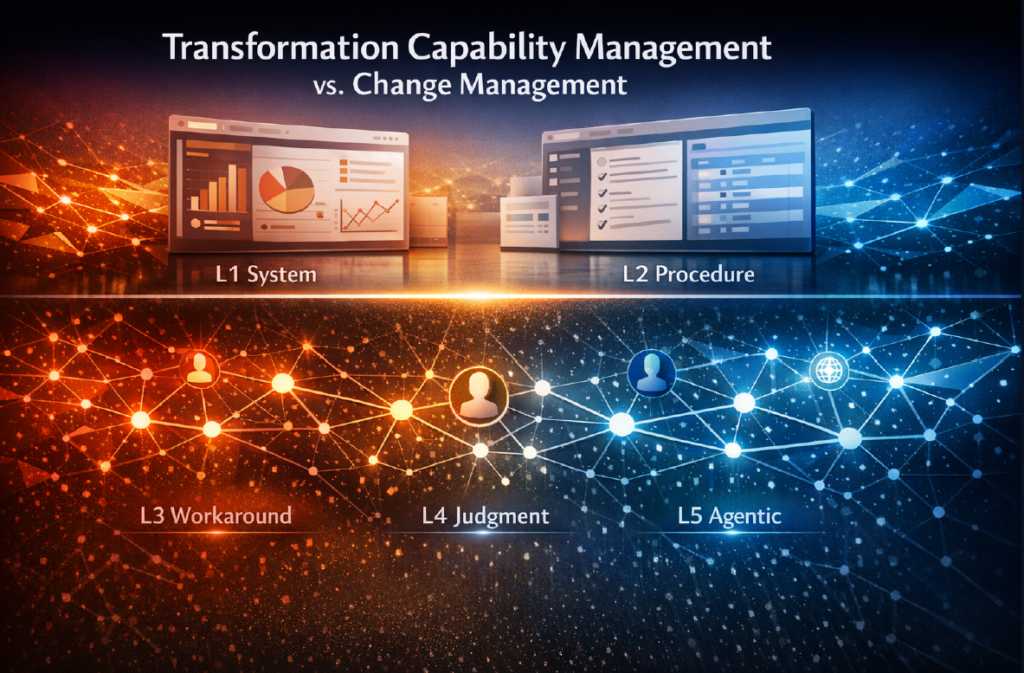
Transformation Capability Management is a proposed open standard that focuses on what an organization keeps between projects: its ability to change. It sits alongside project and change-management standards. It does not replace or rank them.
Its practical question is simple: when this program shrinks, what will the organization still know, decide, and do for itself?
That question changes the handover conversation. It asks the program sponsor to identify the decisions that must remain understandable. It asks the business to keep a record of important exceptions and their reasons. It asks leaders to test whether the people carrying the next change have room to do so. It also asks for evidence that the organization has gained more independence, not simply completed more activity.
None of this requires an organization to keep every consultant, every workshop note, or every technical design. It requires a deliberate distinction between information that can be archived and judgment that the business will need again.
Put Retention Into the Program While It Is Still Alive
Establish the record during the program, while its decisions and trade-offs are still visible. Four practical habits provide a starting point.
Make important decisions traceable. For each significant exception, record the decision-maker, the reason, and the event that should trigger a review.
Name the business owner of the working knowledge. The owner is accountable for keeping practical process knowledge current after the program team shrinks.
Review change capacity across the portfolio. Ask which people and functions are carrying overlapping consequences, not only which projects are scheduled at the same time.
Test the handover with a real question. Ask a member of the retained team to use the retained record to explain a material control, exception, or design choice before asking the implementation partner.
These are modest practices. They become valuable when the next release, acquisition, regulation, or operating-model change arrives and the organization does not have to recreate its own judgment.
The proposed Transformation Capability Management standard is published openly and is still being developed. Its contribution is not a claim that existing program disciplines are inadequate. It is a reminder that those disciplines should leave something behind: an organization more able to carry its next change than the one that began the last.