Data and Data Management

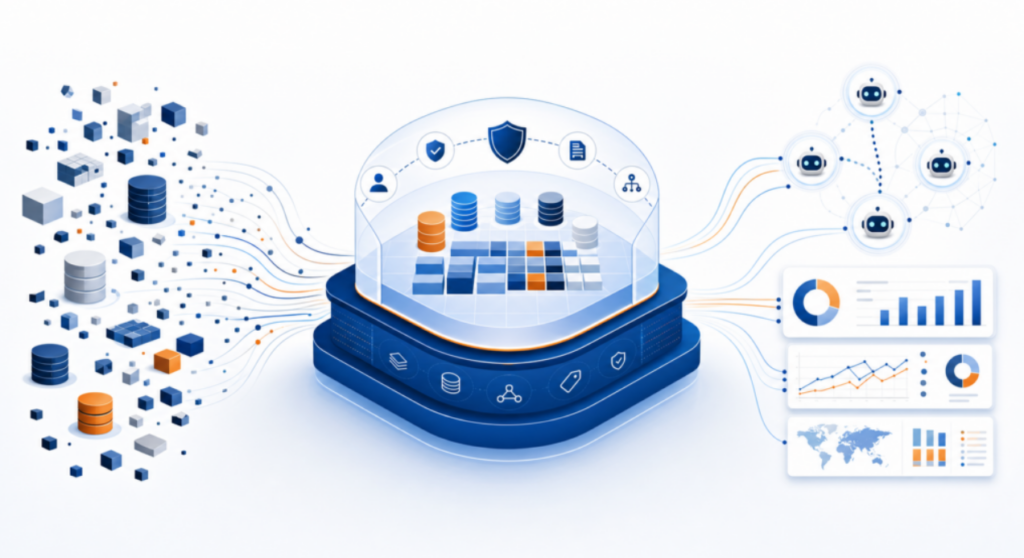
Efficient data management, encompassing the systematic collection, organization, and retrieval of data, is fundamental for enhancing productivity, efficiency, and informed decision-making. Regardless of their scale or industry, organizations benefit significantly from implementing a robust data management strategy and adopting a modern data management system. This ensures streamlined operations and optimized use of information, facilitating better decision-making processes. The integration of Enterprise Resource Planning (ERP) solutions further enhances the effectiveness of data management, providing organizations with comprehensive tools to manage and utilize data seamlessly across various facets of their operations.

enterprise data architecture sapinsider las vegas
SAPinsider Las Vegas: Why Enterprise Data Architecture Must Change for the AI Era
At SAPinsider Las Vegas, Gaurish Dessai explored how enterprise data architecture must evolve for the AI era, shifting focus from reporting to decision-making and from centralized data to connected data products.
CIOs attend SAPinsider Las Vegas 2026 session on AI adoption and SAP strategy
SAP CIOs Say AI Adoption Remains Early Despite Growing Attention
CIOs report that AI execution in ERP environments remains limited, with organizations prioritizing efficiency, cost control, and data readiness over large-scale AI deployment.
data analytics strategy
SAPinsider Las Vegas: Why Data Strategy Must Start With Trust
At SAPinsider Las Vegas 2026, Ingo Hilgefort explains why data trust, governance, and business alignment are essential to building a successful data and analytics strategy.
Bellagio Hotel in Las Vegas, host location of SAPinsider Las Vegas 2026 CIO transformation discussions
CIOs Shift SAP Transformation Focus to Long-Term Value at SAPinsider Las Vegas 2026
CIOs at SAPinsider Las Vegas 2026 discuss how SAP transformation decisions are shifting toward long-term value, with a focus on migration versus modernization, cost pressures, and post-go-live accountability.
Cloud ERP Growth Set to Grow Worldwide as Digital Transformation Accelerates
The global cloud ERP market is projected to grow to $128.3 billion by 2033, driven by enterprises' focus on scalability and efficiency, with cloud ERP adoption yielding significant productivity gains, proven ROI, and resilience in crises, despite ongoing challenges in data migration and implementation complexities.
Managing Legacy Data in a Cloud-First World With SNP
Legacy systems kept for just-in-case audits bloat IT budgets and expand attack surfaces. Learn how strategic decommissioning and data tiering can reduce SAP landscape TCO by up to 80% while maintaining compliance.
Abu Dhabi skyline representing the UAE as the country prepares to implement its national e-invoicing mandate for businesses by 2027.
UAE E-Invoicing Mandate: What ERP and Finance Teams Need to Know Before 2027
The UAE e-invoicing mandate will require businesses to generate structured invoice data and report transactions through accredited service providers by 2027. The shift moves invoice compliance into ERP systems, where billing data, validation workflows, and compliance architectures determine whether invoices pass regulatory checks.
European Economic and Social Committee building in Brussels representing EU cloud sovereignty and data governance policy.
‘Sovereignty Washing’: Why Cloud Sovereignty Claims Don’t Always Match Reality
As concerns about data sovereignty grow across Europe, many cloud providers now promote ā€œsovereign cloudā€ solutions. But legal jurisdiction, technology dependencies, and supply-chain relationships can complicate these claims. This article explores the emerging phenomenon of sovereignty washing and explains how organizations can evaluate whether cloud services truly meet sovereignty requirements.
Zurich Switzerland street scene representing Microsoft Azure cloud infrastructure region supporting sovereign data and AI deployments.
SAP Business Data Cloud Expands to Azure Switzerland with EU Access Controls
SAP is preparing to launch its Business Data Cloud platform on Microsoft Azure infrastructure in Switzerland in the coming weeks, introducing a deployment designed to meet European data residency and governance requirements. The rollout includes ā€œEU Accessā€ availability, meaning data...
Johor Bahru skyline and transport infrastructure near Singapore, a fast-growing hub for hyperscale data center development in Southeast Asia.
AI Is Redrawing Southeast Asia’s Data Center Map
AI infrastructure investment is rapidly reshaping Southeast Asia’s data center geography. As hyperscale providers expand across Singapore, Malaysia, Indonesia, and emerging markets, the region is evolving into a distributed infrastructure network that will increasingly influence cloud availability, AI compute capacity, and enterprise ERP deployments.
CData logo representing MCP performance optimization and managed AI connectivity platform.
Optimizing MCP for Production: 10 Proven Performance Techniques
Model Context Protocol (MCP) is becoming production infrastructure for AI agents. This article outlines 10 proven performance optimization techniques to improve latency, throughput, and scalability while positioning managed MCP platforms as a foundation for reliable enterprise AI.
SAP Positions Itself as the Digital Backbone of New York Fashion Week
SAP is evolving its role at New York Fashion Week from event sponsor to infrastructure provider, collaborating with N4XT Experiences to create a connected, data-driven platform that enables real-time integration of enterprise systems and analytics for designers.
European Union flag in front of modern glass office buildings symbolizing cloud sovereignty and digital regulation in Europe.
Why Inetum Sees Control—Not Infrastructure—as the Real Sovereignty Challenge
ERP modernization in Europe now unfolds under sovereignty expectations. Data control, hybrid architecture, and governance-by-design increasingly determine whether AI-enabled systems can withstand regulatory scrutiny and scale with confidence.
Agentic AI Signals a Shift to New Enterprise Operating Model
The rise of agentic AI is compelling executives to reassess whether AI merely enhances existing operations or fundamentally transforms their business models.
The Hidden Cost of AI: Why Data Debt is Actually a Human Problem
Explore how leaders at DMI’s Digital Lounge @ Davos are tackling transformation fatigue and data debt to liberate SAP teams for S/4HANA innovation.
Digital Lounge @ Davos with DMI
Beyond the Hype: 3 Structural Shifts Every SAP Leader Must Make In 2026
At this year's Digital Lounge @ Davos, over 200 leaders acknowledged the industry's shift from the allure of AI capabilities to focusing on data sovereignty, accountability, and governance as critical components for ensuring responsible AI implementation, underscoring the importance of addressing legacy data management and integrating AI within a broader risk landscape.
Boomi
Oracle Helping Organizations Enhance Process Manufacturing
Oracle enhances its Fusion Cloud Supply Chain & Manufacturing platform with new capabilities aimed at process manufacturers, enabling improved real-time production visibility, regulatory compliance, and streamlined operations through integrated batch execution and recipe management.
Oracle AI Agents Improve Efficiency, Resiliency for Supply Chain Leaders
Oracle has introduced AI agents within its Fusion Cloud Applications to streamline supply chain decision-making and efficiency by automating workflows and providing actionable insights.
Acumatica Summit 2026: Manish Chandak
At Acumatica Summit 2026, Tech Electronics CEO Manish Chandak discussed the evolving themes in ERP, focusing on the impact of digital replicas and AI on the future role of ERP systems.
Financial data and stock figures overlaid on a city banking district skyline at dusk.
UiPath Extends Automation Into KYC and AML Investigations With WorkFusion
UiPath is extending automation into KYC and AML investigations with WorkFusion, a move that highlights how regulated workflows increasingly depend on enterprise platforms and audit-ready execution.
ERP Today Interview: Achyut Jajoo
Salesforce's Achyut Jajoo talks with ERP Today about how they're working on helping manufacturers enhance operational scalability through prebuilt AI templates and improving autonomy and competitiveness in the face of labor shortages.
Microsoft Maia 200 Inference Accelerator Targets AI Economics at Enterprise Scale
Microsoft's Maia 200 inference accelerator, built on TSMC's 3-nanometer process, boasts 30% improved performance per dollar over prior hardware, featuring advanced specifications aimed at optimizing AI model efficiency.
Business user interacting with AI-powered analytics on a laptop, illustrating enterprise AI and real-time data intelligence.
The New ERP Backbone: Databricks, Inetum, and the Shift to AI-Native ERP Architectures
ERP systems are entering an AI-augmented era, but many data foundations are not ready. This analysis examines why AI-native ERP architectures are emerging, how Databricks is becoming the intelligence layer, and how Inetum helps enterprises operationalize AI with trust, governance, and scale.
Achieving Manufacturing Operational Excellence in the Marketplace
The partnership between Syspro and SugarCRM introduces Sugar for Syspro, designed to enhance sales navigation and operational efficiency in complex manufacturing environments by eliminating manual data entry errors and fostering collaboration through integrated ERP-CRM visibility.
Sage Embeds AI Copilot Into X3 and Operations Products for Mid-Market
Sage has integrated AI-powered features into its mid-market ERP solutions, notably embedding Sage Copilot into Sage X3 and Sage Operations to provide predictive insights and autonomous workflow management.
NetSuite 2025.2 Enhances Supply Chain Agility Amid Growing Operational Pressures
NetSuite’s 2025.2 release enhances supply chain management with improved planning and fulfillment capabilities, allowing organizations to better handle production schedules, inventory allocation, and order prioritization amidst ongoing global disruptions.
Acumatica Summit Recap: ERP Elevated as Proactive Intelligence Infrastructure
At Summit 2026, Acumatica executives revealed a vision for ERP systems as predictive intelligence platforms leveraging digital replicas and AI to streamline operations, improve decision-making, and enhance user experiences through behavioral telemetry, all while emphasizing a partner-led growth model to address mid-market challenges.